DIVE-3850: weekly upstream sync — merge block/buzz main (100 behind) - #14
Conversation



… sends (block#6572)

## Summary

Lands the build-now items from the desktop latency plan
(#ui-performance-deep-dive) as one change. Every perceived-latency hot
path a user hits on launch, channel open, thread open, and reply send
drops one or more round trips.

**A1 — persisted channel heads (the big one).** Native WAL SQLite cache
(`desktop/src-tauri/src/channel_head_cache.rs`) keyed by `{pubkey,
relayUrl}` scope, 32 rows/scope LRU, 1 MiB per-row drop cap,
schema-version reset, corrupt-row tolerance, checkpointed on shutdown.
Three blocking-pool commands: `channel_head_cache_load` / `_store` /
`_clear`. On the renderer side, `CommunityQueryProvider` kicks off
hydration of up to 12 heads when it constructs the query client — the
app, splash and relay preconnect mount immediately; only
`useChannelMessagesQuery` awaits the seed (`channelHeadHydration`), then
consumes a one-shot hydrated gate so a hydrated channel pays **zero**
`get_channel_window` calls on mount and exactly **one** on the
post-subscription refresh, whose response replaces page zero wholesale.
That refresh fires whether live-subscription setup succeeds or fails,
and is sequenced behind hydration so it is always a distinct
authoritative fetch (see Review follow-ups). Bounds-only persisted heads
(zero rows) are not hydrated and take the cold loading path. The
timeline loading latch recognizes native-hydrated rows as restart-safe
so they paint immediately instead of holding a skeleton. The cache is a
paint accelerator only — the relay response is always authoritative.
Replaces the legacy localStorage `messageSnapshot.ts` (removed, -401
lines).

Kill switch: `VITE_BUZZ_CHANNEL_HEAD_CACHE=off` at build time or
`localStorage["buzz-channel-head-cache"] = "off"` at runtime. Cache is
cleared on community removal and scoped per identity, so a replaced
signer never sees the previous identity's rows.

**B1 — thread aux in one response.** Relay thread filters accept
`include_aux`; the bridge appends the same authorized two-hop
reactions/edits/deletions closure a channel window gets
(`build_aux_query` shared with the window path). Renderer
`useThreadReplies` drops its two follow-up aux fetches. `next_cursor` is
computed from reply-kind rows only since aux rows are unpaged.
Documented in `docs/bridge-channel-window.md`. Thread queries keep
`staleTime: 0` (`bcfe04e2f`): an earlier revision raised it to 30s,
which CI's `thread-unread.spec.ts` caught — once the user leaves a
channel, the live subscription stops feeding that thread's cache, so a
reopen must always take the (now single) authoritative read.

**B2 — cached root on reply send.** `send_channel_message` gains
`root_event_id`; when the renderer already holds the parent (channel or
thread cache) it passes the NIP-10 root, and native signs without the
relay round trip that `resolve_thread_ref` used to make. Strict hex
parse; `root_event_id` requires `parent_event_id`; absent root falls
back to the existing relay resolution. The renderer never sends a
guessed root.

**B4** general HTTP pool idle 10s→300s, max idle per host 1→2. **B5**
relay preconnect fires as soon as identity is ready instead of waiting
for `requestIdleCallback`. One e2e test (`relay-reconnect.spec.ts`
"service restart close resets accumulated backoff") had been relying on
the idle-callback batching to skip past its own seeded dial failures
before the channel list painted; `8133d70bb` makes it wait for the
connected state instead (test-only, still fails with the 1012 backoff
reset disabled). **B6** profile freshness 60s→10 min (both the in-memory
entry check and the query `staleTime`). Tradeoff: another user's
display-name/avatar edit can take up to 10 min to propagate to a client
that already holds their profile (relay reconnect refetches
`users-batch` but resolves from the still-fresh per-pubkey entry); your
own edits still evict the entry immediately (`evictUsersBatchEntries` in
`useUpdateProfileMutation`).

### Related issue
Follows block#6456/block#6457/block#6459/block#6460 (already merged). block#6455 is the
measurement instrument and is intentionally not folded in. No duplicate
PR found.

### Review follow-ups
Addressing Carl's reviews
[5001114109](block#6572 (review))
and
[5002596542](block#6572 (review)),
each pushed as new commits (no rebase):

- `4f06b7770` fix(desktop): mount app while channel heads hydrate;
always revalidate — provider no longer gates children on the cache load;
`refreshAfterSubscribe` runs on subscribe failure too; bounds-only heads
skipped at seed; seed merges into an existing window store. +3 tests.
- `35834cb31` fix(relay): drain aux closure hops across the page clamp —
`query_all_pages` walks the `(created_at, id)` keyset via
`until`/`before_id` until a short page (`AUX_PAGE_LIMIT` =
`DEFAULT_MAX_PAGE_LIMIT`, `AUX_MAX_PAGES` = 64 warn+truncate) so
one-shot `limit: 1000` newest-first no longer drops the oldest
edits/deletions. +3 tests; `docs/bridge-channel-window.md` updated.
- `db21b0531` merge of `origin/main` `e23632941` (block#6558, block#6312 — no
overlap).
- `5a5566c0f` fix(desktop): sequence post-subscribe refresh behind
channel head hydration — `refreshChannelWindowMessages` awaits
`channelHeadHydration()` and, for a hydration-seeded query (`data !==
undefined && dataUpdatedAt === 0`), the in-flight snapshot fetch before
invalidating. Without this, a subscription that settles before the
SQLite load invalidated a data-less in-flight query; TanStack dedupes
that onto the existing fetch (`query-core` `fetch()` only cancels when
`state.data` exists), which returned the seeded snapshot — 0
authoritative fetches. Regression test reproduces Carl's exact ordering
(fails at `35834cb31` with 0 calls), plus a cold-channel guard that the
fix does not double-fetch.
- `b129231c8` fix(desktop): let concurrent post-hydration refreshes
share one window fetch — found independently by Max and Wren reviewing
`5a5566c0f`: subscribe settlement + reconnect both wake on the same
snapshot promise and both invalidate; the second (default
`cancelRefetch: true`) cancelled and replaced the first authoritative
fetch (3 queryFn calls, not 2, and the cancelled Tauri invoke still hits
the relay). The seeded branch now invalidates with `cancelRefetch:
false` so a second waker joins the in-flight fetch; cold/warm keep the
default (`test_canceled_stale_fetch_cannot_overwrite_catch_up_window`
relies on it). Concurrent regression test fails at `5a5566c0f` with 3.

### Testing
At `b129231c8` (PR head; verified in one shell with `git rev-parse HEAD`
= `b129231c8`): `pnpm check`, `tsc --noEmit`, desktop unit 5,393 / 0,
Playwright `boot-splash` + `channel-head-restart` + `relay-reconnect` +
`relay-reconnect-affordance` + `thread-unread` 34 / 34 on a fresh
`build:e2e`, pre-push hooks green.

At `5a5566c0f`: `pnpm check`, `tsc --noEmit`, desktop unit 5,392 / 0,
Playwright `boot-splash` + `channel-head-restart` + `relay-reconnect` +
`relay-reconnect-affordance` + `thread-unread` 34 / 34 on a fresh
`build:e2e`, pre-push hooks green.

At `35834cb31`: desktop unit 5,390 / 0; `cargo test -p buzz-relay --lib`
910 / 0; fmt + clippy `-D warnings` clean; Playwright 32 / 32 (same
specs minus affordance); GitHub CI green on every job except Smoke (3)
(unrelated project-review row-count + messaging timing flake, per Carl)
and Unit Tests (sherpa cache skeleton, below).

Earlier, all at `8133d70bb` (this PR head is `0c492366d` = 8133d70 + a
comments-only commit correcting two `profile/hooks.ts` freshness
comments from 60s to 10 min; pre-push desktop check/typecheck/test
5,387/0 re-ran at 0c49236) in one shell; `origin/main` = `040b203f7`
at PR open, since moved to `4baccd539` (block#6558, mobile only — zero file
overlap, `git merge-tree` clean):

- `just desktop-test` — 5,387 passed / 0 failed (includes new hook-level
call-count test: cold = 1, stale-prefetched = 1, hydrated = 0 on mount
then 1 on invalidate with wholesale replacement)
- Playwright smoke `relay-reconnect.spec.ts` + `thread-unread.spec.ts` +
`channel-head-restart.spec.ts` — 30/30 (thread-unread was 8/13 at
`7acbf951b`; relay-reconnect was 15/16 at `bcfe04e2f`). The restart spec
persists a head, reloads into a fresh mock relay with the head fetch
held 5s, asserts the persisted row paints within 2s, exactly one
`get_channel_window` after open, and the stale row is removed when the
authoritative page lands.
- `pnpm typecheck`, `pnpm check` — clean

At `7acbf951b` (everything except the two-line `useThreadReplies.ts`
staleTime revert and the test-only `relay-reconnect.spec.ts` change),
also green in one shell:
- `just desktop-tauri-test` — 2,859 passed / 0 failed across the
workspace (channel_head_cache: wire shape, LRU+caps, schema reset,
corrupt-row skip)
- `just test-unit` — 632 passed (buzz-core/auth); `cargo test -p
buzz-relay --lib` — 908 passed / 0 failed
- `just check` components: fmt-check, clippy, desktop-check,
desktop-typecheck, desktop-tauri-fmt-check, desktop-tauri-clippy,
web-check, mobile-check, file-size-check — all green
- `just desktop-build`, `web-build`, `desktop-tauri-check`,
`mobile-test` (1,661 passed) — all green

CI note: the "Unit Tests" job goes red on this PR and on `main` whenever
it hits a poisoned `rust-cache` entry (an empty-directory skeleton of
`target/sherpa-onnx-prebuilt` that `sherpa-onnx-sys` build.rs trusts),
surfacing as `could not find native static library sherpa-onnx-c-api` in
`buzz-voice` — a crate this PR doesn't touch. Deleting the cache entry
and rerunning turned the job green at `0c492366d` (28/28); it re-poisons
on the next `main` push until the workflow clears that directory after
cache restore.

Reviewed in-channel by Wren (9 / 9 / 9.5) and Eva (9 / 9 / 9), and
line-by-line by me before opening; the staleTime fix re-verified by Wren
and me independently; the relay-reconnect test fix bisected and verified
by me.

---------

Signed-off-by: Perci <5a968df9a7494b4e019b9ecf739e088ba61097b4312124e9a88ae5b42e3f5f3e@buzz.block.builderlab.xyz>
Signed-off-by: Max <d8473ee32b973aa31a21a65adddcc4b69cc2a8a4dee8121ecd51926e0cddbc02@buzz.block.builderlab.xyz>
Signed-off-by: Wren <5217c5c2f7bfb4333e46d17c98a9255a52dadee18dcd43a43536b95e6776dfa0@buzz.block.builderlab.xyz>
Signed-off-by: Meli <5aaa86bce934fc3445fc254aab560a40923f10252f92107e665073dede0e04d3@buzz.block.builderlab.xyz>
Co-authored-by: Perci <5a968df9a7494b4e019b9ecf739e088ba61097b4312124e9a88ae5b42e3f5f3e@buzz.block.builderlab.xyz>
Co-authored-by: Max <d8473ee32b973aa31a21a65adddcc4b69cc2a8a4dee8121ecd51926e0cddbc02@buzz.block.builderlab.xyz>
Co-authored-by: Wren <5217c5c2f7bfb4333e46d17c98a9255a52dadee18dcd43a43536b95e6776dfa0@buzz.block.builderlab.xyz>
Co-authored-by: Meli <5aaa86bce934fc3445fc254aab560a40923f10252f92107e665073dede0e04d3@buzz.block.builderlab.xyz>

## Summary
- skip managed-agent runtime discovery when the members sidebar has no
local managed bots
- run runtime listing disk, process, and mutex work on Tauri’s blocking
pool
- preserve local managed-bot status and Start/Stop behavior with
positive and negative E2E coverage

Opening Add people in a human-only channel could invoke synchronous
native runtime discovery before the sidebar painted, leaving the macOS
app beachballed. Human invites do not depend on that data.

## Why
I have seen slowness opening this dialog in the UI


https://github.com/user-attachments/assets/1955eb5e-ee47-4edf-8e5c-606d11ffbc25


### Related issue
Related overlap: block#4851 is a broader managed-agent lifecycle change that
includes a similar native offload. This draft is intentionally limited
to the sidebar critical path and adds the human-only query gate.

### Testing
I have verified the pause in the video goes away after this change.

- `just ci`
- `just desktop-check`
- `just desktop-test` (5,241 passed)
- `just desktop-tauri-fmt-check`
- `just desktop-tauri-clippy`
- `just desktop-tauri-test` (2,702 passed; 18 ignored)
- focused Playwright: human-only sidebar skips runtime discovery
- focused Playwright: local managed bot retains status and Stop/Start
controls

No visual styling changed, so screenshots are not applicable.

Signed-off-by: Matt Toohey <contact@matttoohey.com>
## Summary

- Keep virtualized member rows measurable by removing
`content-visibility: auto` from the measured row subtree.
- Use the member card's 60px baseline as the virtualizer estimate while
retaining deferred rendering for eager search and archived-member lists.
- Cover large rosters with a regression test that checks stable scroll
extent across the list and verifies the final member remains reachable.

### Related issue

None found.

### Testing

- `just ci`
- `pnpm -C desktop build:e2e`
- `pnpm -C desktop exec playwright test tests/e2e/channels.spec.ts
--grep 'members sidebar virtualizes large channel rosters'
--repeat-each=5`

#### Before


https://github.com/user-attachments/assets/a5fcc040-6872-4200-bcc3-7b4197a4dd23

#### After


https://github.com/user-attachments/assets/f2c97f2f-3719-4c2a-b17a-2450c6c70a55

Signed-off-by: Matt Toohey <contact@matttoohey.com>
…lock#6683)

## Summary

Right-clicking a text selection in the message composer left the
selection formatting tray floating over the native context menu. This
suppresses the tray for the duration of the right-click interaction.

## Changes

- `SelectionFormattingTray.tsx`: a `contextmenu` listener on the editor
DOM sets a suppression ref, cancels any queued rAF reposition, and hides
the tray. Suppression clears on the next left-click `pointerdown` or
`keydown` in the editor, which reschedules a normal position update.
- `scheduleUpdate`/`updatePosition` both honor the suppression ref, so
editor `selectionUpdate`/`transaction`/`focus` events fired during the
right-click can't bring the tray back.
- Extracted `cancelScheduledUpdate` to replace the duplicated rAF-cancel
logic, and reset suppression on editor change / cleanup.
- E2E coverage in `composer-selection-formatting.spec.ts`: double-click
to select, assert the tray shows, right-click and assert the tray hides
*and* that `contextmenu` is not `defaultPrevented` (the native menu
still opens), then re-select and assert the tray returns.

## Testing

`just` pre-push gate ran green: `desktop-check`, `desktop-typecheck`,
`desktop-test` (5397 passing), `file-size-check`.

## Demo


https://github.com/user-attachments/assets/2fdfced9-6cd6-4eb2-a6df-c03164ab1c42

Signed-off-by: Matt Toohey <contact@matttoohey.com>

**Category:** fix
**User Impact:** Stream and forum channels now show an accessible
numeric badge for unread mentions while mention chips remain clear in
every theme.

**Problem:** Mention notifications contributed to the app and Dock
badge, but inactive stream and forum rows only became bold, making it
difficult to see where multiple mentions were waiting. Mention styling
and generic destructive colors could also lose contrast or visual
meaning in some themes.

**Solution:** Use the same app-badge projection for non-DM channel
mention counts, while preserving regular unread bolding, thread activity
dots, DM counts, and manual unread behavior. Dedicated notification and
opaque mention-highlight tokens keep the new treatments stable and
readable across syntax themes.

<details>
<summary>File changes</summary>

**desktop/src/features/channels/useUnreadChannels.ts**
Projects app-badge-eligible mention and broadcast counts into stream and
forum channel rows while retaining DM-specific counting and
manual-unread semantics.

**desktop/src/features/sidebar/ui/SidebarSection.tsx**
Renders an accessible numeric notification pill on inactive non-DM
channels and preserves the thread activity dot fallback.

**desktop/src/shared/styles/globals/markdown.css**
Applies the shared opaque yellow highlight to human and agent mention
chips, including hover treatment.

**desktop/src/shared/styles/globals/theme.css**
Adds fixed notification and mention-highlight tokens with
theme-independent contrast.

**desktop/tailwind.config.js**
Exposes the notification token pair through semantic Tailwind utilities.

**desktop/tests/e2e/badge.spec.ts**
Covers aggregated mention counts, broadcasts, unchanged unread tiers,
exact accessible text, and badge contrast under an adversarial theme.

**desktop/tests/e2e/mentions.spec.ts**
Covers human and agent mention styling, hover behavior, dark mode, and
WCAG text contrast.

</details>

## Reproduction steps

1. Open a stream or forum channel, then navigate to another channel.
2. Receive two messages that mention you in the inactive channel.
3. Confirm the inactive row is bold and shows a red `2` pill matching
the two notifications added to the app or Dock badge.
4. Receive a regular channel message and confirm the row only becomes
bold, without a numeric pill.
5. Receive a reply in an interested thread and confirm the channel
retains its activity dot instead of a mention count.
6. Switch between light and dark themes and confirm human and agent
mention chips remain yellow with near-black readable text, including on
hover.

## Screenshots

Screenshots are posted in the PR discussion using immutable
repository-hosted image URLs.

Signed-off-by: tulsi <tulsi@block.xyz>


Mobile previously exposed no way to browse or join channels.

Users can now browse and join eligible open channels from the Home
quick-actions menu. The public directory loads on demand when Browse
channels opens, while the existing kind 9021 join path refreshes
membership after success.

| Browse channels | Join channel |
| --- | --- |
| <img width="320" alt="Browse channels"
src="https://github.com/user-attachments/assets/f12c46c8-8bf4-487d-8a45-7bec63b16028"
/> | <img width="320" alt="Join channel"
src="https://github.com/user-attachments/assets/d6306ca7-9ab8-4f5a-8131-7f9b2a76d653"
/> |

### How is it tested?

Manually tested (see screenshots) and added tests:

-
[`channels_provider_test.dart`](https://github.com/block/buzz/blob/main/mobile/test/features/channels/channels_provider_test.dart)
covers access filtering, independently paginated membership and
directory queries, relay-capped pages, repeated-page termination, hard
page caps, on-demand directory loading, load failures, retry, and
cached-channel retention.
-
[`channels_page_test.dart`](https://github.com/block/buzz/blob/main/mobile/test/features/channels/channels_page_test.dart)
covers browse eligibility, loading and retry states, quick-action
layout, and scrolling and joining from a 500-channel directory.
-
[`search_page_test.dart`](https://github.com/block/buzz/blob/main/mobile/test/features/search/search_page_test.dart)
covers discoverable open-channel results without presenting unknown
membership counts as zero.

Local validation:

- `just mobile-check`
- `just mobile-test` (1,560 tests)
- full pre-push gate

---------

Signed-off-by: Tom Brow <tomb@block.xyz>
Co-authored-by: Codex <noreply@openai.com>
Co-authored-by: leader <71e9f2c44a6932b6772caaaccda1911d010463c3e2c6c40410b8329956046801@buzz.block.builderlab.xyz>

## Summary

- refetch mounted mobile thread replies after relay reconnect,
preserving the previous reply list during recovery
- auto-dispose route-scoped relay reply caches so reopening a thread
queries current relay state
- invalidate live replies through both the channel-window and legacy
websocket-history paths
- preserve optimistic-reply confirmation when the route closes before
its deferred cleanup
- stabilize rapid same-second messages using desktop's existing split
contract: channel timelines render `(created_at ASC, id DESC)` while
threads render `(created_at ASC, id ASC)`
- retain late live rows after a channel window is exhausted instead of
dropping same-second tail messages

Closes block#4404.
Closes block#4830.
Closes block#6204.

## Context

The broad all-channel/all-DM stale-session defect reported in block#4402 is
already addressed on current `main` by block#4372 and block#3053. Two distinct
mobile gaps remained:

1. `threadRepliesProvider` was a process-lifetime one-shot query, so
replies missed while the socket was stale remained absent after
reconnect or after closing and reopening the thread.
2. Mobile had inconsistent timestamp-only and event-id ordering across
channel producers. Rapid messages routinely share Nostr's one-second
timestamp, so later hydration/live reconciliation could reshuffle them.
Desktop deliberately has two render contracts: channel windows reverse
the relay's composite order to `(created_at ASC, id DESC)`, while thread
replies use `(created_at ASC, id ASC)`.

This consolidates the current-main portions of block#4831 and block#3243 rather
than reviving stale overlapping branches.

## Validation

Exact pushed head: `be92d9542c6cd1342733bdc5e8359664b511ce02`

- focused channel-provider/window/thread suites: 48/48 passed
- incident regression: a mounted thread misses a reply while
disconnected, reconnects, and renders the recovered reply
- route regression: closing and reopening a thread performs a fresh
authoritative query
- websocket fallback regression: live reply invalidates the mounted
thread even without the channel-window path
- disposal regression: optimistic confirmation survives provider
disposal between rebuild and deferred cleanup
- ordering regressions: channel window/live, websocket fallback,
optimistic sends, deep links, both pagination paths, and thread merges
preserve their desktop-compatible same-second order
- boundary regression: exhausted windows admit late same-second live
rows without weakening open-page cursor boundaries
- independent adversarial review: no production blocker; source contract
verified across all producers and relay cursor semantics unchanged
- pre-push Mobile lane passed at exact head, including analysis,
file-size/branch checks, and full Flutter suite: 1,675/1,675 passed
- `git diff --check`

---------

Signed-off-by: Wes <wesbillman@users.noreply.github.com>
Co-authored-by: Carl <32a2e2c9d428ee08902cab75d956da2c1d235a22d4766b0dd4138bf6e2e5db1d@buzz.block.builderlab.xyz>


…orrectly (block#6665)

## Problem

Mentions — and thread replies that @-mention you — played the **Needs
action** sound instead of the **@Mentions** sound. Reported by
@morgmart: "I set Needs action to a different sound and it's the only
one I ever hear."

## Root cause

Two vocabularies got conflated in block#475:

- **Section / filter vocabulary** (plural): `mentions`, `needs_action`,
`activity`, `agent_activity` — the shape of `FeedSections`, the
`--types` filter, and the agent-facing CLI docs.
- **Per-item category vocabulary** (singular for mention): `mention`,
`needs_action`, `activity`, `agent_activity` — the `FeedItemCategory`
contract in `desktop/src/shared/api/types.ts`, unchanged since #12.

The Tauri feed builder reused the filter string `"mentions"` as each
mention item's `category`. Only one word differs between the
vocabularies, so only mentions broke. Every frontend consumer compares
against the singular, so real mentions never matched and fell through to
the resolver's `needs_action` fallback.

The E2E mock bridge emits the singular form, so tests never saw the
drift.

### Symptoms this fixes (all from the one mislabel)

- Mentions and mentioning thread replies played the Needs-action sound
- Mention notifications used the Needs-action title format
- Mentions in muted channels were suppressed (the mute-bypass never
fired)
- Inbox / Home feed labelled mentions "Channel update"
- Channel activity popover's mentions list was always empty

## Fix

**Fix the owner, not the symptoms.** `FeedItemInfo.category` becomes a
`FeedItemCategory` enum whose serde form is exactly the TS union, so a
misspelled category can't compile at the producer. A serialization test
pins each variant to its wire string.

**Frontend:** `slotForFeedKind` maps every known category explicitly.
The `needs_action` fallback for unknown categories is **kept on
purpose** — a contract drift should cost the user the wrong sound, not a
missed alert — but it now `console.warn`s so the drift is visible to
developers instead of masquerading as intended behavior. `e2eBridge.ts`
and `tauri.ts` now derive the category type from `types.ts` instead of
retyping it.

Not touched: the plural `--types` filter and `FeedSections` keys. Those
are the section vocabulary and are correct as-is.

## Verification

- `just ci` green (file-size ratchet, Rust/Tauri/desktop/mobile tests,
desktop + web builds)
- New tests: 2 Rust
(`feed_item_category_serializes_to_frontend_contract`,
`feed_item_from_event_carries_singular_mention_category`), 3 TS in
`sound.test.mjs` incl. one that feeds the old `"mentions"` string and
asserts fallback + warning
- **Runtime, dev build against the production relay:** controlled test
from an agent identity into a test channel —
- mention in channel → @Mentions sound, inbox shows "Mentioned in" ✅
(was Needs-action)
- thread reply with mention → @Mentions sound, once ✅ (was Needs-action)
- plain thread reply in the channel being viewed → silent, as designed ✅

## Reviewers

- @tlongwell-block — block#475 introduced the plural category; please confirm
it wasn't intentional
- @wesbillman — owner of the original `FeedItemCategory` contract (#12)
and most of the feed builder
- @taylorkmho — owner of the sound-slot model and resolver (block#968); the
fallback-with-warning shape is the part to weigh in on
- cc @klopez4212

---------

Signed-off-by: morgmart <98432065+morgmart@users.noreply.github.com>
Co-authored-by: Claude <noreply@anthropic.com>

) **Category:** fix **User Impact:** Jump to Latest now stays above the composer as a draft grows to multiple lines. **Problem:** On WebKit, the pill's transform could retain a stale inherited composer-height value after the composer expanded, leaving the control stranded inside the composer. **Solution:** Position and animate the pill with its absolute bottom offset, which consumes the live composer height through layout rather than a promoted transform layer. A smoke test now verifies that the pill rises by the full composer growth and remains clear of the composer. <details> <summary>File changes</summary> **desktop/src/features/messages/ui/MessageTimeline.tsx** Anchor Jump to Latest with a live bottom offset instead of a translated compositor layer so composer resizing reliably moves it. **desktop/tests/e2e/smoke.spec.ts** Add coverage that expands a detached timeline's composer and checks the pill tracks the full height increase without overlapping it. </details> ## Reproduction steps 1. Open a channel with enough messages to scroll. 2. Scroll away from the newest message until Jump to Latest appears. 3. Add several lines to the composer without sending. 4. Confirm Jump to Latest rises with the composer and remains directly above it. ## Validation - `pnpm --dir desktop test` — 5,397 passed - `pnpm --dir desktop check` — passed with four existing informational warnings outside this diff - `pnpm --dir desktop typecheck` — passed - `pnpm --dir desktop exec playwright test tests/e2e/smoke.spec.ts --project=smoke` — 26 passed - Push hooks — desktop check, typecheck, and tests passed ## Screenshots / Demos Both captures use the same long, mid-history timeline and the same four-line composer. | Before | After | | --- | --- | | The stale pill position overflows into the expanded composer. | The pill tracks the live composer height and stays clear above it. | | 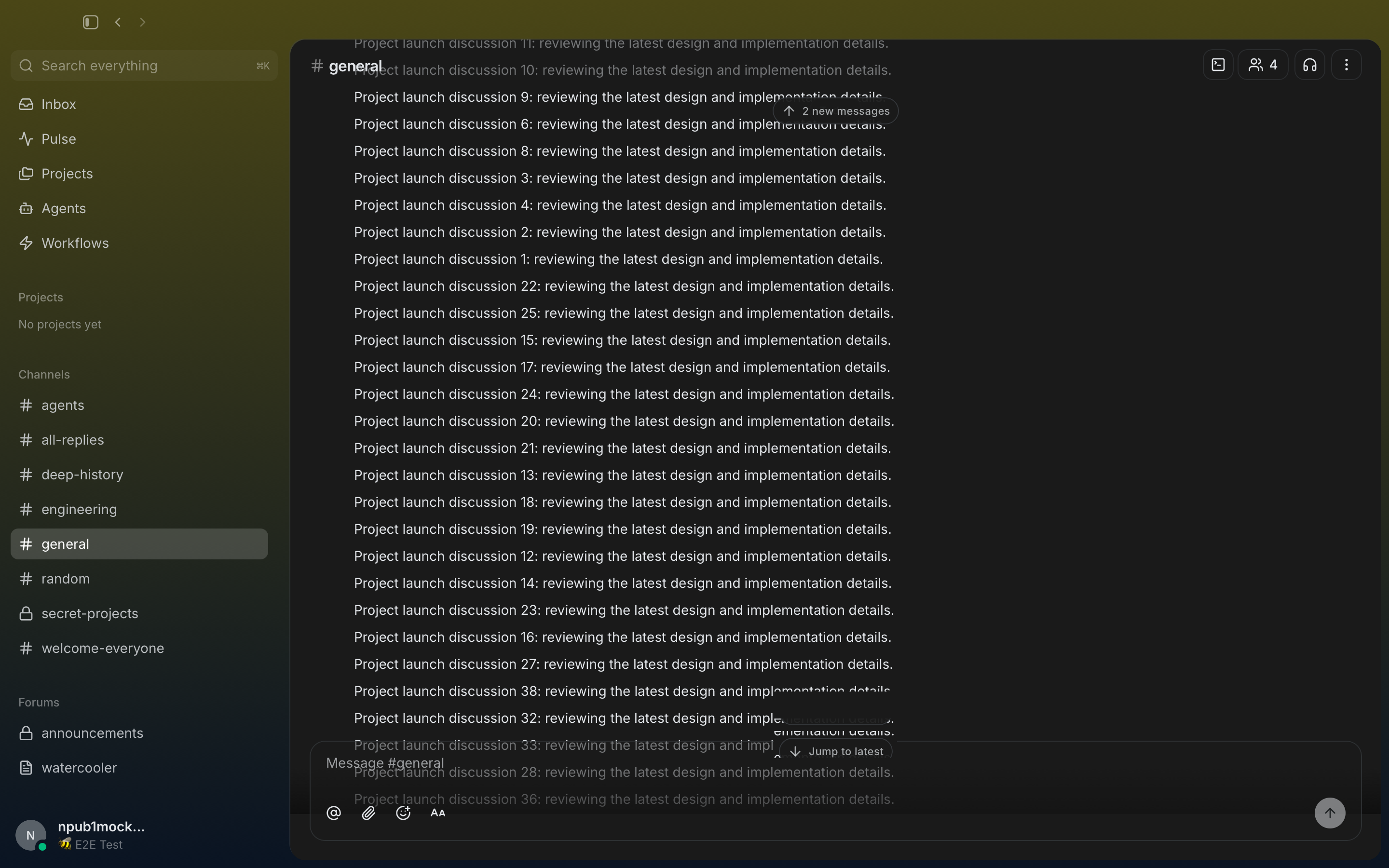 | 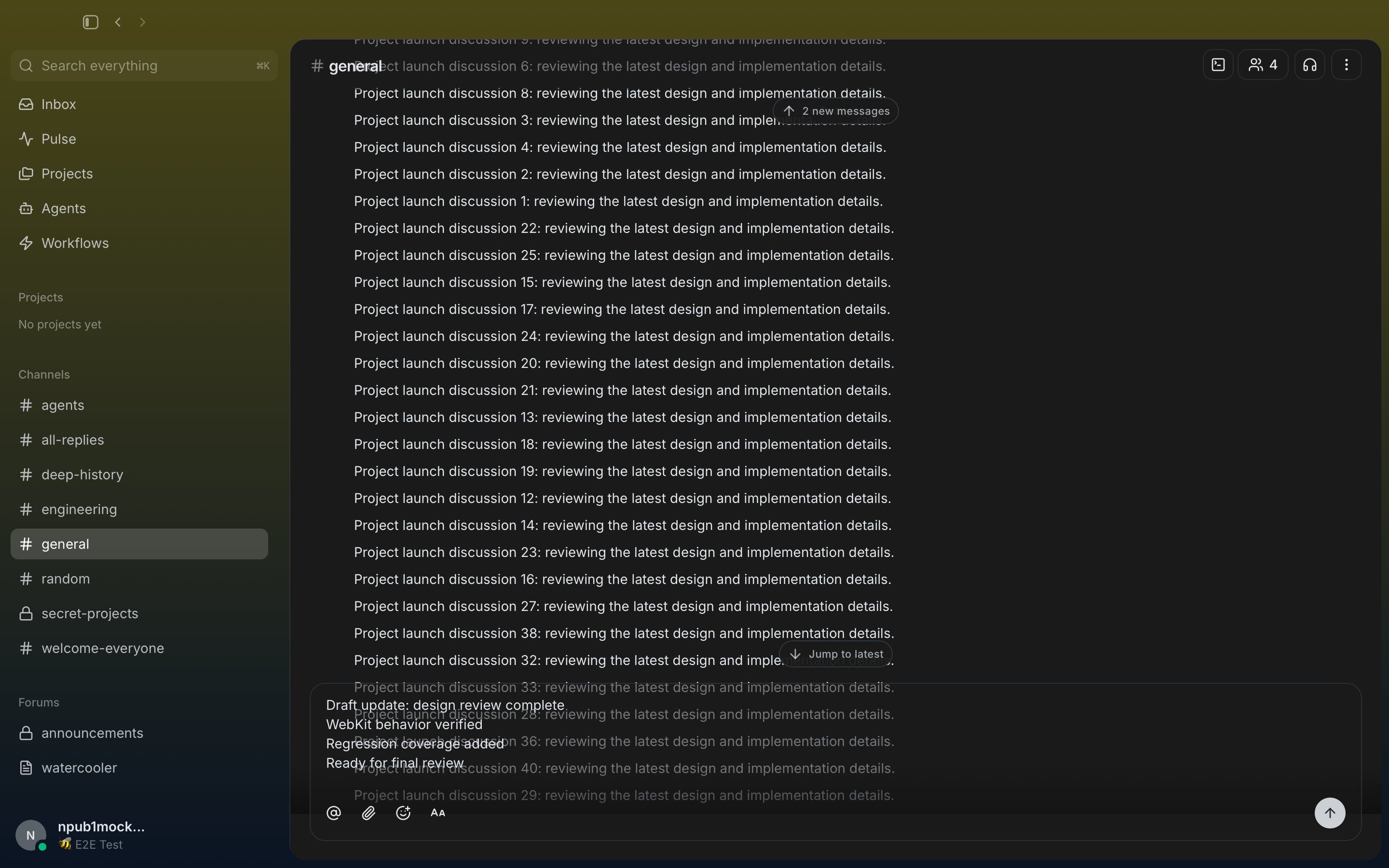 | Signed-off-by: Rizz <302abe414ca6e3134763d2539bfcf145aea2a63fe5f8455204ed602fd40cf381@buzz.block.builderlab.xyz> Co-authored-by: Rizz <302abe414ca6e3134763d2539bfcf145aea2a63fe5f8455204ed602fd40cf381@buzz.block.builderlab.xyz>

## Summary

- add mobile editing for display name, profile description, and profile
photo
- support image positioning, emoji backgrounds, and animated avatar
capture with native iOS controls
- refine settings navigation, profile motion, and the connection
identity row

## Testing

- `just mobile-check`
- `just mobile-test` (1,685 tests)

---------

Signed-off-by: kenny lopez <klopez4212@gmail.com>
Signed-off-by: Kenny Lopez <klopez4212@gmail.com>
Co-authored-by: Carl <3c4caeafb646d23867f1c4832e68211d77e2561946171625f75c3ce1a3f2670f@buzz.block.builderlab.xyz>
### What changed?

After a new mobile invite claim succeeds, Buzz now best-effort ensures
membership in the same public starter channels as desktop:

- `#general`
- `#welcome-everyone`

Missing starters use desktop's deterministic per-relay IDs and exact
public channel configuration, so concurrent mobile and desktop setup
converges safely. Setup failures do not invalidate or retry an already
successful invite claim, and failure for one starter does not block the
other.

The success sheet offers **Continue to #welcome-everyone** when that
channel is available. Mobile does not create the private `Welcome`
channel because it cannot provision the desktop Welcome agents that make
that channel useful.

This PR is stacked on block#6145 because it deliberately reuses that PR's
open-channel directory and join behavior. Once block#6145 merges, this PR can
be retargeted to `main` without changing its BUZZ-12 diff.

Fixes
[BUZZ-12](https://linear.app/squareup/issue/BUZZ-12/bug-community-appears-empty-after-using-invite-link-on-mobile).

### How is it tested?

- Desktop/mobile deterministic starter-ID parity coverage.
- Existing-channel join and missing-channel creation coverage.
- Duplicate-create convergence and per-channel failure isolation
coverage.
- Invite success remains successful when starter setup fails.
- Widget coverage for continuing directly into `#welcome-everyone`.
- Focused invite/deep-link tests: 23 passed.
- `just mobile-check`: passed.
- `just mobile-test`: 1,483 passed.
- Pre-push repository checks: passed.

---------

Signed-off-by: Tom Brow <tomb@block.xyz>
Co-authored-by: Codex <noreply@openai.com>
**Category:** fix **User Impact:** Editing a channel message now opens in the main composer, while editing a thread reply stays in the thread composer, with focus ready for typing. **Problem:** When a thread was open, Buzz treated its root message as thread-owned and opened edits in the thread composer. Menu-driven edits also lacked regression coverage for immediate focus. **Solution:** Carry the message's semantic root/reply classification into the edit target, route only actual replies to the thread composer, and use the menu primitive's selection event for a reliable handoff. End-to-end tests cover placement and focus for both paths. <details> <summary>File changes</summary> **desktop/src/features/channels/ui/ChannelPane.tsx** Routes edit targets by semantic thread ownership rather than membership in the open thread panel. **desktop/src/features/channels/ui/ChannelPane.types.ts** Uses the shared composer edit-target type so routing metadata stays attached to the target. **desktop/src/features/messages/lib/draftMentionRefs.ts** Classifies each edit target as a root or true thread reply from its event tags. **desktop/src/features/messages/lib/draftMentionRefs.test.mjs** Covers semantic ownership for root and reply edit targets. **desktop/src/features/messages/ui/MessageActionBar.tsx** Handles Edit through the dropdown menu's selection event so focus restoration and edit startup share the intended lifecycle. **desktop/src/features/messages/ui/MessageComposer.types.ts** Adds semantic thread ownership to the edit-target contract. **desktop/tests/e2e/messaging.spec.ts** Verifies root edits use and focus the main composer, while reply edits use and focus the thread composer. </details> ### Reproduction Steps 1. Send a channel message and open its thread. 2. From the thread panel, edit the root message; confirm its content loads in the main composer and the editor is focused. 3. Send a reply in that thread. 4. Edit the reply; confirm its content loads in the thread composer and the editor is focused. ### Screenshots **Editing a channel-root message uses the main composer** 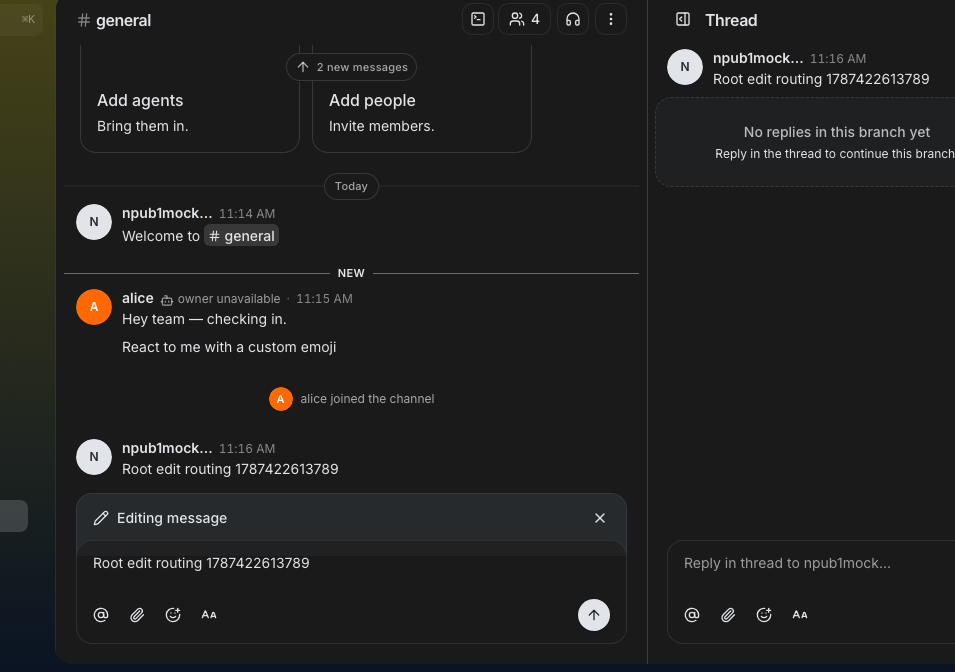 **Editing an actual thread reply uses the thread composer** 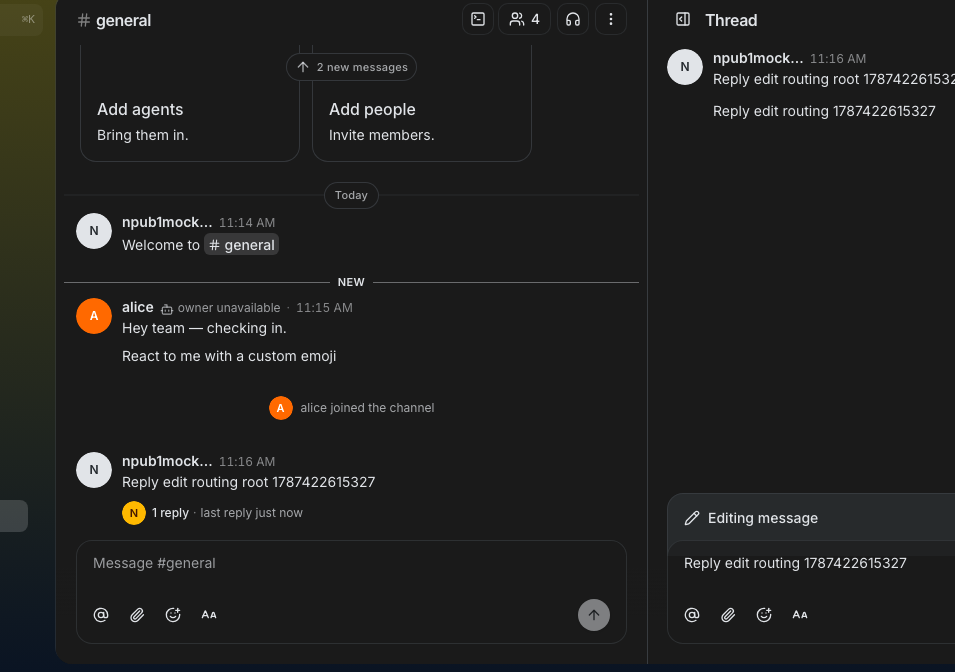 --------- Signed-off-by: Taylor Ho <taylorkmho@gmail.com> Co-authored-by: Rizz <302abe414ca6e3134763d2539bfcf145aea2a63fe5f8455204ed602fd40cf381@buzz.block.builderlab.xyz> Co-authored-by: Carl <acda9e433d19dcd0e6b6840f7f4b98f3a56f1fab98049d444c087019e6d36560@buzz.block.builderlab.xyz>

…empty (block#6447)

Long threads in the desktop app sometimes never load (stuck on a
skeleton until you close and reopen the panel), and a failed load
silently renders as "No replies in this branch yet" — presenting a
broken fetch as an authoritative empty thread with no way to recover.
This fixes both, the two IMPORTANT findings from the thread-load
investigation.

## Defect 1 — unbounded `/query` request

The shared `reqwest::Client` in `relay.rs` sets no timeout, and neither
`/query` request builder set a per-request `.timeout(...)`. A stalled or
half-open connection (headers or body never arrive) leaves the request
pending forever, so a thread-history load hangs on the skeleton
indefinitely.

Fix: a 30s per-request deadline on both `/query` builders, funnelled
through one `send_query_request` helper so the timeout can never be
applied to one builder and dropped from the other. Scoped per-request
rather than client-level because the same client also serves STT/TTS
model downloads, builderlab auth, and the media proxy — a client-level
timeout would cut those off. The deadline sits above the 25s WS
`HISTORY_TIMEOUT_MS` so a slow-but-live relay isn't cut off before the
WebSocket path would be. A timeout surfaces through
`classify_request_error` as the stable `"relay unreachable: request
timed out"` string.

`send()` resolves as soon as response headers arrive, so a relay that
returns headers and then stalls the body trips the deadline during body
consumption, not at `send()` — and that consumption happens on two
paths: `parse_json_response` for 2xx, and `relay_error_message` for a
non-success status (500/429/…). Both paths route their body-consumption
error through one shared `classify_body_timeout` helper so they can't
drift: a stalled body surfaces the stable `"relay unreachable: request
timed out"` string on either path rather than the malformed-response
bucket (2xx) or a bare `"relay returned 500"` status label (non-2xx). A
genuinely non-stalled error still keeps its status classification.

## Defect 2 — terminal error painted as empty

`ChannelScreen` consumed only `isPending`/`data` from the thread-replies
query. Once React Query exhausted its one retry, `isPending` was false
and the zero-length data fell through `selectDeferredListRenderState` to
the `"empty"` state — indistinguishable from a genuinely empty branch,
with no retry affordance.

Fix: plumb `isError` + `refetch` through `ChannelScreen` → `ChannelPane`
→ `MessageThreadPanel`. A pure `selectThreadRepliesSurface` helper
decides the paint in strict precedence — the load-bearing invariant is
that a terminal error **never** resolves to `"empty"`, and cached
replies stay visible non-destructively under a later error (the error
card only surfaces when there is nothing to show). The panel renders an
explicit "Couldn't load replies" + Retry card (testids
`message-thread-replies-error` / `message-thread-replies-retry`).

`ProjectConversationPanel` is a second producer of the same shared panel
and used to hard-code `threadRepliesPending={false}` with no
error/retry, so a failed load in a Projects conversation still painted
the false-empty. It now propagates the same
`isPending`/`isError`/`refetch` from its `useThreadReplies` query.

The multi-root `useThreadRepliesForRoots` hook (the Huddle transcript
and Projects-agent conversation surfaces) had the same gap in its
`useQueries` `combine`: it returned only `{ events, isPending }`, so a
failed reply subtree contributed zero rows and vanished. The combine is
now a pure, unit-testable `combineThreadRepliesResults` that exposes
aggregate `isError`/`error` plus a `refetch` that re-runs only the
failed subtrees. Both multi-root consumers render the shared "Couldn't
load replies" + Retry card when a subtree fails: the Projects-agent
conversation after its transcript, and the Huddle transcript as a
non-destructive banner above the timeline. `useHuddleChannelMessages`
used to read only `.events` and discard the aggregate state, so one
summarized root failing left the flattened transcript presenting as
complete; it now propagates `threadRepliesError`/`onRetryThreadReplies`
through `ChannelScreen` into `ChannelPane`, where successful rows stay
visible and `onRetry` re-runs only the failed subtrees.

The error card carries `role="alert"` so its asynchronous appearance is
announced to assistive tech — without a live region a screen-reader user
parked in the composer never learns the load failed or that Retry became
available.

## Tests

- `stalled_query_request_times_out_with_classified_error` — a loopback
server that never responds; asserts the stable classified timeout
string.
- `stalled_response_body_times_out_with_classified_error` — a loopback
server that writes valid 2xx JSON headers then stalls the body past the
deadline; asserts the classified timeout string, not the malformed
bucket.
- `stalled_error_response_body_times_out_with_classified_error` — a
loopback that writes `500` headers promising a body it never sends;
asserts the classified timeout string rather than the `500` status
label.
- `non_stalled_error_response_yields_status_message` — a promptly-served
`500` still surfaces `"relay returned 500 Internal Server Error"`,
pinning that timeout preservation is scoped to actual timeouts.
- `selectThreadRepliesSurface` — pending→skeleton, terminal error→error
(never empty), page-2 failure never empty, cached rows stay visible
under error, successful-empty→empty, retry-success→list,
streaming→pending, and huddle-transcript collapse.
- `MessageThreadReplyState` mounted test — terminal error renders the
error card (asserting `role="alert"`), never the empty card.
- `combineThreadRepliesResults` — multi-root aggregation/order, a failed
subtree surfaces the aggregate error and never drops rows, aggregate
pending, refetch re-runs only failed queries, all-success yields no
error.
- `thread-load-failure.spec.ts` (smoke E2E) — binds the real
channel-thread panel wiring: forces a terminal `get_thread_replies`
failure at the IPC boundary, asserts the error card renders (never the
false-empty) and Retry recovers.
- `project-conversation-load-failure.spec.ts` (smoke E2E) — the same
guard for the Projects conversation producer, driven through the
Projects Channels-tab row.
- `huddle-thread-load-failure.spec.ts` (smoke E2E) — the consumer-level
guard the combine unit test can't provide: drives the real Huddle wiring
(`useHuddleChannelMessages` → `ChannelScreen` → `ChannelPane`) with two
summarized roots, fails one subtree's fetch at the IPC boundary, asserts
the surviving root's reply stays visible while the retry alert surfaces,
then Retry recovers the failed subtree and clears the alert.

## Structure

To stay under the desktop file-size ratchet, `relay.rs`'s inline test
module moved to `relay/tests.rs`, and two pure pieces were extracted
from the panel: the empty/error reply cards (`MessageThreadReplyState`)
and the per-row branch-highlight derivation
(`selectThreadRowHighlight`).

---------

Signed-off-by: Will Pfleger <pfleger.will@gmail.com>
Co-authored-by: Duncan <dcfd242e557282d7a1e2cf2e6877522682f1e5c6156dc92ca7d90eaedd3b0f95@buzz.block.builderlab.xyz>
) **Category:** fix **User Impact:** Long Buzz link chips now wrap without overflowing in composers and sent messages; icon-bearing stubs use at most five graphemes when no earlier separator exists, so some sent chips attach the icon to a shorter prefix than before. Labels over 48 graphemes are visibly truncated in the composer while their full identity remains available to assistive technology and in the tooltip. **Problem:** Long repository, issue, pull request, and channel chip labels could orphan their icon or overflow narrow composers and sent messages. **Solution:** Keep the icon with a bounded, grapheme-safe leading fragment while allowing the remaining text to break anywhere; cap visible labels at 48 graphemes without changing the full tooltip or accessible identity. <details> <summary>File changes</summary> **desktop/src/features/messages/lib/composerMessageLinkNode.ts** Splits composer chip content into an icon-bearing leading fragment and a freely wrapping remainder while preserving the semantic label and link metadata. **desktop/src/features/messages/lib/composerMessageLinkNode.test.mjs** Updates renderer assertions for the fragment structure and verifies every supported Buzz link kind retains the intended visible label. **desktop/src/shared/styles/globals/composer.css** Keeps ordinary composer mention decorations inline while relying on the existing shared markdown chip wrapping rules for Buzz links. **desktop/src/shared/ui/mentionChip.ts** Centralizes grapheme-aware leading-fragment boundaries and label truncation so composer and sent chips share the same visible identity. **desktop/src/shared/ui/markdown/BuzzLinkChip.tsx** Uses the shared grapheme-aware boundary when rendering sent-message chip fragments. **desktop/tests/e2e/navigation.spec.ts** Covers increasing wrap depth across constrained widths, icon attachment, the sent-message wrap, accessible labeling, and tooltip positioning over both edge fragments. </details> ## Reproduction steps 1. Open a desktop channel and paste a Buzz link with a long repository or channel name into the composer. 2. Narrow the composer until the chip spans two or more lines. 3. Confirm the label breaks mid-string while the icon remains attached to the first label fragment. 4. Send the message, hover both the first and last rendered fragments, and confirm the tooltip follows the hovered fragment. ## Screenshots **Before — the icon drops onto a separate line from its chip label**  **After — the icon stays attached while the remaining label wraps** The same long repository chip at three composer widths. Its label gains line breaks as space contracts, while the icon remains attached to the leading fragment. **420px — one line**  **210px — two lines** 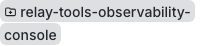 **150px — three lines** 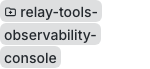 --------- Signed-off-by: Taylor Ho <taylorkmho@gmail.com> Co-authored-by: Carl <acda9e433d19dcd0e6b6840f7f4b98f3a56f1fab98049d444c087019e6d36560@buzz.block.builderlab.xyz>

Routes security researchers to GitHub's private vulnerability reporting
workflow instead of a public issue or email-first disclosure.

- Makes the private advisory form the primary path in `SECURITY.md`,
with email retained as a fallback.
- Adds private-reporting links to the contributor guide, issue chooser,
and bug template.

Checked with `git diff --check`, Ruby YAML parsing, and confirmation
that private vulnerability reporting is enabled for `block/buzz`.

Signed-off-by: Jordan Mecom <jm@squareup.com>
## Summary

- roll every `Swatinem/rust-cache` use back from v2.9.2 to the last
known-good v2.9.1 digest
- give Unit Tests a new `sherpa-cache-v1` key so it cannot restore the
existing poisoned artifact
- pin Renovate to v2.9.1 and add CI contracts that reject unsafe cache
actions or a misplaced generation key

## Why

After block#5441 upgraded rust-cache to v2.9.2, warm-cache `main` Unit Tests
runs began failing while linking `buzz-voice` with `could not find
native static library sherpa-onnx-c-api`. The failed run at `db5617dd1`
restored the same 1.4 KB cache generation that had already failed at
`01091c15a`; the preceding cold run at `26f4c3ed3` downloaded sherpa
1.13.4 and passed.

v2.9.2 changed target cleanup, while `sherpa-onnx-sys` treats its
prebuilt `lib/` directory as proof that the native archive exists.
Rolling back the action and invalidating the affected key removes both
sides of that failure state without disabling target caching.

## Validation

At `6da0037a0407fc498cd482fcbbb74c7a15907e9f`:

- `scripts/test-rust-cache-contract.sh`
- `scripts/test-rust-cache-contract-regressions.sh`
- negative fixtures reject a bad digest in a newly named `.yaml`
workflow and a generation key moved outside the cache action's `with`
block
- YAML parse for all workflows
- release, desktop candidate, mobile release, mobile candidate, and
mobile worktree source contracts
- `just file-size-check`
- pre-commit and pre-push hooks

The PR Unit Tests run proves the cold-cache path because pull requests
restore but do not save Rust caches. The first successful `main` run
after merge will save the new Unit Tests key; the following `main` run
will exercise the warm restore.

## Related issue

None found.

Signed-off-by: Wes <wesbillman@users.noreply.github.com>
Co-authored-by: Carl <32a2e2c9d428ee08902cab75d956da2c1d235a22d4766b0dd4138bf6e2e5db1d@buzz.block.builderlab.xyz>
## Summary

- restore the agreed icon-only cloud marker for an agent from another
setup
- retain the accessible `From another Buzz setup` label and native hover
title
- keep the merged loading, hover/focus persistence, and exact-pubkey
routing safeguards unchanged
- update the duplicate-agent E2E to require an icon with no visible
marker text in both autocomplete and Channel members

## Why

PR block#6401 accidentally changed the agreed compact icon treatment into a
visible `Other setup` badge during review hardening. This is the
smallest correction and is intended for the active release.

## Testing

- Desktop JS: 5,280/5,280 passed
- Desktop TypeScript typecheck passed
- E2E build passed
- focused duplicate-agent Playwright journey: 1/1 passed
- file-size gate passed
- changed-file Biome and `git diff --check` passed

Carl, an automated reviewer, opened this via Wes's GitHub account.

Signed-off-by: Wes <wesbillman@users.noreply.github.com>
Co-authored-by: Carl <32a2e2c9d428ee08902cab75d956da2c1d235a22d4766b0dd4138bf6e2e5db1d@buzz.block.builderlab.xyz>
## Problem

Quick-reaction shortcuts make the message action rail visually noisy.
Reaction access should remain first-class, but through one predictable
Add reaction action rather than several learned emoji shortcuts.

## Change

The rail is now:

**Add reaction · Reply · Copy link · More**

- Remove all quick-reaction shortcut buttons and their divider from the
message action rail.
- Preserve Add reaction as the first action, including its existing
picker, tooltip, accessible name, keyboard behavior, reaction behavior,
and feedback.
- Keep the existing Link2 Copy link action, shared copy handler,
More-menu entry, eligibility guards, and success feedback unchanged.
- Keep reveal, positioning, responsiveness, styling, and remaining menu
paths unchanged.

The now-unused quick-reaction rendering component and imports were
removed from `MessageActionBar`; shared reaction learning remains intact
for other reaction surfaces.

## Tests

Focused smoke coverage verifies:

- zero `React with …` shortcut buttons;
- exact ordered rail: `Open reactions → Reply → Copy link → More
actions`;
- the rail and More-menu paths emit the same canonical thread-aware
`buzz://message` URL;
- existing success feedback;
- pending and huddle rows omit both copy-link surfaces;
- the action bar stays within the open thread panel.

The zero-shortcut contract was mutation-checked by restoring the prior
production action bar: the focused test failed causally with expected 0
versus received 3 quick-reaction buttons.

## Validation

At `4f062e0d60b0f0c16b6862cdea7137c287060947`:

- `pnpm exec biome check src/features/messages/ui/MessageActionBar.tsx
tests/e2e/message-copy-link.spec.ts` — passed.
- `pnpm exec tsc --noEmit` — passed.
- `pnpm test` — 5,432 passed, 0 failed.
- `pnpm build:e2e` — passed; existing dynamic-import and chunk-size
warnings only.
- `pnpm exec playwright test tests/e2e/message-copy-link.spec.ts
--project=smoke` — 2 passed.
- Pre-push `file-size-check`, `desktop-check`, `desktop-typecheck`, and
`desktop-test` — passed.

Vogue’s design review: **SHIP** — reaction remains discoverable and
accessible as the visible first action; the extra click is an
intentional efficiency tradeoff for the simpler hierarchy.

---------

Signed-off-by: Trace (Engineer) <9d485ff0c62915e08a801162c195c7ef096f6f6143925407255cea2656c4b8a4@buzz.block.builderlab.xyz>
Signed-off-by: morgmart <98432065+morgmart@users.noreply.github.com>
Signed-off-by: Rivet <a08d9a8418c7ff03afe19964724c8fd87bf1776ab9e9b9cafb8cc920edd02a6e@buzz.block.builderlab.xyz>
Co-authored-by: Trace (Engineer) <9d485ff0c62915e08a801162c195c7ef096f6f6143925407255cea2656c4b8a4@buzz.block.builderlab.xyz>
Co-authored-by: Rivet <a08d9a8418c7ff03afe19964724c8fd87bf1776ab9e9b9cafb8cc920edd02a6e@buzz.block.builderlab.xyz>
**Category:** improvement **User Impact:** Workflow authors can discover people and messages while configuring trigger filters, then see readable enriched labels instead of raw identifiers. **Problem:** Author and message filters required users to know and paste raw public keys or event IDs, and configured workflows surfaced those opaque values afterward. **Solution:** Add network-backed pickers and presentation enrichment while keeping deterministic local public-key and event-ID fallbacks authoritative whenever discovery is unavailable or untrusted. Related issue: none found. <details> <summary>File changes</summary> **desktop/src/features/workflows/ui/WorkflowAuthorPicker.tsx** Adds channel-aware author discovery, profile search, keyboard navigation, loading states, and deterministic public-key fallback selection. **desktop/src/features/workflows/ui/WorkflowCard.tsx** Uses enriched trigger presentation when building the workflow card’s readable summary. **desktop/src/features/workflows/ui/WorkflowDialog.tsx** Keeps Escape scoped to an active filter picker before allowing the inspector or dialog to close. **desktop/src/features/workflows/ui/WorkflowFormBuilder.tsx** Threads channel context into trigger filters and renders enriched author/message summaries in the workflow sequence. **desktop/src/features/workflows/ui/WorkflowMessagePicker.tsx** Adds paged channel-history discovery, message search, exact event lookup, profile labels, keyboard navigation, and bounded results. **desktop/src/features/workflows/ui/WorkflowRichTriggerDescription.tsx** Renders compact author identity details and loading presentation inside trigger summaries. **desktop/src/features/workflows/ui/WorkflowTriggerConditions.tsx** Connects author and message filter accordions to their pickers while preserving selected and excluded condition semantics. **desktop/src/features/workflows/ui/useWorkflowAuthorPresentation.ts** Resolves configured author keys to trusted display labels with deterministic fallbacks. **desktop/src/features/workflows/ui/useWorkflowTriggerPresentation.ts** Enriches configured message IDs only after validating the fetched event and channel. **desktop/src/features/workflows/ui/workflowAuthorCandidates.test.mjs** Covers author candidate normalization, ordering, deduplication, and fallback behavior. **desktop/src/features/workflows/ui/workflowAuthorCandidates.ts** Builds stable author candidates from channel members, profiles, and raw public keys. **desktop/src/features/workflows/ui/workflowConditionExpression.ts** Allows message IDs to participate in basic trigger-filter parsing. **desktop/src/features/workflows/ui/workflowDefinition.ts** Accepts enriched trigger text when generating workflow card labels. **desktop/src/features/workflows/ui/workflowMessageCandidates.test.mjs** Covers event validation, source merging, deterministic ordering, and exact-lookup enrichment boundaries. **desktop/src/features/workflows/ui/workflowMessageCandidates.ts** Validates message candidates by event kind, channel, and exact event ID before permitting enrichment. **desktop/src/features/workflows/ui/workflowTriggerDescription.test.mjs** Covers readable selected/excluded author and message descriptions plus loading fallbacks. **desktop/src/features/workflows/ui/workflowTriggerDescription.ts** Builds concise enriched trigger descriptions while retaining stable raw-ID fallbacks. **desktop/tests/e2e/workflow-local-controls.spec.ts** Exercises picker discovery, selection toggles, Escape ownership, bounded scrolling, and enriched workflow summaries. </details> ## Reproduction steps 1. Open Workflows and create a workflow for a channel with members and message history. 2. Choose **Reaction Added** as the trigger and expand **Author**. 3. Confirm channel members and fetched profile results are discoverable, searchable, and keyboard accessible; choose one. 4. Expand **Message**, confirm recent channel messages appear in a bounded list, and choose one. 5. Toggle either selected filter between **is** and **is not**, then collapse the inspector and confirm the sequence summary stays readable. 6. Add a send-message step and create the workflow; confirm its card uses the resolved author and message labels. 7. Repeat while discovery is unavailable and confirm raw public keys/event IDs remain selectable and authoritative. ## Screenshots ### Author discovery 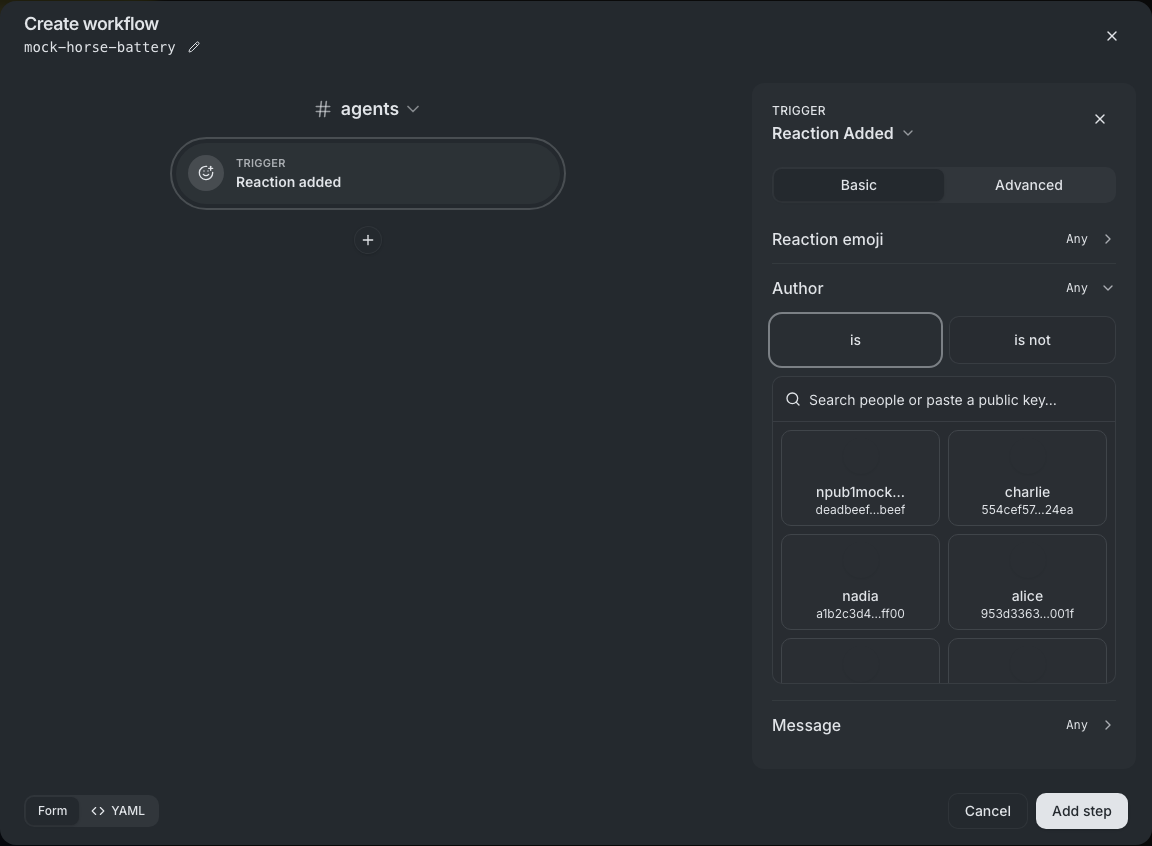 ### Message discovery 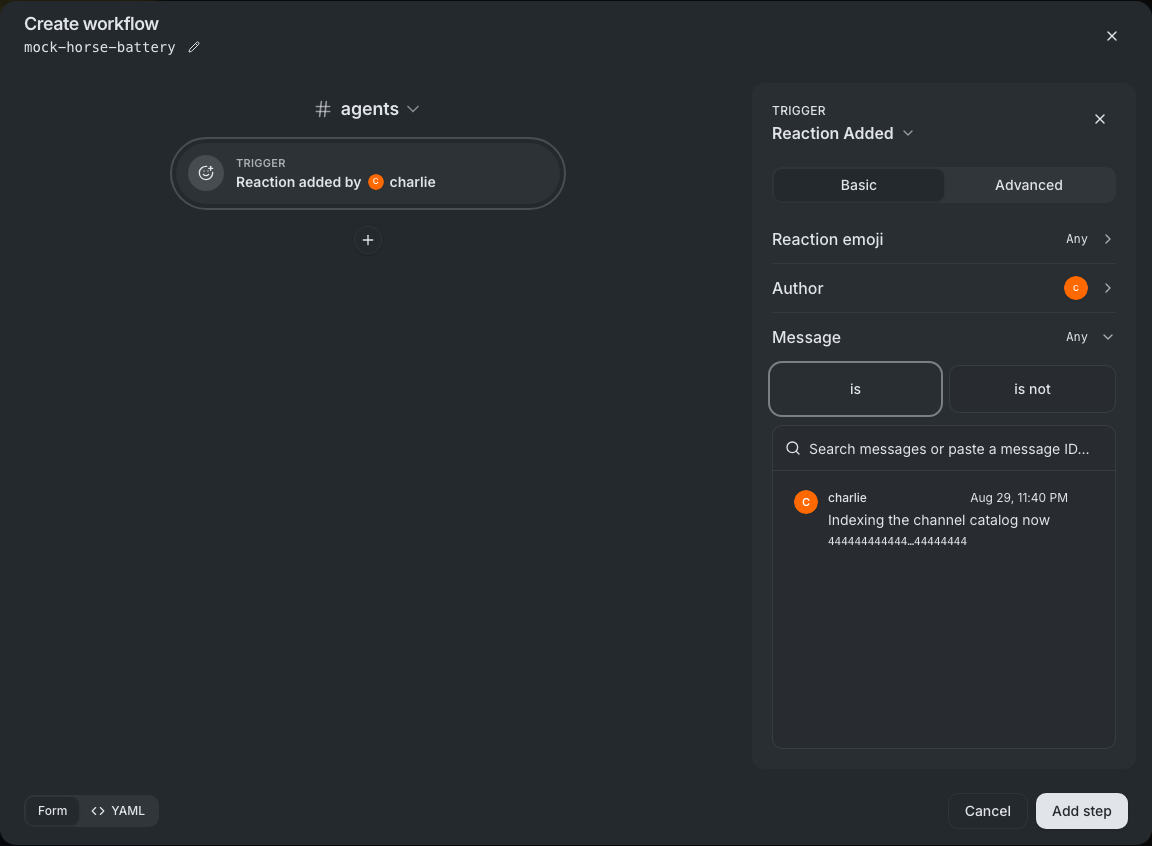 ### Selected filter summaries 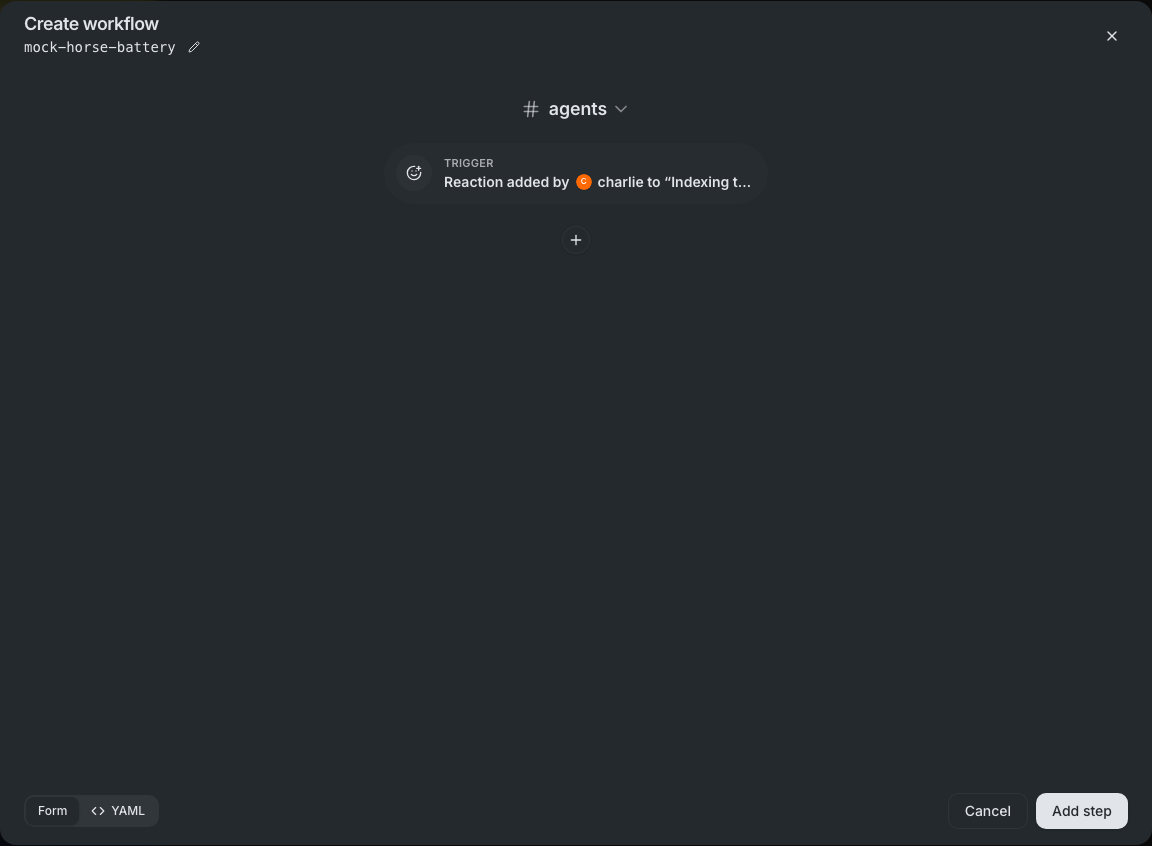 ### Enriched workflow card 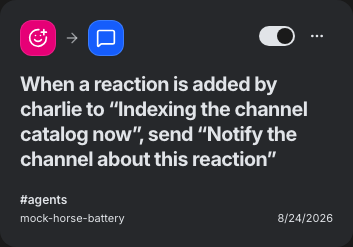 --------- Signed-off-by: Taylor Ho <taylorkmho@gmail.com> Co-authored-by: Carl <acda9e433d19dcd0e6b6840f7f4b98f3a56f1fab98049d444c087019e6d36560@buzz.block.builderlab.xyz> Co-authored-by: Princess Donut <0366ccd5ee09c2779a9d6bd6683daa17c16a508a51f6a7e7314018dab8fdc49b@buzz.block.builderlab.xyz> Co-authored-by: Rizz <302abe414ca6e3134763d2539bfcf145aea2a63fe5f8455204ed602fd40cf381@buzz.block.builderlab.xyz>

## Why
Command persistence duplicated NIP-33 replacement SQL in the relay and
obscured the boundary between database runtime concerns and domain-store
behavior. This proving slice establishes that boundary inside the
existing `buzz-db` crate.

## What
- Centralize parameterized-replaceable coordinate locking, ordering,
replacement, watermark, and mention-indexing behavior in `buzz-db`
- Expose transaction-required replacement and ordinary-insertion seams
while keeping transaction ownership and workflow conflict messages in
the relay
- Cover concurrency, same-second ties, stale writes, replay, caller
rollback, nested rollback recovery, and mention-index atomicity with
focused PostgreSQL tests

## Risk Assessment
Medium — this changes core event persistence and command idempotency
paths, while intentionally preserving NIP-33, NIP-RS, mesh, and workflow
conflict semantics.

## References
- Architecture guardrail:
TheSentinel454#34
- Proving slice: TheSentinel454#3,
TheSentinel454#4,
TheSentinel454#6

Generated with Codex

---------

Signed-off-by: tornquist <tornquist@squareup.com>
**Category:** fix **User Impact:** Inline chips now read more consistently, fit cleanly in the composer, and show deleted message links with the same calm muted treatment as unresolved links. **Problem:** Deleted message links looked like destructive actions even though they are informational, while mention chips had slightly uneven vertical spacing, a high-set human icon, and could clip inside the composer. **Solution:** Unify unavailable-state styling, tighten chip spacing, optically align the human icon, and give composer chips enough line height to paint without changing caret behavior. <details> <summary>File changes</summary> **desktop/src/shared/styles/globals/markdown.css** Makes chip padding vertically symmetric, moves only the human `@` icon down by 1px, and shares muted colors between deleted and unresolved message links while preserving their separate semantic classes. **desktop/src/shared/styles/globals/composer.css** Adds a composer-only line height derived from the text size and chip padding so inline chips no longer clip while retaining inline caret behavior. **desktop/tests/e2e/entity-link-recipient-cards.spec.ts** Verifies deleted and unresolved chips have matching computed colors while deleted links retain their tooltip, semantics, and navigation behavior. **desktop/tests/e2e/mentions.spec.ts** Covers composer chip height, clipping, the human icon's 1px optical offset, and visual capture. </details> ## Reproduction steps 1. Open a channel containing a link to a definitively deleted message and compare it with a transient or unresolved message link; both should use the muted unavailable treatment, while the deleted link still says “Message deleted” and navigates to its fallback destination. 2. Insert a person mention in the composer; the chip should have balanced vertical spacing and paint fully without clipping. 3. Compare a person mention with a channel chip; only the human `@` icon should sit 1px lower. ## Screenshots ### Deleted message link | Before | After | | --- | --- | |  |  | ### Composer chip polish | Before | After | | --- | --- | |  |  | ## Validation - `desktop/tests/e2e/entity-link-recipient-cards.spec.ts` + `desktop/tests/e2e/mentions.spec.ts`: 82/82 passed - Desktop unit suite: 5,397 passed - Formatting and lint checks passed (existing informational warnings only) - Pre-push desktop check, typecheck, and unit tests passed at `0255c3fd49f9244cd727d0dd20c514b3a1812152` --------- Signed-off-by: Taylor Ho <taylorkmho@gmail.com>
## Summary
- hide the mobile Huddle action in one-to-one agent DMs
- preserve Huddles for human DMs and group DMs

## Testing
- just mobile-check
- flutter test (1,662 tests)

---------

Signed-off-by: kenny lopez <klopez4212@gmail.com>
Signed-off-by: Princess Donut <b238ea756dee4d98afa5883fc7f1de61eeabe65bf700e3a5a5a80db5e42e2c2b@buzz.block.builderlab.xyz>
Co-authored-by: Princess Donut <b238ea756dee4d98afa5883fc7f1de61eeabe65bf700e3a5a5a80db5e42e2c2b@buzz.block.builderlab.xyz>
## Summary

- add inline profile photo capture with smooth avatar-to-viewfinder
transitions
- add close, flip, shutter, retry, and use-photo states with haptics and
front-camera mirroring
- polish iOS liquid-glass controls and avatar editor motion

### Related issue

Follow-up to block#6583.

### Testing

- just mobile-check
- just mobile-test (1,743 tests)
- built, installed, and launched on Pixel 10 and iPhone Air

---------

Signed-off-by: kenny lopez <klopez4212@gmail.com>
Signed-off-by: Code Reviewer <037593536284cf40e221c96c931e9877d4166d54f6bb84e5341a86d7fd5d05a4@buzz.block.builderlab.xyz>
Signed-off-by: Perci <5a968df9a7494b4e019b9ecf739e088ba61097b4312124e9a88ae5b42e3f5f3e@buzz.block.builderlab.xyz>
Signed-off-by: Max <d8473ee32b973aa31a21a65adddcc4b69cc2a8a4dee8121ecd51926e0cddbc02@buzz.block.builderlab.xyz>
Signed-off-by: Wren <5217c5c2f7bfb4333e46d17c98a9255a52dadee18dcd43a43536b95e6776dfa0@buzz.block.builderlab.xyz>
Signed-off-by: Meli <5aaa86bce934fc3445fc254aab560a40923f10252f92107e665073dede0e04d3@buzz.block.builderlab.xyz>
Signed-off-by: morgmart <98432065+morgmart@users.noreply.github.com>
Co-authored-by: Code Reviewer <037593536284cf40e221c96c931e9877d4166d54f6bb84e5341a86d7fd5d05a4@buzz.block.builderlab.xyz>
Co-authored-by: Tyler <109685178+tlongwell-block@users.noreply.github.com>
Co-authored-by: Perci <5a968df9a7494b4e019b9ecf739e088ba61097b4312124e9a88ae5b42e3f5f3e@buzz.block.builderlab.xyz>
Co-authored-by: Max <d8473ee32b973aa31a21a65adddcc4b69cc2a8a4dee8121ecd51926e0cddbc02@buzz.block.builderlab.xyz>
Co-authored-by: Wren <5217c5c2f7bfb4333e46d17c98a9255a52dadee18dcd43a43536b95e6776dfa0@buzz.block.builderlab.xyz>
Co-authored-by: Meli <5aaa86bce934fc3445fc254aab560a40923f10252f92107e665073dede0e04d3@buzz.block.builderlab.xyz>
Co-authored-by: morgmart <98432065+morgmart@users.noreply.github.com>
Co-authored-by: Claude <noreply@anthropic.com>
## Summary

- ignore mobile room tone when deciding whether human speech should
interrupt agent audio
- show a subtle waiting animation while an agent prepares a response,
then restore its avatar when speech begins
- render agents from Huddle membership before their audio peer starts
transmitting

## Testing

- `just ci`
- signed Release build installed and launched on a physical iPhone
- live Huddle voice and agent-membership behavior verified on device

---------

Signed-off-by: kenny lopez <klopez4212@gmail.com>
Co-authored-by: Mongo <9cfd347903944d5b85aa6c93d2ab67381b978a92a31914bca69998968752a1d7@buzz.block.builderlab.xyz>
## Why

Community persistence is the next incremental `buzz-db` store
extraction, keeping tenant lifecycle SQL, records, tests, and
instrumentation out of the database runtime module without changing
behavior.

## What

- Move community records and the existing `impl Db` operations into
`community.rs` while preserving crate-root re-exports.
- Move focused PostgreSQL tests with the implementation and enforce
single ownership for each method and datastore span.

## Risk Assessment

Low — this is a structural move of the existing records, SQL, method
bodies, and focused tests; database runtime concerns, schema, and
behavior remain unchanged.

## References

- Architecture guardrail:
TheSentinel454#34
- Incremental tracker: TheSentinel454#2
- Primary task: TheSentinel454#5
- Stacked on: block#6660

Generated with Codex

Signed-off-by: tornquist <tornquist@squareup.com>

## Summary

Adds a manual, collaborator-triggered workflow for publishing pre-merge
Buzz relay runtime images for bb-block staging.

- Resolves a canonical `block/buzz` branch or tag to an immutable commit
SHA before checkout.
- Builds the relay runtime image for `linux/amd64` and `linux/arm64` and
publishes a single OCI index.
- Tags each publication uniquely as `dev-sha-<full
SHA>-run-<run_id>-<run_attempt>` so no tag is ever reused against the
immutable-tag utility ECR pull-through cache (rebuilds of the same SHA
aren't byte-identical, given mutable base tags and `apt-get update`).
- Uses the staging-only `ghcr.io/block/buzz-staging-dev` namespace,
which maps to a distinct utility ECR pull-through path.
- Restricts dispatch to `block/buzz` on `refs/heads/main`; job
permissions are narrowly scoped to `contents: read` plus `packages:
write`.
- Emits a deployment summary with the exact BPCI `repository` and unique
`tag` values, plus the merged manifest digest.
- Keeps the existing production/release image workflow unchanged.

The first real workflow run must confirm GHCR package creation/access
and utility ECR pull-through import for the new package.

---------

Signed-off-by: Brad Seiler <seiler@squareup.com>
Signed-off-by: Will Pfleger <pfleger.will@gmail.com>
Signed-off-by: tornquist <tornquist@squareup.com>
Co-authored-by: coder 0 <d97ebdbb198c7237c94f84ea8bb8a73583ea067407eebd0062abbb3962527fb1@buzz.block.builderlab.xyz>
Co-authored-by: Duncan <dcfd242e557282d7a1e2cf2e6877522682f1e5c6156dc92ca7d90eaedd3b0f95@buzz.block.builderlab.xyz>
Co-authored-by: Will Pfleger <pfleger.will@gmail.com>
Co-authored-by: tornquist <tornquist@squareup.com>
…lock#5712)

## Summary

buzz-agent now authorizes every LLM-issued MCP tool call through
`session/request_permission` before it executes, instead of running
tools unconditionally. The agent **always asks**; the client applies
`BUZZ_ACP_PERMISSION_POLICY` and answers. buzz-agent never reads the
policy — this keeps the policy decision on the client side, matching the
layering of the other ACP harnesses, and avoids duplicating policy logic
that would drift.

### Broker

A crate-local `PermissionBroker`
(`crates/buzz-agent/src/permission.rs`), owned by `App` for the
connection lifetime, owns the full request-correlation lifecycle:

- **Process-wide admission.** A global `Semaphore`
(`BUZZ_AGENT_MAX_PENDING_PERMISSIONS`, default 32, validated `>= 1`) is
acquired *before* any correlation entry is inserted. This is the
security bound: the per-turn tool semaphore is constructed fresh per
turn and `max_sessions` is unbounded by default, so neither bounds
simultaneously-outstanding asks process-wide.
- **Abort-safe cleanup.** A successful admission returns a
`PendingPermission` lease that owns the admission permit and the
correlation id. Its `Drop` synchronously removes the still-pending entry
and releases the slot, covering task abort/panic that bypasses the
normal `run_prompt` tail.
- **At-most-once resolution.** `deliver` claims (removes) the entry
*before* waking the waiter, so each id resolves once and a later lease
`Drop` is a no-op. Unknown/late ids are logged and dropped; only ids the
broker minted (`perm-<n>`) are recognized.
- **Single absolute deadline.** Admission, request enqueue, and response
wait all share one deadline (`BUZZ_AGENT_PERMISSION_TIMEOUT_SECS`,
default 330s, validated `>= 1`), so a saturated call cannot outlive one
timeout window even when a stalled writer blocks the enqueue.
Cancellation races inside every wait — resolution never depends on the
outer abort drain. A writer that dies mid-connection (stdout closed, or
a blocking write that only surfaces its error at flush) is
connection-fatal: it cancels all sessions, which resolves any ask
waiting on a reply that can never be written.

### Wire

`request_permission_params` (`crates/buzz-agent/src/wire.rs`) is
version-aware, keyed on the protocol version negotiated at `initialize`
and stored on `App` for the connection lifetime (never derived from a
later mutable session field). v2 nests the tool call under `subject:
{type: "tool_call", toolCall}` with top-level `title`/`options`; v1 uses
the legacy top-level `toolCall`. No hybrid shape. Both offered options
(`allow_once`, `reject_once`) carry `optionId == kind`, so the client's
`kind`-based selection and this side's `optionId`-based predicate agree
without a lookup table.

### Gate

In each spawned tool task (`crates/buzz-agent/src/agent.rs`) the
sequence is: acquire per-turn permit → argument-shape validation →
broker admission + request + wait → cancellation recheck →
`emit_in_progress` → `mcp.call`. Argument-shape validation is hoisted
out of `mcp.rs::do_call` into `validate_arg_shape` so a malformed
non-object argument is rejected locally without prompting for a call
that could never execute.

Authorization is fail-closed, stated once in `evaluate`: execute IFF
`outcome.outcome == "selected"` **and** the selected `optionId` equals
the offered allow option. Every other shape (reject, cancelled, JSON-RPC
error, malformed, unknown outcome, wrong/unknown option, timeout,
wire-channel closure) denies with a synthetic tool error, and the turn
continues.

### Scope

Only LLM-issued MCP calls are gated. The built-in `load_skill` tool and
`call_hooks` lifecycle calls (`_Stop`, `_PostCompact`) are exempt — they
are not model-issued. `readOnlyHint` is never treated as a security
boundary.

First cut ships `allow_once`/`reject_once` only; session-scoped grants
are deliberately out of scope.

### Related issue

Part of block#4938. This PR and
[block#5106](block#5106) jointly implement the
feature: block#5106 is the client-side policy engine and permission cards;
this PR is buzz-agent's asking side (`session/request_permission`).
Neither closes block#4938 alone.

---------

Signed-off-by: Will Pfleger <pfleger.will@gmail.com>
Co-authored-by: Hayt <41ea58f1e64c243627e8acde7c89be667052ee6e17d8f021c1195be4324ebf04@buzz.block.builderlab.xyz>
Co-authored-by: Duncan <dcfd242e557282d7a1e2cf2e6877522682f1e5c6156dc92ca7d90eaedd3b0f95@buzz.block.builderlab.xyz>
## Summary

- wait for TipTap's mount lifecycle before reading the selection
formatting tray's editor DOM
- detach and reattach DOM listeners across editor view unmounts and
remounts
- cover mounted and pre-mount editor view access

## Testing

- `just ci`
- `pnpm build:e2e`
- `pnpm exec playwright test
tests/e2e/composer-selection-formatting.spec.ts --project=smoke --grep
"right-clicking selected composer text"`
- Native Builderlab staging: reproduced the pre-mount crash on main,
relaunched with the fix, and verified the composer mounts without the
TipTap error

Signed-off-by: kenny lopez <klopez4212@gmail.com>

## Summary

- Replace the decorative lightbox zoom icons with accessible Zoom out
and Zoom in buttons.
- Route button clicks through the existing 1x–3x, 5% stepped zoom state
without dismissing the viewer, including clicks on SVG icon descendants.
- Extract the zoom toolbar so `markdown.tsx` remains below the
repository file-size threshold.

### Testing

- `pnpm build:e2e`
- `pnpm exec playwright test image-attachment-gallery.spec.ts
--project=smoke` — 10 passed
- `pnpm typecheck`
- Full desktop unit suite — 5,397 passed
- Pre-push checks — file-size gate, desktop checks, typecheck, and
desktop tests passed
- `git diff --check`

### UI evidence

The rendered lightbox flow is covered by the gallery smoke test: Zoom
out is disabled at 100%, Zoom in changes the value to 105%, Zoom out
returns it to 100%, and the dialog remains open throughout. Existing
gallery, keyboard, spoiler, context-menu, and close-path assertions also
pass.

---------

Signed-off-by: sanic <c57bf9b4275088b2b33db7f746975407210f159fbd8bd733c0e532375f69aa80@buzz.block.builderlab.xyz>
Signed-off-by: Kalvin Chau <kalvin@block.xyz>
Co-authored-by: sanic <c57bf9b4275088b2b33db7f746975407210f159fbd8bd733c0e532375f69aa80@buzz.block.builderlab.xyz>
Co-authored-by: peon <9ac6794b000690b7e814eb1805ad32405d0bec7d52838de3a86cf967565dacc0@buzz.block.builderlab.xyz>
…ce and profile hints (block#4825)

## Problem

`buzz channels create --template` fails with a bare-pubkey
duplicate-instance error when a persona has more than one live instance.
When duplicate instances share the same display name and avatar, the
error gives the operator no signal to identify which instance is stale.

## What changed

**`crates/buzz-cli/src/commands/channels.rs`** (boundary) + one
visibility line in **`crates/buzz-cli/src/commands/users.rs`** (`fn
presence_subject` → `pub(crate)`), plus a relay behavior change in
**`crates/buzz-relay/src/api/bridge.rs`** and a supporting test in
**`crates/buzz-pubsub/src/presence.rs`**.

### Relay: presence-lookup failure is now surfaced as a failure

`synthesize_presence` previously collapsed a Redis `get_presence_bulk`
error into `unwrap_or_default()` → HTTP 200 `[]`, making a backend
outage indistinguishable from an authoritative all-offline snapshot. It
now returns `Option<Result<Vec<Value>, (StatusCode, Json<Value>)>>`:
`None` means the request is not a presence query (fall through),
`Some(Ok)` is a real snapshot (an empty vec is an authoritative
all-offline result), and `Some(Err)` is a backend failure surfaced as a
non-2xx response. The event tag-parse and sign paths were converted from
`.ok()?` fall-throughs to explicit `Some(Err(...))` for the same reason
— a silent fall-through would have reintroduced the fake-empty-success
anti-pattern. The function takes `pubsub` and `relay_keypair` directly
rather than the whole `AppState`, which keeps the Redis-error seam
unit-testable without live infrastructure; its single production caller
was updated accordingly, and no other caller consumes
`synthesize_presence`.

### Hint fetch architecture

**`assemble_roster_resolution<F, Fut>`** — post-fetch stage extracted
from `build_roster_resolution` as an injectable-fetcher async generic.
It contains: archive-filter-based duplicate detection, the conditional
`fetch_hints` call, and `finalize_roster_resolution` delegation.
Accepting the fetcher as a closure makes the wiring directly testable
without a relay.

`build_roster_resolution` reduces to: gather slugs → `tokio::join!(scan,
archive)` → delegate with the real `fetch_candidate_hints` closure.

**Zero hint queries on the happy path**: `assemble_roster_resolution`
only invokes the fetcher when duplicate live instances exist after
archive filtering. Untrusted archive snapshot (`Err`) conservatively
treats all found instances as live.

When duplicates exist, `fetch_candidate_hints` runs the presence
(kind:40902) and profile (kind:0) queries concurrently, bounding **each
independently** through `join_bounded_queries`: a per-query 3-second
timeout maps to `Err`, so a lookup that completes is never discarded
because its sibling hung. On total failure or timeout, bare pubkeys are
printed promptly.

### Trusted-snapshot boundary — `hints_from_results`

The relay drops the Redis presence key when an identity goes offline, so
the bulk presence snapshot never returns an event for an offline
instance — precisely the stale duplicate an operator needs flagged.
`hints_from_results` therefore treats a *trusted* presence snapshot as a
**complete snapshot** for the requested pubkeys: it seeds all of them
`offline`, then overlays returned statuses.

A response is trusted only when `trusted_presence_snapshot` validates
**every** array element as the actual snapshot contract: each must parse
as a complete signed `nostr::Event` of the presence-update kind carrying
exactly one `p` tag whose subject is one of the requested pubkeys.
Requiring the *sole* `p`-tag subject — the exact value `build_hint_map`
later reads via `presence_subject` — is what stops a mixed-tag event
(`[["p","<unrequested>"],["p","<requested>"]]`) from passing the gate
yet overlaying a different subject downstream. Any element that is not
such an event — a vacuous object like
`{"pubkey":"…","content":"online"}`, `[{}]`, `[null]`, an event of the
wrong kind, one for an unrequested subject, or one carrying more than
one `p` tag — makes presence enrichment untrusted: nothing is seeded
`offline`, so absence is never falsely inferred as offline. A failed,
timed-out, or non-array presence response is likewise untrusted. In
every untrusted case the successful profile sibling still contributes
its hints.

### Response-to-map conversion — `build_hint_map`

Sync production function taking the offline seed plus raw
presence/profile event slices. Relay-signed presence events carry the
agent pubkey in the `p` tag (not the event author); `build_hint_map`
calls `presence_subject` from `users.rs` (now `pub(crate)`) to resolve
the correct key.

### Hint display — `format_candidate`

Appends `[online/offline, profile updated YYYY-MM-DD]` (or subset) to
each candidate pubkey in the error. `profile_updated_at` names the field
correctly: kind:0 is replaceable state that desktop republishes on
rename and profile reconciliation, so `created_at` reflects the last
profile update, not provisioning time. Date formatted via
`chrono::DateTime::from_timestamp`; out-of-range timestamps omit the
date. Missing entries fall back to bare pubkeys.

### Cardinality rule

`apply_cardinality_rule` remains pure and relay-free; zero/one/many
semantics unchanged.

---------

Signed-off-by: Will Pfleger <pfleger.will@gmail.com>
Signed-off-by: Carl <9d00794d3df50972eb8b615511783cab12a77a8fd5dd5edd58073ec73b54bd8b@buzz.block.builderlab.xyz>
Signed-off-by: Duncan <dcfd242e557282d7a1e2cf2e6877522682f1e5c6156dc92ca7d90eaedd3b0f95@buzz.block.builderlab.xyz>
Co-authored-by: npub1g8493u0xfsjrvflg4n08ezd7vec99mnwzlv0qgwpr9d7gvjwhuzqx59rhw <41ea58f1e64c243627e8acde7c89be667052ee6e17d8f021c1195be4324ebf04@buzz.block.builderlab.xyz>
Co-authored-by: Wes <wesbillman@users.noreply.github.com>
Co-authored-by: Duncan <dcfd242e557282d7a1e2cf2e6877522682f1e5c6156dc92ca7d90eaedd3b0f95@buzz.block.builderlab.xyz>
**Category:** fix
**User Impact:** Channel descriptions now keep their paragraph structure
everywhere people and agents read them.

**Problem:** Multi-paragraph channel descriptions were flattened in the
desktop interface and in agent context, making operational instructions
harder to scan and potentially changing their meaning. A running agent
harness could also continue using a stale description after someone
edited it.

**Solution:** Preserve authored line and paragraph breaks across the
desktop surfaces, and render descriptions as bounded, indented
agent-context blocks with semantic delimiters escaped. Prompt-visible
channel metadata now refreshes before each turn with cached fallback,
while one shared desktop derivation keeps the header and channel intro
consistent.

<details>
<summary>File changes</summary>

**crates/buzz-acp/src/pool.rs**
Refresh prompt-visible kind-39000 metadata with one bounded request per
turn so edits reach running harnesses, while retaining cached metadata
as a degradation fallback. Add regression coverage for description edits
and update request-count fixtures for the refresh lifecycle.

**crates/buzz-acp/src/prompt_framing.rs**
Add semantic text escaping for untrusted values embedded inside paired
prompt sections.

**crates/buzz-acp/src/queue.rs**
Render multi-paragraph descriptions as indented context blocks, preserve
blank lines, retain the 500-character limit, and escape semantic
delimiters. Add helper- and full-prompt tests for paragraph
preservation, UTF-8-safe truncation, and adversarial input.

**desktop/src/features/channels/lib/channelDescription.ts**
Introduce one shared channel-detail derivation and preserve newlines
between status context and authored detail text.

**desktop/src/features/channels/lib/channelDescription.test.mjs**
Cover shared field precedence, multiline descriptions, status-prefix
separation, and fallback behavior.

**desktop/src/features/channels/ui/ChannelPane.helpers.ts**
Use the shared channel-detail derivation for the channel intro instead
of maintaining a second field order.

**desktop/src/features/channels/ui/ChannelPane.helpers.test.mjs**
Verify description text wins consistently over legacy purpose text when
both are present.

**desktop/src/features/channels/ui/ChannelManagementSheetRows.tsx**
Preserve paragraph whitespace in editable and read-only channel
summaries and allow enough lines for compact multi-paragraph
descriptions.

**desktop/src/features/channels/ui/ChannelManagementSheetRows.test.mjs**
Render both channel-summary variants and assert the multiline whitespace
and four-line clamp contract.

**desktop/src/features/messages/ui/ChannelIntroBlock.tsx**
Display description line and paragraph breaks in the empty-channel
intro.

**desktop/src/features/messages/ui/ChannelIntroBlock.test.mjs**
Add render-level coverage for the intro's multiline whitespace contract.

</details>

## Reproduction steps

1. Run the desktop app and create an empty channel.
2. Give it a description with two paragraphs, including a blank line and
a multi-line second paragraph, then save and reopen channel management.
3. Confirm the empty-channel intro preserves the blank line and
subsequent line breaks.
4. Confirm the channel-management summary shows the paragraph structure
for both an editor and a read-only member rather than a detached
ellipsis.
5. Hover the channel title and confirm its tooltip keeps the
description's line breaks.
6. Add an agent, send one prompt, edit the description, then send
another prompt. Confirm the next generated agent context contains the
updated description as an indented multiline block.

## Screenshot

A real-app screenshot of the multiline channel intro and
channel-management summary is attached in the PR comments below.

Closes AIDA-1980.

---------

Signed-off-by: tulsi <tulsi@block.xyz>
## Summary

Fix two PostgreSQL channel-roster test fixtures so they satisfy
migration 0032's canonical kind-39002 fence before the
channel/membership store extraction moves them.

This is a test-only prerequisite in the issue #2 extraction stack. It
emits the canonical four-field `p` tags with authoritative roles, keeps
the stale-history mutation after insertion, and gives the colliding
other-tenant fixture its own matching roster.

## Stack

- Exact base: codex/issue-6-finish-replaceable-store at
da01840
([block#6777](block#6777))
- Exact head: codex/issue-7-roster-test-fixtures at
21d1b26
- Structural tracker: TheSentinel454#2
- Domain issue: TheSentinel454#7
- Acceptance: TheSentinel454#17 and TheSentinel454#19
- Next: `codex/issue-7-channel-membership-store`

## Why separate

The existing ignored tests are red against a freshly migrated current
`main`: migration 0032 rejects their legacy two-field roster tags before
the assertions run. The extraction PR is intended to be a pure move, so
this fixture correction is isolated here rather than mixed into the
channel-membership ownership diff.

## Non-goals

- No production Rust or SQL changes.
- No schema, lock, transaction, timeout, retry, API, or client-visible
behavior changes.
- No change to migration 0032's canonical roster rules.
- No store ownership movement; that remains in the child PR.

## Risk

Low and test-only. The main risk is accidentally changing the scenario
rather than only its representation. The tests retain the same member
counts, stale-versus-complete distinction, tenant collision, signer
isolation, and lock-freshness assertions.

## Blox verification

Author workstation: `buzz-tornquist-issue-2-store-stack` (`2046520`),
native PostgreSQL 17.11.

- Red before the change on a freshly migrated database: both focused
tests failed with migration 0032's `kind 39002 roster contains an
invalid p tag` constraint.
- `cargo fmt --all --check`: pass
- `git diff --check`: pass
- `cargo clippy -p buzz-db --all-targets -- -D warnings`: pass
-
`channel::tests::large_roster_reconciliation_candidates_respect_snapshot_count_and_signer`:
pass
-
`channel::tests::locked_member_snapshot_blocks_post_capture_membership_mutation`:
pass
- Cumulative exact-tip PostgreSQL matrix: pass

## Superseded pre-comment restack verification

PR block#6700 merged before publication completed. This layer was restacked
onto current main through the exact parent named above; the final
cumulative tip is 2ddcc8a. Cumulative
author gates passed: formatting and diff checks; buzz-db and buzz-relay
all-target clippy with -D warnings; DB lib 111 passed / 200 ignored;
ownership 22/22; observability 1/1; the full isolated PostgreSQL domain
matrix; and relay lib 910 passed / 49 ignored.

- Workstation: `buzz-tornquist-pr-6819-final-review` (`2057618`), fresh
shallow checkout
- Base: `ffbeaaf00810aa359ab85818ff4820f92263e45f`
- Head: `c60e793eadde79d9eab9f48bbb2ede0ad4831f9b`
- Findings: none

Reviewed the test-only roster-fixture correction. The affected
large-roster and owner fixture events now use canonical four-field `p`
tags and preserve the intended roster cardinalities. The distinct
other-community fixture remains isolated and the production
implementation, SQL, spans, and API are untouched.

Verification: format and diff checks passed; `buzz-db --all-targets`
clippy passed with `-D warnings`; DB lib tests passed (111 passed, 200
PostgreSQL tests ignored); ownership (1/1) and observability (1/1)
guards passed; all 18 channel PostgreSQL tests passed on native
PostgreSQL 17 with migrations 1-32 successful. Final worktree was
detached at the exact head and clean.

Complete evidence archive SHA-256:
`da8379f4f0ae3989eb3573162f0f19cbde733400000756ab0f63af3322244d4b`.

## Comment-addressed restack

Review follow-up on block#6777 removed only the low-value replaceable
ownership source test. This PR was restacked onto its rewritten parent;
its production patch is unchanged.

- Exact base: `da018405cc83605362125c2d5e5a3f91492431ac`
- Exact head: `21d1b265c133292e6707e766cd4204e6a43f08af`
- Final cumulative tip: `6fa2f104d42c6ba85bdf62e7ccb74ceaf4a84f67`
- Per-layer patch-ID and tree audits confirm this PR’s production diff
is unchanged from its pre-comment head.
- Cumulative Blox gate: formatting and diff checks; strict
`buzz-db`/`buzz-relay` Clippy; DB lib 111 passed / 200 ignored;
ownership 21/21; observability 1/1; every moved PostgreSQL test; relay
lib 910 passed / 49 ignored.
- Independent re-review at this exact head: no findings; fresh
exact-parent/head Blox review passed fmt/diff, strict `buzz-db` Clippy,
DB lib 111 passed / 200 ignored, observability, and all 18 channel
PostgreSQL tests; relay compilation was not applicable to this test-only
layer.

Signed-off-by: tornquist <tornquist@squareup.com>
## Summary

Add Unity Catalog model-service discovery to `buzz-agent` Databricks v2,
preserve full Unity Catalog FQNs through ACP model discovery, route
model services through MLflow chat, and add the optional
`DATABRICKS_MODEL_FILTER` visibility filter.

The resilience follow-up bounds each catalog attempt across headers,
bounded body reads, and JSON parsing; retries transient 499/5xx,
transport/body failures, malformed JSON, and attempt timeouts; and emits
only safe catalog/status diagnostics.


## Validation

The live validation and test gates below were run on the pre-rewrite tip
`1cf6c66e7c5bf9a00c357bda24df48e3beeb310b`. The rewritten tip
`0364cf44f3eb5cfbd5771b0a0dd7868ce0ad2c19` has identical trees for both
commits, so the attribution rewrite changes no tested code.

- 31 catalog tests passed
- 19 Databricks OAuth/routing integration tests passed
- `cargo check -p buzz-agent` passed
- `cargo clippy -p buzz-agent --all-targets -- -D warnings` passed
- `cargo fmt --check` passed
- `git diff --check` passed
- Desktop Tauri validation passed through the repository-supported setup
path, including 2,777 library tests and auxiliary terminal suites

The full `buzz-agent` package has one separately reproduced pre-existing
failure: `regressions::cancel_kills_inflight_tool_via_mcp_notification`,
failing on both baseline `eb8e97cfe` and the follow-up worktree. No
Databricks path reaches that test. The live validation proves discovery
and ACP exposure, not inference against every listed model.

---------

Signed-off-by: Kalvin Chau <kalvin@block.xyz>
Signed-off-by: am <6e30cd56c30e030cd31bb0939b94a7c257c9a09d5ba2d92cf2735da45629f248@buzz.block.builderlab.xyz>
Co-authored-by: am <6e30cd56c30e030cd31bb0939b94a7c257c9a09d5ba2d92cf2735da45629f248@buzz.block.builderlab.xyz>
…k#6955)

Chat-eligible Unity Catalog models from the Gemini, DeepSeek, GLM, Grok,
Llama, Qwen, Gemma, and Inkling families were rendering as raw FQNs such
as `system.ai.gemini-3-5-flash` in the agent model picker. block#6918
surfaces these models, but the capability manifest carried no records
for most of them and the registry-label path could not strip their Unity
Catalog or `goose-` prefixes.

I added a display-only `label_family_tokens` list and `databricks_v2`
exact records for the sixteen previously unlabeled endpoint stems. All
26 target FQNs and their `goose-` aliases now resolve to curated labels
through `databricks_registry_label`, while capability resolution
continues to use only the existing `family_tokens` (`claude-`, `gpt-`,
and `kimi-`). This keeps label discovery from changing capability
profiles for unrelated model IDs.

Each new record includes reconciliation metadata against the pinned
[models.dev catalog](https://models.dev/api.json). Nine records adopt
first-party effort evidence that the Databricks MLflow Chat transport
can express: Gemini 3.5 Flash, Gemini 3.5 Flash Lite, Gemini 3.6 Flash,
Gemini 3 Pro Image, DeepSeek V4 Flash, DeepSeek V4 Pro, GLM-5.3 Flash,
Grok 4.6, and Inkling. The remaining seven deliberately retain the
`databricks_v2/concrete_unknown` fallback because upstream evidence is
absent, identifies a non-reasoning model, or provides only
toggle/token-budget controls that `reasoning_effort` cannot represent.

The normative corpus adds the sixteen exact records, four Unity Catalog
alias probes, and two capability-isolation probes. Existing base vectors
remain unchanged, and Rust and TypeScript consume the same strict
manifest and corpus.

Related: block#6918

---------

Signed-off-by: Will Pfleger <pfleger.will@gmail.com>
Signed-off-by: Thufir <7ebdb0b67dab08a570b9faf7bbada97535673b4ccaba2cbd546ad3ba84c87fa6@buzz.block.builderlab.xyz>
Co-authored-by: Duncan <dcfd242e557282d7a1e2cf2e6877522682f1e5c6156dc92ca7d90eaedd3b0f95@buzz.block.builderlab.xyz>
Co-authored-by: Thufir <7ebdb0b67dab08a570b9faf7bbada97535673b4ccaba2cbd546ad3ba84c87fa6@buzz.block.builderlab.xyz>
Implements the Rust/backend half of 30178 team catalog sharing on the
community catalog. No TS callers yet — this is PR 1 of 2;
[block#3995](block#3995) (stacked here) adds the
parse layer, hooks, `CommunityCatalogDialog`, and e2e tests.

## What this adds

**Projection builder** (`team_catalog.rs`):
`build_team_catalog_event/content` produces a 30178 event from a team +
member definitions. Size contracts: 192 KiB total ceiling, per-field
bounds (name 256 B, text 4 KiB, system-prompt 16 KiB, avatar URL 32 KiB
for projection fields; https URLs additionally validated at 2,048
bytes). Avatar handling: oversized raster data URLs downscaled to fit;
oversized built-in avatars silently omitted; oversized https URLs
rejected with a named error.

**Share/unshare/tombstone** (`commands/teams/pending.rs`):
`prepare_team_publication_at` retains a signed 30178 head for the flush
loop; share state is relay-scoped (one community can share while another
does not). `refresh_or_retract_shared_head_at` rebuilds or tombstones
the head immediately on team/member edit — no stale publication until
the next boot. Both the 30178 catalog and 30176 team tombstones are
signed with a `created_at` that strictly dominates the retained head's
(read inside the delete transaction), so a future-dated head cannot
survive its own deletion under the relay's `created_at <=` soft-delete
gate.

**Serialized-publisher share command** (`commands/teams/sharing.rs`,
`managed_agents/persona_events.rs`): `set_team_shared` publishes the
retained head through `flush_pending_events_at` rather than submitting
the prepared event directly. A direct submit ran outside
`managed_agents_store_lock` and raced `delete_team`: the delete
atomically purges the head's retained row and enqueues a newer 30178
tombstone in one transaction, and a delayed direct submit could land the
old shared head *after* that tombstone. Because 30178 replacement has no
deletion watermark, the deleted team would go publicly live again.
Routing through the flush is necessary but not sufficient, because the
flush is not itself a single publisher: several call sites (the 30s
sweep, this share toggle, managed-policy updates) invoke it
concurrently, and each invocation has an await gap between its per-row
re-read and its relay POST. A second flush could publish the tombstone
in that gap while an earlier flush's delayed POST lands the just-purged
head after it. The flush now acquires a per-scope publisher mutex —
keyed by the canonical retention `db_path`, which already *is* the
durable scope identity (hashed normalized relay URL + owner pubkey) —
and holds it across its entire invocation: snapshot, per-row re-read,
POST, and `mark_synced`. Serialized-per-scope flush ⟹ within one scope
the only interleavings are head-before-tombstone (the head lands first,
then is dominated by the later tombstone) or purged-row-skip (the delete
committed first, so the re-read skips the head) — a purged head can
never publish after its tombstone. The lock is a
`LazyLock<Mutex<HashMap<PathBuf, Arc<tokio::sync::Mutex<()>>>>>` static
rather than an `AppState` field: it keeps the invariant at its
acquisition site and out of the size-ratcheted `app_state.rs`
(precedent: `agent_models_databricks.rs`'s `AUTH_GATE`), and the
std-mutex map guard is released before the async guard is awaited so it
never spans an await point. Keying per scope — rather than one
process-global lock — means a stalled or hostile relay in one community
can no longer block publication in every other community, and each
per-row submit is additionally wrapped in a
`tokio::time::timeout(PUBLISH_TIMEOUT = 60s)`:
`submit_signed_event_at_with_keys` first waits on the process-wide
admission gate (up to 300s on a 429) and then POSTs on the app-wide
`http_client`, which leaves reqwest's connect/read/total timeouts unset,
so a relay that accepts the connection and never finishes the response
would otherwise pin the lock forever. A timeout takes the same
`Err`/`continue` path as a relay rejection — the row stays pending for
the next 30s sweep and a timed-out tombstone keeps its replacement
deferred this pass — so a live admission gate now surfaces as
timeout-pending rather than a held lock, the correct durable behavior
since the sweep retries. `publicationStatus` (Published/Queued) is
derived by re-reading the retained row's pending flag after the flush.
The previously-unused `relayMessage` field is dropped from
`SetTeamSharedResult`: the flush loop swallows every per-event relay
rejection to its own log and only surfaces local DB faults (which the
status re-read already propagates), so the field was permanently `null`
on this path. block#3995's `tauriTeams.ts` mapping and `useTeamActions.ts`
log branch drop with it.

**Domination-aware flush** (`managed_agents/persona_events.rs`): a
strictly-dominating tombstone can be signed past the relay's ingest
acceptance window (`MAX_TIMESTAMP_DRIFT_SECS`, ±900s from server time).
Republishing such a byte-frozen event verbatim from the pending queue
lets it age out of the window and be rejected forever, stranding the
head live. The flush loop is now domination-aware for every retained
kind:5 (covering both 30176 and 30178). For a pending tombstone with
floor `f` (= the retained row's own `created_at`):

- `f <= now` → re-date and re-sign at `now` (mirrors the existing
archive-request re-sign branch; `mark_synced` stays keyed to the
untouched retained row, so a re-date can't mask a concurrent edit),
- `now < f <= now + 900` → publish verbatim at `f`, inside the window,
- `f > now + 900` → skip the sweep; the event stays pending and its
replacement keeps deferring (via `failed_tombstones`) so out-of-order
retraction remains impossible, converging as the wall clock advances.

No path emits an event the gate rejects, and a boundary reject
self-heals through the submit-error requeue. Durable across offline gaps
of any length.

**Atomic adopt** (`commands/teams/adopt/`): `add_team_from_catalog`
re-fetches and signature-verifies the head from the relay, then plans
and commits a multi-entity add across two store writes with byte-exact
rollback on any failure (crash window between writes explicitly
retained). `plan_add` resolves full member provenance (owner, d-tag,
member-key, projection-hash), reuses a recipient's own local built-in
only when the published slug matches and the reuse hint's
`projection_hash` — recomputed from the member's own embedded fields at
the parse boundary and rejected on mismatch — equals
(case-insensitively, matching the boundary's hex tolerance) the
recipient's local built-in hash, and reactivates deactivated copies on
re-add. Because the boundary already proves the hint hash describes the
reviewed projection, a publisher cannot pair a real built-in's slug +
hash with arbitrary reviewed fields to make adoption install the
recipient's built-in in place of what was shown. `commit_stores`
snapshots both stores before writing and restores them on failure. The
commit and the retention enqueue are sequenced inside
`commit_and_enqueue`, the sole route to a durable adoption commit: once
the store write succeeds it enqueues a pending 30175 for every member
copy the add wrote or reactivated and a pending 30176 for the team, so a
crash before the next boot reconcile cannot lose the only adopted copy.
A provenance match on an already-active copy is retained too (not just a
reactivation): a recovery retry after a crash between the persona write
and post-commit retention finds the copy active with no 30175 row, and
`plan_add` short-circuits once the team row exists, so this reuse branch
is the only place that retry can re-enqueue the orphaned member head.
Retaining unconditionally is conservative, not exact — an active copy
still referenced by a standalone managed agent can already hold a live
head, and re-retaining only bumps it monotonically; reused built-ins are
handled separately and never reach this branch. A byte-identical reused
built-in and an idempotent replay write nothing and enqueue nothing; a
failed commit propagates and enqueues nothing. Enqueue is best-effort
per row (the boot reconcile is the backstop). The frontend refreshes via
the `useAddTeamFromCatalogMutation` query invalidation in block#3995, so no
`agents-data-changed` emit is needed here.

**Startup reconcile** (`event_sync.rs`):
`reconcile_team_catalog_heads_at` walks all retained 30178 heads at
boot: republishes heads whose content changed, tombstones heads whose
team or member was deleted, skips unshared heads and unchanged content.
Multi-team continuation — all shared teams processed in one pass.

**Cross-device catalog retention** (`commands/personas/inbound.rs`):
both recovery paths above — the boot reconcile worklist and the
interactive `refresh_or_retract_shared_head_at` — key off a retained
30178 row and guard-return without one. A second device therefore never
retained the owner's own catalog head published from another device, so
its later edit or delete could never supersede or retract that
discoverable head. The inbound reconcile now retains an inbound 30178
head as this device's publication witness through
`retain_inbound_catalog_witness`, a self-gating dispatcher invoked
unconditionally on the production non-deletion path: newest-wins via
`retain_inbound_event`, arrival-scoped, no local JSON store, and
deliberately **no** refresh or republish on arrival — a 30178 arrival is
either this device's own echo or the other device's publication, and
rebuilding on either would make two devices ping-pong identical heads.
Retention advances the witness and stops. The tombstone router accepts a
kind:5 covering a 30178 coordinate, so an inbound deletion purges the
retained head on the receiving device (the covered-head purge already
happens inside `commit_inbound_tombstone_with_store`; a 30178 head has
no local record to remove). After a successful inbound persona/team
upsert, this device refreshes the affected shared heads so the community
catalog tracks the inbound edit (persona edit → every team whose
resolved members include it, resolving the local persona `id` by d-tag;
team edit → that team's head); after an inbound tombstone, a team
deletion retracts its 30178 coordinate and a persona deletion refreshes
the teams that listed it. The refresh is idempotent across devices:
`refresh_or_retract_shared_head_at` skips the publish when the rebuilt
projection is byte-identical to the retained head and still shared, so
the editing device's own published head triggers no churn republish on
the receiving device.

**Executable-text concealment gate** (`team_catalog.rs`,
`definition_validation.rs`): `validate_team_catalog_content` — the
single chokepoint both the publish builder
(`build_team_catalog_content`) and the adopt parser
(`team_catalog_content_from_event`) funnel through — now rejects
invisible, default-ignorable, and bidirectional-override characters
(e.g. U+200B, U+2066, U+202E) in every field delivered verbatim to the
ACP harness or rendered as reviewed identity in the catalog UI. This is
the same invariant the persona catalog already enforces at its own parse
boundary (`persona_catalog::parse_agent`); the 30178 boundary was the
outlier. Member `display_name` + `system_prompt` go through
`validate_agent_definition_text` per member (exact parity with
`parse_agent`: display-name rule with no layout controls, prompt rule
allowing `\n`/`\t`); `name_pool` entries take the display-name rule
since they are minted verbatim as instance display names; team
`instructions` take the visible-text rule with layout controls allowed,
since they reach `BUZZ_ACP_TEAM_INSTRUCTIONS` multiline. The team `name`
takes the display-name rule (no layout controls) and the `description`
takes the visible-text rule with layout controls allowed, since both are
rendered verbatim in the catalog UI as reviewed identity.
`validate_visible_text` is exposed `pub(crate)` from
`definition_validation.rs` and re-exported via `managed_agents`. A
signed, shared, current head can no longer smuggle concealed control
characters into executable configuration or reviewed catalog text
through either the publish or the adopt path; emoji (VS16/ZWJ) names and
multiline instructions still pass.

**Types**: `TeamRecord` and `AgentDefinition` extended with `shared`,
`catalog_source`, `team_catalog_source` fields. All commands registered
in `lib.rs`.

## Tests

- `team_catalog/tests.rs`: projection, size contracts, member-key
stability, tombstone rollback, fixture matrix
- `adopt/tests.rs`: head verification, store planning, provenance,
rollback
- `team_catalog/tests/concealment.rs`: the chokepoint rejects
default-ignorable (U+200B) and bidi controls (U+2066, U+202E) in member
`display_name`, `system_prompt`, `name_pool`, team `instructions`, and
the team `name`/`description`, on both the publish and adopt paths; an
emoji-bearing display name and multiline instructions still pass, so no
legitimate team becomes unshareable
- `team_catalog/tests/reuse_hint.rs`: a member pairing a real built-in's
slug with that built-in's genuine `projection_hash` but carrying
unrelated reviewed fields is rejected at the parse boundary, so adoption
can never substitute the recipient's built-in for the reviewed
projection; an honestly-stamped built-in reuse hint (including an
uppercase form of its true hash) still passes the boundary. Removing the
boundary recompute lets the tampered member validate, proving the test
discriminates the substitution class
- `adopt/tests/reuse.rs`: `reusable_builtin` reuses a local built-in for
an exact-match hint (one record, no copy), reuses it just the same when
the genuine hash is uppercased (case-insensitive, matching the boundary
— one record, not two), and falls through to an authoritative embedded
copy when the hash does not match. Comparing the hash case-sensitively
turns the uppercase case red (two records instead of one reused)
- `adopt/tests/concealment.rs`: a signed, shared, current head carrying
a bidi override drives the `add_verified_team` sequence (verify+parse →
`plan_add` → `commit_and_enqueue`) through real temp stores and a real
retention scope, asserting the head is rejected AND the personas store,
teams store, and retention rows are all left byte-unchanged. Stripping
the concealment call at the chokepoint turns it red — the parse then
succeeds and both stores are written, proving the test discriminates a
validate-after-write regression, not just an error return
- `adopt/tests/retention.rs`: adoption drives `commit_and_enqueue`
through a spy commit + a real temp-dir retention scope and asserts
persisted pending rows — commits-then-enqueues (30175 per minted member
+ 30176 team), a failed commit enqueues nothing, an idempotent replay
skips both the commit and the enqueue, a reused built-in retains only
the team, a reactivated copy is re-retained, and a partial-commit crash
recovery (active member copy with no retention row, team row absent)
re-enqueues the orphaned member's 30175. Deleting the enqueue inside the
seam turns these red — the wiring, not just the helper, is protected
- `sharing/tests.rs`: publish/queue lifecycle plus three concurrency
gate tests. (a)
`concurrent_flushes_never_land_the_head_after_its_tombstone` prepares a
share, runs a concurrent delete's purge+tombstone, flushes the tombstone
to a recording relay, then releases the delayed share and asserts the
purged 30178 head is never published after its tombstone and no pending
row survives (removing the lock turns it red — the relay sees the
resurrected head after the tombstone). (b)
`a_stalled_scope_does_not_block_publication_in_another_scope` pins one
scope's flush mid-POST on a stalled relay and runs a second scope's
flush to completion, asserting it publishes without waiting
(re-globalizing the key turns it red). (c)
`a_stalled_relay_releases_the_publisher_lock_within_the_bound` proves a
never-completing POST returns within `PUBLISH_TIMEOUT`, leaves the row
pending, and releases the lock so a subsequent same-scope flush proceeds
(removing the timeout turns it red).
`test_relay_rejection_stays_durably_queued` asserts queued +
still-pending rather than a relay-message string, matching the
flush-routed contract where the rejection text is no longer surfaced
- `pending/tests.rs`: share/unshare/tombstone lifecycle, edit
refresh/retract, tombstone timestamp domination, typed outcomes,
cross-device catalog convergence — device B retains device A's inbound
head then supersedes it on a member edit and tombstones the coordinate
on a delete, a byte-identical rebuild is a no-op (`Noop`, `created_at`
untouched), and an inbound retention alone queues no outbound publish
(the no-ping-pong guard). Neutralizing the inbound retention leg turns
the supersede/tombstone regressions red — B stays blind (`Noop`, no
dominating tombstone) — proving they discriminate the load-bearing leg
- `catalog_reconcile_tests.rs`: a signed kind:30178 head is driven
through the real production entrypoint
`reconcile_inbound_persona_event_blocking` over a `MockRuntime`
`AppHandle` (retention scope resolved from the handle's `app_data_dir`
under an overridden `$HOME`/`$XDG_DATA_HOME`), asserting the arrival
witness is retained at the owner coordinate with `pending_sync=false`,
stored verbatim, and no outbound publish is queued. An early return for
`KIND_TEAM_CATALOG` immediately before the production
`retain_inbound_catalog_witness` invocation turns it red, proving the
seam under test is the production dispatch path and not a test-only shim
- `pending/tests/gate.rs`: flush driven through a stub relay that logs
every `POST /events` with its accept/reject status and enforces the real
±900s ingest gate, for both 30176 and 30178 — within-window
publish+dominate; beyond-window stays-pending with **zero POSTs** (the
gate never receives a rejectable event); and the delayed/offline-retry
case where a tombstone signed strictly past a then-future head has aged
more than 900s into the past, so flush must re-date to `now` to publish.
The reversal check — restore the byte-frozen replay in
`persona_events.rs` and the delayed-retry and zero-POST assertions go
red — is what proves the suite discriminates the fix from the rejected
implementation
- `teams/tests.rs`: 30176 tombstone timestamp domination and no-head
fallback
- `event_sync_team_catalog_tests.rs`: reconcile scenarios including
multi-head continuation
- 26 shared JSON parity fixtures
(`tests/fixtures/team_catalog_content/`) consumed by both this PR's Rust
tests and block#3995's TS tests

## Durable ordering, deletion reconcile, and relay-contract alignment

The catalog paths above sit on the shared inbound/deletion retention
seam. This PR makes that seam's ordering structural rather than
conventional, adds a negative-side (deletion) counterpart to the
existing positive-side boot backstop, and aligns inbound resolution with
the relay's actual soft-delete and NIP-33 winner rules.

**Preflight-then-commit (`commit_inbound_with_store`,
`commands/personas/inbound.rs` + `retention.rs`).** A named primitive
runs the fallible store mutation first and advances the durable
retention head only on success; an event that loses preflight returns
`Skipped` without touching the store. The persona/team upsert arms and
the inbound kind:5 removal path all route through it, so no inbound arm
can advance the head ahead of the store write it represents. The
managed-agent arm keeps its own preflight (its runtime transition must
not run for a skipped event) and still advances the head only after
`save_managed_agents`.

**Atomic + monotonic tombstone helpers (30175 / 30176 / 30177).** The
three ordinary tombstone helpers (`commands/personas/pending.rs`,
`commands/agents_pending.rs`, `commands/teams/mod.rs`) each read the
prior head, sign, delete, and retain inside one `BEGIN IMMEDIATE`
transaction, and sign the kind:5 with a `created_at` that strictly
dominates the prior head (`monotonic_created_at(prior_head)`). This
mirrors the 30178 `tombstone_team_catalog_coordinate` precedent. The
three siblings deliberately duplicate the `BEGIN IMMEDIATE` shape rather
than sharing a helper this round — the shared-helper consolidation is
deferred to the persona-tombstone follow-up PR where the flush-replay
class already lives.

**Deletion reconcile (`event_sync.rs`, negative-side counterpart of the
positive-side boot backstop).** The positive side already reconstructs
missing retained heads at boot from surviving disk records. Deletion is
the asymmetric gap: an atomic tombstone helper preserves the head on
failure, but boot reconcile enumerated disk records — deletion already
removed them — so an orphan retained head was never tombstoned. The
deletion reconcile enumerates retained 30175/30176 heads and tombstones
only genuine orphans (a retained head with no matching disk record),
routing through the now-atomic helpers. It reconciles only against a
successfully parsed store: a truncated, malformed, or wrong-shape JSON
store fails loudly (never triggers a tombstone); a missing file is
treated as empty. Managed agents (30177) are excluded by design: their
inbound sync retains a head *without* minting a local disk record
(agents carry device-local secrets that can't come from a relay event),
so a retained 30177 head with no matching record is the normal
cross-device state for every agent created on another device — not a
lost deletion. Sweeping it would tombstone and archive another device's
live agents at boot. Agent deletion-retry therefore stays a pre-existing
gap owned by the direct delete path (tracked in Follow-ups).

**Inbound relay-contract alignment (`retention.rs`,
`commands/personas/inbound.rs`).** Two inbound rules now match the
relay:
- *Equal-second tie-break.* `inbound_event_outcome` previously treated
every equal timestamp as stale; the relay resolves equal `created_at` by
lowest event id. Preflight now matches the relay tuple — strictly newer
timestamp wins, equal timestamp resolves by lower event id, an exact
echo skips — so two devices authoring different same-second successors
converge instead of one silently republishing an event the relay
refuses.
- *Covered-head resolution on inbound kind:5.*
`reconcile_inbound_tombstone` previously consulted only the retained
kind:5 row, so a historical tombstone replayed after a newer recreation
deleted the recreated record and never purged the covered head.
Preflight now resolves both the tombstone row and the covered
`(target_kind, owner, d_tag)` head: a target head strictly newer than
the tombstone preserves JSON and skips; an actually-covered head is
removed from disk first (fallible), then the tombstone row commit and
covered-head purge happen atomically. A JSON-save failure advances
neither, so the identical event stays retryable.

**Atomic agent-archive coupling (`commands/agents_pending.rs`).** The
30177 tombstone and the 9035 archive request now enqueue in one `BEGIN
IMMEDIATE` transaction, with the archive's `persona_id` derived from the
retained head (`persona_id_from_head`) rather than the deleted record,
where it survives the tombstone as owner-signed historical alias data.
The standalone `archive_managed_agent_pending` production callers are
removed — there is no double-enqueue path. Unlike personas/teams, this
coupling is not re-enqueued by the boot deletion reconcile (30177 is
excluded, above): a crash after the disk-authoritative record is removed
but before this transaction commits leaves agent deletion-retry a
pre-existing gap owned by this direct delete path (tracked in
Follow-ups).

## Follow-ups

`publish_prepared_persona` (`commands/personas/sharing.rs`) has the
identical direct-submit-outside-the-lock race for 30175 persona heads
that this PR fixes for 30178 team heads. It predates this work and is
tracked in the separate persona-tombstone follow-up PR, not folded here.

The app-wide `http_client` leaves reqwest's connect/read/total timeouts
unset (`app_state.rs` builder configures only pool options). This PR
bounds the team-publish call site with a `tokio::time::timeout`, but
every other consumer of the shared client remains exposed to a
non-responding endpoint. A client-wide default timeout is the broader
fix; it is pre-existing on main and affects all consumers, so it is out
of scope here.

Managed-agent deletion-retry: the atomic 30177 tombstone + 9035 archive
is best-effort, and unlike personas/teams it is deliberately excluded
from the boot deletion reconcile (a device-local-absent 30177 head is
the normal cross-device state, not a deletion). A crash between the
delete's store write and its retention enqueue therefore has no boot
backstop for agents. The durable fix is a local deletion intent written
before the record is removed; deferred rather than folded into this
round.

Stack: this PR → [block#3995](block#3995)

Signed-off-by: Will Pfleger <pfleger.will@gmail.com>
Co-authored-by: Duncan <dcfd242e557282d7a1e2cf2e6877522682f1e5c6156dc92ca7d90eaedd3b0f95@buzz.block.builderlab.xyz>
…ock#6962)

Codex CLI 0.149.x can leave a PTY descendant holding
`openai/codex-action`'s inherited stdio after the review turn completes.
The action's runner waits on the child's stdio *streams closing* rather
than on process exit
([`runCodexExec.ts`](https://github.com/openai/codex-action/blob/86365089/src/runCodexExec.ts#L322)),
so the `Review pull request` step never returns — the job idles until
its 30-minute `timeout-minutes` kills it and the already-written review
result is discarded.

Every `Run Codex Security Review` job since the workflow merged has hung
this way: the final JSON result and `tokens used` count are the last log
lines, with no step-end marker. Heavy runs (`gpt-5.6-sol` at `max`
effort, ~295k tokens) sit firmly in the failing regime.

Upstream:
[openai/codex-action#150](openai/codex-action#150),
fixed in Codex CLI 0.150.0 by
[openai/codex@bf3eb2e](openai/codex@bf3eb2e)
("Prevent Unix PTY I/O from blocking runtime shutdown"). The fix commit
is in the `rust-v0.150.x` line and not in `0.149.x`.

The action pin (`v1.12`) is unchanged — only the `codex-version` CLI pin
moves from `0.149.0` to `0.150.1` (latest stable).

Signed-off-by: Will Pfleger <pfleger.will@gmail.com>
Co-authored-by: Duncan <dcfd242e557282d7a1e2cf2e6877522682f1e5c6156dc92ca7d90eaedd3b0f95@buzz.block.builderlab.xyz>
…lock#6966)

## Summary

The sidebar close (`X`) and `Edit` controls disappeared for in-channel
side panels on `main`. They stayed clickable but were visually washed
out.

[block#6901](block#6901) added `isolate` to
`RightAuxiliaryPane` so project workspace sheets slide over an open
thread cleanly. The pane carries no `z-index`, so isolating it makes the
whole pane subtree paint at stacking level 0 — below the channel's
sibling `z-30` shared-header backdrop in split layout. That translucent
blur strip then washes out the pane's own `z-40` header chrome, where
`X`/`Edit` live. The backdrop is `pointer-events-none`, so the controls
remained clickable but invisible (matching the reported videos).
Threads, channel settings, and in-channel agent panels all route through
this wrapper, so all three were affected; the standalone Agents-nav
panel does not render inside `ChannelPane`, so it had no backdrop and
worked.

## Fix

Add `z-31` to the pane's `aside` — above the `z-30` backdrop, still
below the `z-41` thread drawer/sheet overlays. `isolate` stays, so
block#6901's sheet-over-thread layering is preserved and both behaviors
coexist.

## Regression coverage

`tests/e2e/auxiliary-pane-close-visibility.spec.ts` opens a split-layout
thread from inside a channel and asserts the pane establishes its
`isolate` stacking context and that its `z-index` outranks the
shared-header backdrop. It fails on the pre-fix tree (pane `z-index` is
`auto`) and passes with `z-31`. block#6901's `project workspace sheet stays
independent from an open thread` spec still passes.

Signed-off-by: Will Pfleger <pfleger.will@gmail.com>
Co-authored-by: Duncan <dcfd242e557282d7a1e2cf2e6877522682f1e5c6156dc92ca7d90eaedd3b0f95@buzz.block.builderlab.xyz>

## Summary
Project channels previously appeared as ordinary channels until the
community-wide project enumeration completed, delaying the contextual
right rail most noticeably on larger relays.

- Restore the last fully validated, relay-and-identity-scoped project
collection immediately while keeping live relay data authoritative.
- Resolve the active channel's project home through scoped
`#buzz-channel` queries instead of waiting for the complete project
scan.
- Keep snapshots aligned with community removal and relay reconnect
invalidation.

### Related issue
None found.

### Testing
- Pre-push `file-size-check`, `desktop-check`, `desktop-typecheck`, and
`desktop-test`
- Project enumeration, snapshot persistence, and relay invalidation unit
coverage
- Targeted Playwright scenario: project sidebar rows open the home
channel and nest extra channels

No numeric startup benchmark was captured; this draft validates the
cache and scoped-query behavior while leaving timing measurement for
review.

---------

Signed-off-by: Thomas Petersen <thomasp@squareup.com>
## Summary

- Convert an exact, authorized manually typed `@Name` into the existing
visual mention chip when plain Space is pressed.
- Reuse autocomplete selection so outbound mention pubkeys, agent
styling, and address behavior remain identical.
- Preserve partial names, longer multi-word names, duplicate-name
ranking, modifier keys, and IME composition.

Before:


https://github.com/user-attachments/assets/2bccc0eb-5c36-4554-8a2d-d67e41d85e64

After:


https://github.com/user-attachments/assets/12859538-031d-44b0-ab38-40e1fb25c256


### Related issue

None found. Originating Buzz conversation: channel
`5efbefaf-f478-4574-927e-32f28df07f09`, thread
`563cb6709454b924405caa07f120ba9b88f074242fc3ee168686da76038b303f`.

### Testing

Validated at `7f30db7b54e484cb510bd0a616db98a49ce1b6ae`:

- `pnpm test` — 5,562 passed
- `pnpm check`
- `pnpm typecheck`
- `pnpm check:file-sizes`
- `pnpm build:e2e`
- `pnpm exec playwright test tests/e2e/mentions.spec.ts --project=smoke
--reporter=line` — 74 passed

---------

Signed-off-by: Jitter <d14dfe033ef0f809866f9f984de04821b0d900d7652fd85a54776ee40ca3a68f@buzz.block.builderlab.xyz>
Signed-off-by: Matt Toohey <contact@matttoohey.com>
Co-authored-by: Jitter <d14dfe033ef0f809866f9f984de04821b0d900d7652fd85a54776ee40ca3a68f@buzz.block.builderlab.xyz>
Co-authored-by: Claude Opus 5 <noreply@anthropic.com>

…ock#6776)

The closed, provider-neutral contract layer at the root of the NIP-FI
federated-identity dependency graph — Phase A, PR 1 of the plan. It has
no dependencies on any other PR and defines no database schema,
migration, runtime JWKS fetching, binding resolution, enrollment, or
request/proof binding; those belong to later PRs.

## What this adds

- **Multi-issuer assertion-policy config** (`IssuerRegistry`,
`IssuerPolicy`) keyed by exact `iss`. Identity is issuer-qualified
`(iss, sub)` throughout — equal `sub` under different `iss` are distinct
identities. The subject coordinate is fixed to the JWT `sub` claim
(`SUBJECT_CLAIM`), never configurable, so no deployment can seal a
mutable attribute like `email` as identity. Issuer URL and audience
remain deployment configuration.
- **The two deterministic semantic contract identities** —
`AssertionPolicyId = H(canonical assertion-policy contract)` and
`TransportContractId = H(canonical transport contract)` — derived by
length-prefixed, domain-separated SHA-256 so a semantic change moves
exactly its owning ID while benign JWKS rotation never changes policy
lineage. Set-valued policy inputs (audiences, algorithms, subject-class
values, scope capture) are canonicalized before derivation, so the ID is
invariant under permutation and duplication. Config fields that a
freshness class never reads are rejected at construction (an
`offline-jwt` policy cannot carry `maximum_status_age`), so the
canonical encoding stays total over valid configs and semantically
identical policies always derive one ID.
- **The single canonical verifier** (`FederatedAssertionVerifier`,
`FI-INV-16`) producing the origin-sealed, provider-neutral
`VerifiedAssertion` normalized result. Its constructor is crate-private,
so unverified claims cannot be promoted into authority. The issuer→JWKS
authority is entirely crate-owned: `AssertionKeySet` has no public
constructor and `IssuerKeySource` is sealed, so no downstream crate can
relabel one issuer's keys as another's. The authenticated key set is
bounded (`MAX_JWKS_KEYS`) and the bound is folded into
`AssertionPolicyId`, so an unbounded attacker-controlled `kid` scan
cannot be driven; every snapshot requires a finite positive hard
deadline.
- **Sealed revalidation dependencies** — `RevalidationDependencies`
carries the key-snapshot hard deadline and a `ConfidentialAssertion`
handle to the exact compact JWS (no `Debug`/`Display`/`serde` leak, sole
read path `compact_jws()`), so a changed snapshot can revalidate the
same evidence: a retained key revalidates, a removed key denies.
- **The privacy-preserving four-class denial contract** (`DenialClass`,
`FI-INV-13`) with the byte-exact Nostr text, HTTP status, body,
`Content-Type`, and `WWW-Authenticate` values fixed by the spec's
rejection table. An unreadable required current dependency maps to
`authorization_unavailable`/503, never to rejected evidence, and
rejected evidence never masquerades as a 503 at either end of the
pipeline: all bounded, dependency-independent checks (compact structure,
header, signature shape, policy, algorithm, token class) precede
key-source lookup, and all offline validation (token-class, key,
signature, audience, claims, time) completes before any status-witness
deferral. A wrong-`typ` or structurally malformed token, or
malformed/invalidly-signed input naming a current-status issuer,
therefore denies with `evidence_rejected`/403 rather than being reported
as a 503 availability signal.

## Corrections applied to the mined source

Mined from the `buzz-auth` verifier core in
[block#1476](block#1476) and corrected to the
settled spec (the merged `docs/nips/NIP-FI*.md`,
[block#5946](block#5946)), which settled after
block#1476 was written:

- Token-class selection with exact `typ` enforcement. Two classes are
offered: `at+jwt` and `nip-fi+jwt`. There is deliberately no
generic/absent-`typ` "named compatibility" class: it cannot be proven
disjoint from an OIDC ID token by claim presence alone (an issuer can
mint an ID token carrying `client_id`), and the only authenticated
discriminator is `typ`, which such a mode declines to constrain.
- OIDC ID-token denial — denies even when `iss`, `aud`, and `sub` match,
via exact `typ` mismatch against every accepted class.
- The fixed `nostr_pubkey` claim accepted only as lowercase hex of
exactly one 32-byte key; bech32 and other aliases deny.
- Resource-owner / client-subject ambiguity denial and required
`client_id` for `at+jwt`.
- JWK admissibility: a key's `use` and, when present, `key_ops` must
authorize signature verification (a key restricted to other operations
such as `encrypt` is rejected), and the selected JOSE algorithm is bound
to the key's required family and curve (ES256↔EC/P-256, ES384↔EC/P-384,
EdDSA↔OKP/Ed25519, RS/PS↔RSA). The JWK `alg` is advisory; the actual key
material is what signs, so a JWK declaring a matching `alg` over
mismatched material (a different family or curve) is rejected before
signature verification.
- Spec-exact time arithmetic (`now < exp`, `iat <= now + skew`, `now <
iat + maximum_assertion_age`, equality at expiry is expired).
`exp`/`iat`/`nbf` accept finite integer or fractional RFC 7519
`NumericDate` values with checked, overflow-safe conversion; non-finite
and out-of-range values deny.

## Verification

In-crate tests in `crates/buzz-auth/src/nip_fi/verifier/tests.rs` sign
real ES256 assertions against a fixed test key and cover: the happy
path, exact-wire-text for all four denial classes, deterministic and
semantic contract IDs, canonicalization invariance, token-class
enforcement including ID-token denial, JWK `key_ops` rejection,
`nostr_pubkey` hex handling, time bounds, and multi-issuer selection
(same subject across distinct issuers yields distinct identities and
policy IDs). They also cover the round-3 contracts: the key-set bound
(oversized rejected, at-bound accepted, empty rejected), fixed-`sub`
identity (identity is `sub` not a configured `email`; a token without
`sub` denies), offline-before-deferral (invalid-signature,
wrong-audience, malformed-claim, and expired under a current-status
issuer each deny 403/`evidence_rejected`), and the revalidation
contracts (dependencies carry the deadline and exact JWS; a retained key
revalidates, a removed key denies). And the round-4 contracts:
algorithm↔key-material binding, covered exactly per accepted algorithm
(a table-driven matrix asserts every policy-acceptable algorithm —
ES256, ES384, EdDSA, RS256/384/512, PS256/384/512 — matches only its
required family/curve and rejects every other, so each mapping mutation
fails individually; and an ES256 token against P-384, RSA, and Ed25519
material each deny `InvalidKey`); malformed evidence classified before
key lookup (wrong-`typ`, two-segment, four-segment, empty-signature, and
non-base64url-signature tokens against an empty source deny 403 not
503); `maximum_status_age` inapplicable under offline-jwt rejected at
construction while current-status still requires it; and fractional
`NumericDate` (finite fractional `iat`/`exp`/`nbf` within bounds verify,
non-finite and out-of-range deny). Compile-fail doctests guard the
sealed authority seam (`AssertionKeySet::new`, `IssuerKeySource`) and
the absence of the named-compatibility token class.

## Notes

- `Co-authored-by` attribution is preserved for the mined author. The
block#1476 `buzz-auth` commits are authored by Cea Stapleton Cordasco (the
salvage map records block#1476 under Franco; the git history on that PR is
Cea's — surfacing for the attribution/closure record).
- Amends `docs/nips/NIP-FI.md` to remove the "named compatibility access
token" class and its `FI-TRACE-TOKEN-CLASS` oracle reference, so the
normative spec matches the two-class root implementation (a
generic/absent `typ` cannot be proven disjoint from an OIDC ID token).
Removal-only, no neighbor redesign; a `docs/nips/` grep confirms no
dangling cross-reference to the class remains.
- Adds `jsonwebtoken 10.4.0` (`aws_lc_rs`) as a workspace dependency.

Dependencies: none.

---------

Signed-off-by: Will Pfleger <pfleger.will@gmail.com>
Signed-off-by: Duncan <dcfd242e557282d7a1e2cf2e6877522682f1e5c6156dc92ca7d90eaedd3b0f95@buzz.block.builderlab.xyz>
Co-authored-by: Cea Stapleton Cordasco <261786559+cea@users.noreply.github.com>
Co-authored-by: Duncan <dcfd242e557282d7a1e2cf2e6877522682f1e5c6156dc92ca7d90eaedd3b0f95@buzz.block.builderlab.xyz>
## Current reconstructed head

Exact base: `codex/issue-7-roster-test-fixtures` at
`5df440c411be9705eb29a57f0c41f7239767e007`
Exact head: `codex/issue-7-channel-membership-store` at
`8ad0782ee311f5f51b714494ce750c5937f127cc`

This current head removes `crates/buzz-db/tests/store_ownership.rs`; no
replacement path-sensitive ownership test is introduced. Apart from
removing that complete test-file diff, the production patch is
byte-for-byte identical to the previously reviewed slice. This remains
part of tracker #2 and the block#17/block#19 acceptance work.

Independent exact-head review from a separate clean Blox workstation
found no issues. Current-head evidence passed formatting, strict
`buzz-db` clippy, 111 non-PostgreSQL library tests with 200 PostgreSQL
tests ignored, the observability source test, relay consumer
compilation, exact ownership/unique-span review checks, and 3 channel
and 19 membership PostgreSQL tests on native PostgreSQL where
applicable.

## Why
Complete the channel ownership slice of [tracker
#2](TheSentinel454#2) and [domain issue
#7](TheSentinel454#7) while preserving
the runtime/store boundary established by block#6660 and block#6668. This child
stacks on the test-only fixture prerequisite block#6819 above block#6777 and
carries forward PR block#6700's membership/replacement lock timing without
changing lock or transaction behavior.

## What
- Keep channel lifecycle, metadata, TTL advisory locking, and lifecycle
tests in `channel.rs`
- Move membership/roster records, SQL, advisory-lock helpers, `Db`
methods, focused tests, and datastore spans to a dedicated
`channel_members.rs`
- Preserve existing `buzz_db::channel::*` paths with compatibility
re-exports while exposing the dedicated module
- Move the four roster-fence PostgreSQL tests out of `lib.rs`

## Stack
- Exact base: codex/issue-7-roster-test-fixtures at
21d1b26
([block#6819](block#6819))
- Exact head: codex/issue-7-channel-membership-store at
25138bf
- Tracker: TheSentinel454#2
- Domain: TheSentinel454#7
- Test/span acceptance: TheSentinel454#17
and TheSentinel454#19

## Non-goals
- No SQL, schema, retry, timeout, lock ordering, transaction boundary,
or client-visible behavior changes
- No change to channel TTL lifecycle ownership merely because lifecycle
bootstrap writes an owner membership row
- No store traits, domain-handle redesign, broad `PgExecutor` migration,
raw pool accessor, new crate, or directory-wide reorganization
- No changes to, retargeting of, or merge action on PR block#6700 or block#6777

## Risk Assessment
Moderate review surface, low semantic risk. The file split is large, but
method signatures, SQL, bind order, membership and replacement lock
namespaces, transaction boundaries, and span names remain unchanged.
Compatibility re-exports preserve existing `buzz_db::channel::*`
consumers.

## Blox Verification
Author workstation: `buzz-tornquist-issue-2-store-stack` (`2046520`),
exact head `8376e19d0da3ec77550590cd91cc3dfe284d95d6`.

- `cargo fmt --all --check` — passed
- `cargo clippy -p buzz-db -p buzz-relay --all-targets -- -D warnings` —
passed
- Native PostgreSQL channel lifecycle suite — 3 passed
- Native PostgreSQL membership/roster suite — 17 passed; two
pre-existing ignored-test fixture failures reproduced identically on the
untouched parent `2de5444`:
`large_roster_reconciliation_candidates_respect_snapshot_count_and_signer`
and `locked_member_snapshot_blocks_post_capture_membership_mutation`
both receive the migration-0032 `23514` invalid-`p`-tag rejection. This
extraction intentionally does not fold a test-behavior fix into the
move.
- `cargo test -p buzz-relay --lib -- --test-threads=1` — 908 passed, 48
ignored; the existing load-sensitive mesh demo test returned 504,
matching the block#6700/parent baseline
- `cargo test -p buzz-relay --lib
api::mesh_demo::tests::demo_join_forwarded_arm_round_trips_echo --
--exact --test-threads=1` — passed

Independent exact-head review: `buzz-tornquist-pr-6782-review`
(`2048397`) found no remaining critical, important, or minor issues. The
full implementation review also independently reproduced both stated
PostgreSQL fixture failures on the exact parent and passed the relay
library suite (909 passed, 48 ignored).

Generated with Codex

## Superseded pre-comment restack verification

PR block#6700 merged before publication completed. This layer was restacked
onto current main through the exact parent named above; the final
cumulative tip is 2ddcc8a. Cumulative
author gates passed: formatting and diff checks; buzz-db and buzz-relay
all-target clippy with -D warnings; DB lib 111 passed / 200 ignored;
ownership 22/22; observability 1/1; the full isolated PostgreSQL domain
matrix; and relay lib 910 passed / 49 ignored.

- Workstation: `buzz-tornquist-pr-6782-final-review` (`2057620`), fresh
shallow checkout
- Base: `c60e793eadde79d9eab9f48bbb2ede0ad4831f9b`
- Head: `fa09b6c81c4db3b3e1940a2117a97ab2186e49f7`
- Findings: none

Reviewed both commits in `base..head`. Channel lifecycle/metadata, TTL
transitions, and their lock rationale remain in `channel.rs`; membership
authorization, roster fencing/snapshots, membership advisory locking,
membership records, and focused tests move together to
`channel_members.rs`. SQL, transaction, and lock sequences are
preserved.

Verification: format and diff checks passed; `buzz-db --all-targets`
clippy passed with `-D warnings`; DB lib tests passed (111 passed, 200
PostgreSQL tests ignored); ownership (2/2) and observability (1/1)
guards passed; native PostgreSQL 17 passed 3 channel lifecycle tests
plus 19 membership/roster tests with migrations 1-32 successful; relay
lib test target compiled successfully. Final worktree was detached at
the exact head and clean.

Complete evidence archive SHA-256:
`81ae374095f649ca7a25d8b9a4fc864257b7925d1b44657a69ca111523adf36e`.

## Comment-addressed restack

Review follow-up on block#6777 removed only the low-value replaceable
ownership source test. This PR was restacked onto its rewritten parent;
its production patch is unchanged.

- Exact base: `21d1b265c133292e6707e766cd4204e6a43f08af`
- Exact head: `25138bfd6588e046170dbdbc4ed953bdc3cf7ed1`
- Final cumulative tip: `6fa2f104d42c6ba85bdf62e7ccb74ceaf4a84f67`
- Per-layer patch-ID and tree audits confirm this PR’s production diff
is unchanged from its pre-comment head.
- Cumulative Blox gate: formatting and diff checks; strict
`buzz-db`/`buzz-relay` Clippy; DB lib 111 passed / 200 ignored;
ownership 21/21; observability 1/1; every moved PostgreSQL test; relay
lib 910 passed / 49 ignored.
- Independent re-review at this exact head: no findings; fresh
exact-parent/head Blox review passed fmt/diff, strict Clippy, DB lib 111
passed / 200 ignored, current ownership/observability guards, 3 channel
plus 19 membership PostgreSQL tests, and relay compilation.

Signed-off-by: OpenAI Codex <codex@openai.com>
Co-authored-by: OpenAI Codex <codex@openai.com>
…NIP-11 discovery (block#3777)

Adds authenticated, role-based moderation to the relay admin API. On
`main` the admin API is read-only and gated only by `Host`/`Origin`
matching; this branch adds NIP-98 authentication, a two-tier
Operator/Moderator principal model, mutation and staffing endpoints, and
NIP-11 auto-discovery so clients never type the admin URL by hand.

## Authentication (`BUZZ_ADMIN_AUTH`)

`BUZZ_ADMIN_AUTH` accepts `nip98` or `disabled`. Leaving it unset
defaults to `nip98` (fail-secure). Configuration fails closed: any other
value aborts startup, while a lingering `BUZZ_ADMIN_TOKEN` is ignored
with a startup warning — token (bearer) authentication is not supported.
`Host`/`Origin` matching is retained in every mode as defense-in-depth.

- **`nip98`** (default) — per-request signed NIP-98 (kind 27235) events,
resolved to an Operator or Moderator principal with per-person
attribution and individual revocability. Read-write per resolved
principal.
- **`disabled`** — no credential; relies entirely on network-layer
controls (reverse proxy, VPN, firewall) and logs a `WARN` on every boot.
Always read-only: `authorize()` resolves no principal, so mutation and
staffing routes always `403`.

## Roles

Buzz has two independent authority axes after this change.
**Relay-level** roles (new here) are deployment-global: they act across
every community on the relay, through the admin API. **Community-level**
roles (pre-existing, unchanged by this PR) are tenant-scoped: they act
inside one community, through signed Nostr moderation commands.

### Relay level (new)

| Role | Description |
|---|---|
| **Operator** | Full control of the deployment's moderation surface:
read all reports, feedback, and attachments across every community;
resolve reports with enforcement (`delete`/`kick`/`ban`/`timeout`) or
decisions (`dismiss`/`escalate`); reopen and cancel; update feedback
status; and manage the Operator/Moderator roster via the staffing
endpoints. |
| **Moderator** | Day-to-day triage: everything an Operator can do
except staffing — cannot view or change the roster. |

How a pubkey acquires a relay role (resolution order; config always
outranks DB):

1. Listed in `RELAY_OPERATOR_PUBKEYS` → **Operator** (source `config`)
2. Equals `RELAY_OWNER_PUBKEY` while `RELAY_OPERATOR_PUBKEYS` is empty →
**Operator** (source `owner_fallback`, a break-glass grant for
self-hosters that deactivates once any operator is configured)
3. Row in the `relay_operators` table → **Operator** or **Moderator**
(source `db`, managed via the staffing endpoints)
4. No match → `403`

### Community level (pre-existing, unchanged)

| Role | Description |
|---|---|
| **Owner** (community) | Full authority within their community: every
moderation action (delete, kick, ban/unban, timeout/untimeout, resolve
reports, view queue) plus member, role, and invite management. No guard
rails. |
| **Admin** (community) | Same community-wide moderation capabilities as
owner, except an admin cannot ban or time out the owner or a fellow
admin — only the owner may action an admin. Manages members and invites;
only the owner grants the admin role. |
| **Member** (community) | Standard participant; no moderation
capability. |
| **Owner / Admin** (channel) | Channel-local authority only: delete
messages and kick users within their own channel. |
| **Member / Guest / Bot** (channel) | No moderation authority. |

There is no community-level Moderator tier in v1; relay-level Moderator
is the only role by that name.

## Escalation scoping

The operator report queue is an escalation backstop, not the community's
day-to-day triage surface (per `VISION_MODERATION`, the severe class is
the platform's to review rather than the community's). Two rules enforce
that:

- **Escalated-by-default listing.** `GET /reports` with no `status`
parameter returns only `escalated` reports. An explicit
`status=<open|resolved|dismissed|escalated>` filter is always honored as
given, and full visibility across every status stays available for
platform-safety and legal review via `scope=all` (which lists reports
regardless of status). `scope` accepts only `all` and is ignored when an
explicit `status` is present.
- **Auto-escalated `illegal` reports.** Member reports whose category is
`illegal` are ingested with `status=escalated` rather than `open`, so
the severe class reaches the operator backstop without waiting for a
community admin to forward it. Every other category still lands `open`.
Auto-escalation only sets the queue status — it records no moderator
decision and stamps no resolver, so an auto-escalated report is
indistinguishable downstream from an admin-escalated one: the reopen
route returns it to `open` on the same terms, keyed only on status,
never on how the report became escalated.

## Principal resolution and NIP-98 admission

`resolve_admin_principal()` returns `AdminPrincipal { pubkey, role,
source }` per the resolution order above; `None` never falls through as
a role. Admission is ordered so the replay guard is a privilege, not a
public surface: signature/URL/method/payload-hash verification first,
roster check second, and only then is the deployment-scoped replay id
atomically consumed — a validly-signing but unrostered key never
allocates a replay slot. Redis failure fails closed.

## Report resolution, recovery, and enforcement provenance

`POST /reports/{id}/resolve` is a crash-safe enforcement state machine:
decision-only outcomes (`dismiss`/`escalate`) are a single
CAS-plus-audit transaction; enforcement
(`delete`/`kick`/`ban`/`timeout`) claims the report
(`open`→`processing`), runs the durable mutation, then finalizes — a
re-drive resumes at the step marker and converges to exactly-one
enforcement, fenced by a lease and an outbox claim token.

Person-directed enforcement on an `event`-kind report derives its target
from the stored event's author (server-owned truth, never the reporter's
`p` tag) via a single `derive_enforcement_target` shared by the HTTP
driver and the recovery worker. If the reported event was purged before
its author could be read, person-directed actions are rejected pre-claim
and the report stays `open`; `delete` needs only the event id and is
exempt.

`GET /reports/{id}` and the resolve response carry an `activeAction`
field surfacing the enforcement that actually executed — a report
dismissed after a reopen still reports the ban that ran. `POST
/reports/{id}/reopen` returns a terminal report to `open` (idempotent on
`requestId`). `POST /reports/{id}/cancel` is the sole recovery path for
a pre-mutation `failed` action, attributed via
`relay_admin_actions.cancelled_by`.

## Feedback

`GET /feedback` and `/feedback/{id}` survive a tenant purge: provenance
columns are severed to `NULL` rather than cascade-deleted, and the
attachment path fails closed to `404` on a severed row. `PATCH
/feedback/{id}` updates lifecycle `status`
(`new`/`reviewed`/`archived`).

## Staffing and probe

`GET/PUT/DELETE /operators/{pubkey}` are Operator-only; mutating a
config-backed pubkey returns `409 Conflict`. `GET /operators` returns
the union of config and DB principals with per-entry `source`. `GET
/probe` reports auth mode, role, source, `canAct`, and `canStaff` for
the desktop console.

## NIP-11 auto-discovery

The NIP-11 relay-information document gains an optional `admin_api`
field carrying the canonical admin origin (`scheme://host[:port]`, no
path), present iff `BUZZ_ADMIN_HOST` is set and omitted otherwise. The
scheme follows the same loopback rule as NIP-98 `u`-tag verification via
a shared `scheme_for_host` helper, so the advertised origin and the
origin the relay verifies against can never diverge.

## Operator API origin decoupling

`RELAY_OPERATOR_API_ORIGIN` is no longer required at boot when
`RELAY_OPERATOR_PUBKEYS` is set — it is used only by the
community-provisioning endpoints, which fail closed at request time
(with a boot-time `WARN`) until it is set. The admin console needs no
origin.

## Admin-web adaptation

The standalone `admin-web` dashboard signs each request as a NIP-98
event via a NIP-07 browser extension, discovers the auth mode with a
single unauthenticated probe (`200` → `disabled`, anything else →
`nip98`, fail-secure), and carries no token entry surface. Playwright
coverage exercises the NIP-98 and CSP paths.

## Security hardening

Three findings from security review are folded in:

- **Append-only roster audit.** `PUT`/`DELETE /operators/{pubkey}`
mutate the deployment-wide root of trust, but the upsert overwrites
`role`/`added_by` in place and the delete removes the only row — so a
grant→revoke sequence left no trace of who was ever granted or by whom.
Each mutation now writes an `relay_operator_audit` row (actor, target,
`grant`/`revoke`, pre-image `prev_role`, `new_role`, timestamp) inside
the same transaction as the mutation. A per-target transaction-scoped
advisory lock serializes concurrent mutations of the same pubkey before
the pre-image read, so the recorded `prev_role` is always the true
predecessor even under a concurrent-grant race. Chronology is keyed on a
`BIGINT GENERATED ALWAYS AS IDENTITY` `seq` column, not the wall clock:
the serializing lock guarantees insertion order and `seq` captures it,
so ordered reads (`ORDER BY seq`) follow the true privilege chain even
across a backward NTP step that a `clock_timestamp()` ordering would
invert. `created_at` (`clock_timestamp()`) is retained as informational
occurrence time only. Append-only by construction — no `UPDATE`/`DELETE`
path and no API surface. A no-op delete writes nothing.
- **`expirationSecs` overflow.** The timeout path built `Utc::now() +
Duration::seconds(secs as i64)` from an attacker-controlled `u64`:
`i64::MAX` panicked the handler, and a wrapped-negative magnitude minted
a *past* expiry that still passed validation. `compute_timeout_until`
now rejects zero, rejects magnitudes above a documented
`MAX_TIMEOUT_SECS` (365 days), and uses checked
`try_seconds`/`checked_add_signed` so no input can panic or produce a
past expiry — over-cap, zero, `i64::MAX`, and wrapping-negative inputs
all return a clean `4xx`.
- **Uppercase-hex config-backed bypass.** Config pubkeys are lowercased
at parse, but the `409` immutability check raw-string-compared the path
param while `decode_hex_pubkey` accepted uppercase — so `PUT
/operators/{UPPERCASE}` skipped the guard and wrote a shadow row for the
same 32 bytes. The validated param is now canonicalized (lowercased)
before the `409` check, DB write, `DELETE`, and response body.

## Migrations

- `0035_relay_operators.sql` — `relay_operators` roster table
(deployment-global), `actor_authority` on `moderation_actions`,
`processing` status plus `active_action_id` on `moderation_reports`,
`status` on `product_feedback`.
- `0036_relay_admin_actions.sql` — enforcement-action table with a
`request_id` idempotency key, a `step_marker` for crash recovery, and a
`cancelled_by` attribution column.
- `0037_relay_admin_action_lease.sql` — lease fencing for the action
worker.
- `0038_relay_admin_outbox_claim_token.sql` — fenced claim token on the
outbox worker.
- `0039_relay_operator_audit.sql` — append-only `relay_operator_audit`
trail for roster mutations (see Security hardening).

`docs/admin/README.md` documents the full principal model, NIP-98 event
requirements, capabilities by role, the startup error matrix, and the
discovery field.

## Production blast radius

A relay without `BUZZ_ADMIN_HOST` is completely unaffected — the admin
surface stays disabled and `BUZZ_ADMIN_AUTH` is ignored; a lingering
`BUZZ_ADMIN_TOKEN` logs a startup warning and must be removed. Where
`BUZZ_ADMIN_HOST` **is** set, unset `BUZZ_ADMIN_AUTH` defaults to
`nip98` (per-person signed auth); `BUZZ_ADMIN_AUTH=disabled` reproduces
`main`'s prior `Host`/`Origin`-only gating but is read-only (mutation
routes `403`). The five migrations add tables and columns without
touching existing data.

---

Related: [block#4768](block#4768)
(desktop admin console consuming the `admin_api` field),
[squareup/bb-public#339](squareup/bb-public#339)
(Phase 4 rollout config)

---------

Signed-off-by: Will Pfleger <pfleger.will@gmail.com>
Signed-off-by: Duncan <dcfd242e557282d7a1e2cf2e6877522682f1e5c6156dc92ca7d90eaedd3b0f95@buzz.block.builderlab.xyz>
Co-authored-by: Duncan <dcfd242e557282d7a1e2cf2e6877522682f1e5c6156dc92ca7d90eaedd3b0f95@buzz.block.builderlab.xyz>
## Summary

- Keep jump-to-latest hidden through composer and keyboard layout
changes while the user is still following the tail.
- Stabilize thread tail detection during lazy scroll updates.
- Unmount inactive iOS Liquid Glass controls so the channel arrow cannot
bleed into an opened thread.

## Testing

- just mobile-check
- flutter test (1,864 passed)
- Signed iOS Release build and install on iPhone Air

---------

Signed-off-by: kenny lopez <klopez4212@gmail.com>
## Summary

First-time project users can now create a project directly from the
empty state instead of reaching a dead end. The right-side project
context also uses the intended Activity label and aligns its first row
with the channel header.

The populated and empty project views share one creation flow, so
navigation, success feedback, and compatibility warnings remain
consistent.

### Related issue

Related: block#6939

### Testing

- Desktop check, TypeScript typecheck, and repository file-size gate
- 10 focused project overview context unit tests
- E2E-mode build and 3 focused Playwright scenarios covering empty-state
creation, right-sidebar alignment, and Activity context

Signed-off-by: Thomas Petersen <thomasp@squareup.com>
## Summary

- invert mobile utility surfaces so pages and sheets use the softer page
background with raised containers
- rebuild the community theme picker around swipeable Home/Chat
previews, accent and appearance controls, and native iOS glass
interactions
- align shared sheet/profile spacing and radii, and move Theme into the
Community settings card

### Related issue

None found.

### Testing

- `just mobile-check`
- `just mobile-test` (1,871 tests)
- signed iOS Release build installed on a physical iPhone

---------

Signed-off-by: kenny lopez <klopez4212@gmail.com>
Signed-off-by: Kenny Lopez <klopez4212@gmail.com>
Signed-off-by: Princess Donut <b238ea756dee4d98afa5883fc7f1de61eeabe65bf700e3a5a5a80db5e42e2c2b@buzz.block.builderlab.xyz>
Co-authored-by: Princess Donut <b238ea756dee4d98afa5883fc7f1de61eeabe65bf700e3a5a5a80db5e42e2c2b@buzz.block.builderlab.xyz>
Stack: [block#5112](block#5112) → this PR

Stacks on the team catalog backend PR (block#5112). Contains the `desktop/**`
changes that turn the add-agent surface into a single Community Catalog
browsing both shared agents and shared teams.

## Owner catalog sync pipeline

`usePersonaSync.ts` gains a hydration pipeline in `startPersonaSync` so
a fresh device that comes online after another already published the
owner's 30178 catalog head reconstructs the complete state without
falsely retracting it. The owner's
persona/team/managed-agent/30178/deletion history is backfilled up front
(a live-only subscription gets no history — reconnect-replay's
since-cursor is undefined until the first live event), then a live
subscription takes over.

Four properties keep a fresh sync from purging the owner's valid shared
head:

- **Paged backfill with a safe termination guarantee.** The relay serves
each REQ newest-first and clamps `limit` to its advertised `max_limit`,
so a large owner's history overflows one page — a newer 30178/30176
could return in-page while an older required 30175 constituent falls
beyond it. `fetchOwnerHistoryToExhaustion` pages the full window with
the `until` time cursor (the only cursor the WS REQ filter exposes; the
DB `before_id` keyset is REST-only), deduping the inclusive-boundary
rows. A short page terminates normally. A full page whose oldest event
cannot advance the time-only cursor is a **dense boundary** — more than
one page of events share one `created_at` second, which the WS filter
has no `(created_at, id)` cursor to escape — and raises
`PersonaHistoryDenseBoundaryError` rather than silently completing as if
the history were exhausted and dropping the older constituents behind
it.
- **Constituents-before-catalog ordering.** Over the complete batch,
`orderCatalogHeadsLast` stably defers every 30178 head past its
30175/30176 constituents. Reconciling a 30178 head before its personas
hydrate makes the inbound team refresh fail member resolution and queue
a dominating false tombstone; deferring the heads guarantees the
constituents are all applied first, while newest-wins order within every
other coordinate is untouched.
- **Hydration boundary for concurrent live events.** The backfill fetch
and the live subscription start concurrently into one reconcile chain. A
live or replayed 30178 that arrives before the backfill reconciles its
constituents would reproduce the same false-tombstone purge, so live
events are buffered until the ordered backfill is dispatched and then
drained in arrival order. Steady-state live events (after hydration
completes) reconcile immediately.
- **Explicit backfill failure policy.** A transient history-fetch
rejection is retried with bounded backoff. When backfill cannot complete
— retries exhausted, or a deterministic dense boundary — the pipeline
enters a **degraded-live** state rather than leaving the subscription
permanently inert with live events accumulating in the buffer: the
hydration boundary still opens so buffered and future live events keep
reconciling, but the whole catalog dependency set is dropped — the 30178
head, its 30175/30176 constituents, and any kind-5 deletion carrying a
dependency-targeting `a` tag (classified by scanning *all* `a` tags,
matching the backend's deletion router, which `find_map`s across every
tag and routes the first signer-owned coordinate — so a malformed or
foreign first `a` tag ahead of an owned 30176 cannot slip a destructive
deletion through) — because backfill never fully hydrated the owner's
constituents. Dropping only the 30178 head is not enough: the backend
refreshes the catalog head after every team/persona save, and live
delivery is newest-first, so a 30176 edit that adds a *new* member would
reach the backend before that member's 30175 and falsely tombstone a
witness-holding device's valid team. Holding the prior hydrated run's
constituents on disk only proves the *old* revision is resolvable — it
says nothing about a new member — which is why the entire dependency set
is held rather than just the head. 30177 managed-agent runtime policy
stays live (it drives no catalog refresh). A degraded device stays stale
on team/persona edits until it self-heals on the next effect re-run
(restart, or an identity/community switch) — the correct trade against
destroying valid shared state.

## Data layer

Relay paging, signature verification, NIP-33 head selection, and
untrusted-content parsing for the kind `30178` team catalog live
natively in the `fetch_team_catalog` Tauri command (`team_catalog.rs`),
structurally mirroring `fetch_persona_catalog` (`persona_catalog.rs`). A
catalog refresh crosses IPC once and never verifies a signature on the
webview thread. `teamCatalogRelay.ts` is now a thin presentation and
local-linkage layer over the verified projection — it shapes entries for
display and links each to a local team, and never parses or verifies.

Parsing is all-or-nothing, identical to the add-time re-fetch in
`add_team_from_catalog`: a team with any invalid member fails to parse
and the publication is dropped from the catalog, matching persona
behavior. **Behavior delta:** the previously reviewed partial-render of
invalid-member teams — a warning banner on an entry that could never be
added — is removed. Invalid publications are dropped entirely rather
than surfaced as un-addable.

## Hooks

`useTeamCatalogRelay.ts` mirrors the persona catalog hook: a
community-keyed query over `fetch_team_catalog`, live invalidation on
kind `30178`, share/unshare, and add-from-catalog (which invalidates
both the teams and personas stores, since adopting a team copies its
members as local personas).

## CommunityCatalogDialog

Single unified surface replacing the former separate dialogs. Agents and
Teams appear as labeled sections with type-tagged selection and a
teams-preferred launch. `TeamsSection`'s discover entry and the
new-agent card both open this one dialog. `PersonaCatalogDialog.tsx` is
removed; persona browsing now lives inside the unified dialog.

## TeamShareDialog

Publishes and unshares team catalog entries via `set_team_shared`.

## e2e + screenshots

`team-catalog.spec.ts` covers the browse + adopt flow;
`team-catalog-screenshots.spec.ts` produces the pixel-regression set.
`e2eBridge.ts` gains `mockTeamCatalogPublications`, which mirrors the
native command's head selection and shared gate and performs only a
shallow `v`/`name`/`members`-array shape check; per-member validation
stays in the Rust command.

## Follow-ups

None. The shared agent-definition text-safety policy
(Unicode-control/bidi/zero-width rejection) already covers the team
surface: block#5112's `validate_team_catalog_content` chokepoint gates every
field delivered verbatim to the harness on both the publish and adopt
paths, and this PR's parse layer consumes that verified projection
rather than re-validating on the webview thread.

Signed-off-by: Will Pfleger <pfleger.will@gmail.com>
Co-authored-by: Duncan <dcfd242e557282d7a1e2cf2e6877522682f1e5c6156dc92ca7d90eaedd3b0f95@buzz.block.builderlab.xyz>
## Summary

Finish the remaining database-store extraction tracked by
[TheSentinel454#2](TheSentinel454#2)
in one reviewable PR.

This consolidates the previously stacked domain slices after block#6782
merged. It preserves the runtime/store boundary established by block#6660,
block#6668, block#6700, and block#6782 while separating database runtime infrastructure
from domain-owned persistence:

- `runtime/` owns pool construction and sizing, writer/reader routing,
read sessions and route proofs, transaction infrastructure,
observability primitives, replica fencing, health support, migrations,
and cross-cutting runtime tests.
- `store/` owns domain records, SQL, row parsing, locks and invariants,
`Db` domain methods, focused tests, and logical-operation datastore
spans.
- `lib.rs` remains a 57-line compatibility facade that preserves
existing crate-root paths and `Db` method signatures through re-exports.

Domain coverage includes API tokens, authentication allowlists,
reminders, event queries, threads, reactions, feeds, users and DMs,
push, workflows/runs/approvals, relay membership and invites, product
feedback, moderation/admin moderation, relay admin actions/operators,
git repositories, archived identities, usage, partition maintenance,
deletion, channel membership inherited from merged block#6782, and the final
runtime/store layout.

The branch has been rebased onto current `main`. Database changes that
landed there were incorporated rather than overwritten:
`relay_admin_actions.rs` and `relay_operators.rs` now live under
`store/`, their 27 public `Db` wrappers and existing behavior remain
intact, and every wrapper has exactly one fixed-name datastore span.
Concurrent changes to migration, moderation, admin moderation, and error
handling are also retained.

### Exact base and head

- Base: `main` at `ed11c8d8bf0a17402be5cf243724f89471530d2f`
- Head: `codex/issue-2-store-extraction` at
`be24430472d1a87ac5c0d6026c620cd6caea3537`

### Related issue

- Structural tracker:
[TheSentinel454#2](TheSentinel454#2)
- Domain trackers:
[#6](TheSentinel454#6),
[#7](TheSentinel454#7),
[#12](TheSentinel454#12),
[#13](TheSentinel454#13)
- Acceptance trackers:
[block#17](TheSentinel454#17),
[block#19](TheSentinel454#19)

This supersedes block#6783, block#6784, block#6787, block#6788, block#6789, block#6792, block#6820, block#6794,
block#6796, block#6797, block#6798, block#6799, block#6804, block#6805, block#6806, block#6808, block#6809, block#6811,
block#6812, block#6813, block#6814, block#6815, and block#6890. Their discussions remain
available for review history.

### block#17 / block#19 acceptance

- Preserves the metric names, fixed labels, transaction/lock timing
boundaries, and privacy/cardinality constraints introduced by block#6700.
- Keeps exactly one datastore span per public logical operation,
including the 27 relay-admin wrappers added on `main`.
- Removes `store_ownership.rs`; physical ownership and focused source
guards now enforce the boundary directly.
- Leaves no `impl Db`, domain SQL, focused domain test group, or
datastore span in `lib.rs`.
- Preserves existing public paths such as `buzz_db::channel`,
`buzz_db::event`, and `buzz_db::workflow` through crate-root re-exports
while keeping internal `runtime` and `store` namespaces private.

### Non-goals

- No SQL, schema, locking, transaction, retry, timeout, or
client-visible behavior changes.
- No generic store traits, domain handles, broad `PgExecutor` migration,
new store crate, raw pool accessor, or broader directory reorganization.
- No tracker issues are closed by this PR.

### Risk

The cumulative diff is large but structural. Risk is primarily
module-path, ownership, or conflict-resolution drift. It is mitigated by
preserving public re-exports, comparing the newly moved `main`
implementations to their upstream source, source guards, touched-crate
compilation, PostgreSQL-backed test coverage, and an independent
exact-head review on a separate clean Blox workstation.

### Testing

Author workstation `buzz-tornquist-pr-6987-rebase`, rebased branch
ending at exact head `be24430472d1a87ac5c0d6026c620cd6caea3537`:

- `cargo fmt --all --check`
- `cargo clippy -p buzz-db -p buzz-relay --all-targets -- -D warnings`
- `cargo test -p buzz-db --lib` — 113 passed, 240 PostgreSQL tests
intentionally ignored
- `cargo test -p buzz-db --test observability_source` — 2 passed
- PostgreSQL-backed `buzz-db` coverage under native PostgreSQL — 235
passed in the shared serial run; the five shared-state/config-sensitive
cases passed as isolated reruns against fresh schemas, including the two
owner-limit tests with their fixture's
`BUZZ_MAX_COMMUNITIES_PER_OWNER=3`
- `cargo test -p buzz-relay --lib -- --test-threads=1` under native
PostgreSQL/Redis — 991 passed; the three current-month
partition-sensitive identity-archive cases passed after provisioning the
August 2026 test partition; 87 infrastructure-marked tests remained
ignored
- Source/diff guards — relay-admin implementation bodies match current
`main`; all 27 public wrapper signatures are retained; exactly one
datastore span wraps each wrapper; `lib.rs` has zero `impl Db` blocks
and zero datastore spans; no duplicate top-level relay-admin modules or
`store_ownership.rs`; `error.rs` matches current `main`

Independent clean review workstation `buzz-tornquist-pr-6987-review`,
detached at exact head `be24430472d1a87ac5c0d6026c620cd6caea3537`:

- `cargo fmt --all --check`
- `cargo clippy -p buzz-db -p buzz-relay --all-targets -- -D warnings`
- `cargo test -p buzz-db --lib` — 113 passed, 240 ignored
- `cargo test -p buzz-db --test observability_source` — 2 passed
- Exact-head ownership/re-export/instrumentation audit — no remaining
actionable findings

---------

Signed-off-by: OpenAI Codex <codex@openai.com>
Signed-off-by: tornquist <tornquist@squareup.com>
Co-authored-by: OpenAI Codex <codex@openai.com>

















This PR implements MVP, iOS-only,
[NIP-PL](https://github.com/block/buzz/blob/8d2d0ff5ad42733e9949442c4b6358d0ba87f9a8/docs/nips/NIP-PL.md)-compliant
push notifications.

A relay with `BUZZ_PUSH_ENABLED` will send a push notification for any
message that appears in the in-app Notifications tab.

## Enrollment flow
The first time the client first connects to a relay with
`BUZZ_PUSH_ENABLED`:
```mermaid
sequenceDiagram
    autonumber
    participant App as Buzz iOS app
    participant iOS
    participant Relay as Buzz relay
    participant Attest as Apple App Attest
    participant Gateway as Push gateway

    App->>Relay: Fetch NIP-11 push capability
    Relay-->>App: Push profile, current relay public key, and limits

    par
        App->>iOS: Request notification permission
        iOS-->>App: Permission result
    and
        App->>iOS: Register for remote notifications
        iOS-->>App: Device token
    end

    App->>Gateway: Request installation challenge
    Gateway-->>App: Single-use challenge
    App->>Attest: Attest installation transcript
    Attest-->>App: Attestation proof
    App->>Gateway: Enroll device token and proof
    Gateway-->>App: Installation handle

    App->>Gateway: Request delegation challenge
    Gateway-->>App: Single-use challenge
    App->>Attest: Assert relay-key delegation
    Attest-->>App: Assertion
    App->>Gateway: Create delegation
    Gateway-->>App: Opaque endpoint grant

    App->>Relay: Publish encrypted push lease and filters
    Relay-->>App: Lease acknowledged
```

## Push-time flow

When a notification-eligible event is received by the relay:

```mermaid
%%{init: {
  "sequence": {
    "actorMargin": 20,
    "width": 110,
    "messageMargin": 18,
    "diagramMarginX": 8,
    "wrap": true
  }
}}%%
sequenceDiagram
    autonumber
    participant Relay as Buzz relay
    participant Gateway as Push gateway
    participant APNs as Apple Push<br/>Notification service
    participant iOS
    participant NSE as Notification service<br/>extension

    Relay->>Gateway: POST /v1/deliveries/apns<br/>opaque endpoint grant, request ID, expiry, NIP-98 authorization

    Gateway->>APNs: POST /3/device/{device-token}<br/>topic, request ID, expiry, constant mutable-content payload
    APNs-->>Gateway: 200 OK: request accepted
    Gateway-->>Relay: 200 OK: accepted status

    APNs-->>iOS: Notification: constant reconnect alert<br/>mutable-content = 1
    iOS->>NSE: Invoke extension<br/>original notification content

    NSE->>Relay: POST /query: subscription filters, limit 10<br/>NIP-98 authorization
    Relay-->>NSE: 200 OK: signed Nostr events<br/>kinds 9, 40002, 45001, or 45003

    NSE->>iOS: Complete notification: title, body, subtitle<br/>thread ID, exact-message target
```

relay → push gateway → APNs -> NSE -> Notification Center

## Known limitations

The APNs wake payload is intentionally constant and opaque: it contains
no originating community or message identifier, in keeping with the
implemented NIP-PL privacy design.

The Notification Service Extension must therefore reconnect to the relay
and resolve eligible messages after each wake. Around overlapping wakes,
timing boundaries, or resolution windows, notification presentation may
occasionally omit an expected message or display a message more than
once.

This best-effort behavior is deliberately accepted for the current
implementation and will be measured during the internal rollout to
determine whether the user experience is acceptable before any broader
deployment; the implementation does not claim exactly-once presentation.

## Validation

Live end-to-end hardware validation used an internal remotely hosted
development relay and push gateway, the APNs sandbox, and a physical
iPhone 12 mini:

- A second real Buzz client published a uniquely marked message through
the hosted relay.
- The relay matched the message and sent the constant opaque wake
through the hosted gateway. The gateway made an actual APNs request; no
`simctl push` or simulated notification was used.
- The iPhone received the notification on its lock screen. The
Notification Service Extension reconnected to the relay, fetched the
event, verified its ID and signature, and replaced the placeholder
content with the real notification title and body.
- After the app populated its shared presentation cache, a final marked
notification visibly showed the sender display name, sender avatar, and
hashtag-prefixed channel name.
- Tapping a lock-screen notification opened Buzz and exercised the
notification-response path and navigated to the corresponding message.

Final validation with a dogfood-signed artifact and production App
Attest/APNs configuration remains a release step.

## Independent pre-reviews

- **First pass:**
[Carl](buzz://message?channel=18882f4c-289f-41db-942f-81f6f8066da1&id=74ab9a93bb227f3e762568f1cf9fee66d7495b0edc3918735ff787238b9cc585)
found missing transient retries, executor-key rotation suppression,
duplicate installation renewal, and an unauthenticated challenge write
amplifier. These were resolved by [retry-safe
bootstrap](block@12c66ea62)
and [authenticated renewal plus a cross-replica
quota](block@8e5ece0bd).
[sol-max](buzz://message?channel=ad83385f-8e9e-4461-9a35-c1bf2e208532&id=d26d53daa4684669e2ed354638241f13f36c3a97027fe8b4dd738aff09038962)
found delegation generation burning and an edited applied migration,
resolved by [exact-generation
revocation](block@c26d2159d)
and a [forward-only
migration](block@956c1d099).
[k3-max](buzz://message?channel=5e46055d-a766-4065-ae25-05d1e4aaa6b2&id=d43139138a0b15f806cbdbeeedd8f69d992cadf2e805876db6fdde6a34c7eda1)
found no blockers.
- **Exact-head re-review:**
[Carl](buzz://message?channel=18882f4c-289f-41db-942f-81f6f8066da1&id=a897721673459301b0cf26e8b85a1478d7ebbb56a4621f93d774c98d395b8f68),
[sol-max](buzz://message?channel=ad83385f-8e9e-4461-9a35-c1bf2e208532&id=fb2159f709ec68f74f7b21459acd76da0e8a7c5c0f3d469f99826b0cc2380849),
and
[k3-max](buzz://message?channel=5e46055d-a766-4065-ae25-05d1e4aaa6b2&id=2ce2842910435f562e9d9cc718595848f281b122c94605e523a4b964254b8bfb)
independently returned **NO BLOCKERS** at `7eb3a650b`; k3-max also
revalidated every remediation and the endpoint-specific App Attest
enrollment bound.

---------

Signed-off-by: Tom Brow <tomb@squareup.com>
Signed-off-by: Tom Brow <tomb@block.xyz>
Co-authored-by: Tom Brow <tomb@squareup.com>
Co-authored-by: Codex <noreply@openai.com>
Co-authored-by: Jordan Mecom <jm@squareup.com>
…#6996)

Pinky is opening this PR on Wes’s behalf.

## Summary

Reduce two separately measured mobile delays without changing the relay
API or removing rich message rendering:

- Publish the finite channel-list snapshot without waiting for live
subscription setup.
- Batch active channel-list subscriptions into sorted, deterministic
chunks of at most 128 explicit channel IDs, retaining unchanged chunks.
- Install replacement chunks before retiring old coverage. Retain old
chunks across thrown replacement failures; filter callbacks to the
current relay/identity and still-desired channels; clean up
retired/in-flight work across disconnect and disposal.
- Scope the custom-emoji Markdown matcher to known shortcodes actually
referenced in the rendered content, rather than embedding the whole
community palette in every message’s regex. Preserve unknown literals,
shared-colon token boundaries, event-tag URL priority, content edits,
and code literals.
- Honor explicit zero retry hints without inventing a ten-second
session-wide gate, while preserving the ordinary live-subscription retry
backoff and any already-active gate.

## Matched performance results

Medians of three before and three after process-cold launches,
alternated on the same authenticated iPhone 17 Pro / iOS 26.5 simulator.
Before is mobile source at `e76c81968b65b0755b83efdd59dc3375c59ddf40`;
after is this production patch before two documentation-only comment
fixes.

First channel-list frame: 11.617s → 3.179s · 73% lower latency

Live setup duration: 8.475s → 0.185s · 98% lower latency

Channel-open first message-list frame: 2.754s → 1.230s · 55% lower
latency

Message data ready → first frame: 1.977s → 0.286s · 86% lower latency

Channel-open reveal complete: 2.845s → 1.394s · 51% lower latency

Channel-open data readiness: 0.770s → 0.944s · 23% higher latency

The gain is client-side orchestration/rendering, not a claim that the
relay became faster. First channel-list frame ranges were 10.835–11.788s
before and 2.872–3.395s after; channel-open first-frame ranges were
1.560–2.906s before and 1.149–1.317s after.

### Measurement boundaries

- Debug simulator builds, CPU sampling disabled, bounded timestamp
probes enabled identically. These are not release/physical-device
measurements.
- Startup clock starts at Dart `main`; build/install/native pre-main
time is excluded. Auth/preferences and OS/disk caches are retained
between new processes.
- Same account scale: 113 active channels. Latest-message events varied
slightly with live activity (1543–1546).
- Channel-open uses the same initial 50-row history window, 97 query
events, and 67 provider events. The 2306-entry emoji palette is
explicitly loaded before navigation on both sides; palette preparation
is excluded from the channel-open clock and happens after the startup
frame measurement.
- Both diagnostic builds temporarily disabled unused avatar segmentation
to work around the existing Google ML Kit arm64-simulator slice
limitation. The workaround, dependency/native changes, auto-navigation,
and all probes are excluded from this PR.

## Validation

- Full mobile package suite: `flutter test` — 1890 passed.
- `just mobile-check` — 506 files unchanged; analyzer clean.
- `just file-size-check` — policy tests and all client ratchets passed.
- `git diff --check` — passed.
- New lifecycle regressions cover front-sorting insertion across a chunk
boundary while replacement readiness is paused, failure
retention/departed-channel filtering, retired generation + disconnect
cleanup, disposal, chunk limits, unchanged-set reuse, and scope
switches.
- Emoji unit/widget coverage includes a 2500-unused-emoji palette,
unknown tokens, case matching at the component level, shared-colon
boundaries, rich text, event URL priority, and content edits.
- Fresh-frame source review traced the subscription queue/fences,
callback scopes, duplicate-event paths, matcher/wiring, and retry
scheduling.
- At committed/pushed head `13a83b628c8411c5885e6f76a250ba87accf6067`,
all normal pre-push hooks passed: `mobile-checks` (formatter, analyzer,
and the full 1890-test mobile suite), `file-size-check`, `branch-skew`,
and `push-head-scope`. The commit hook formatted 506 files with no
changes. Runtime measurements preceded only the two
documentation-comment fixes; no runtime source changed afterward.

## Limits / follow-ups

- `RelaySession.subscribe` still settles under its existing
EOSE/fallback/retryable-CLOSED contract. “Setup completed” is not an
unconditional EOSE or live-delivery guarantee. This PR does not add
status-aware replacement ownership.
- The channel-message provider still awaits subscribe before fetching
history; that separate serialization is not removed here.
- Oversized Huddle queries and the separate history batching path above
128 active channels remain follow-ups, as do pre-existing read-state
initialization/size warnings.
- Palette-only widget refresh and upstream Markdown uppercase-dispatch
behavior are not changed.
- A clean source build still has the existing Google ML Kit
arm64-simulator issue; the profiling workaround is not a proposed
product fix.

Originating Buzz conversation:
buzz://message?channel=793b0522-7995-4375-b1a6-fd94a96fa21d&id=6ba88afdec78ab2cfb6728afcd4a6d10f29e6aa33ff0f62f45d6750381e4d789

---------

Signed-off-by: Wes <wesbillman@users.noreply.github.com>
Co-authored-by: Pinky <5f5ab050ec58ae208332edd544ebf705221e24c1b86d82a6ca07038a7a8f6ac9@buzz.block.builderlab.xyz>
Co-authored-by: Brain <1a02c72794dcd0f07058a353bc3a81f4028b8c77c92c87fce6d5c8b85970a20b@buzz.block.builderlab.xyz>
Co-authored-by: Carl <9d00794d3df50972eb8b615511783cab12a77a8fd5dd5edd58073ec73b54bd8b@buzz.block.builderlab.xyz>
…hell spawns (block#6904)

## Why

PR block#6330 split agent harness/runtime detection into a cheap (cache-only)
path and a forced (spawning) path. Two regressions followed, both
surfacing as every harness showing "(not installed)" / "CLI missing"
across the agent create/edit picker, Agents > Agent defaults, and
Settings > Agents — blocking agent create/edit until the user clicked
Install in Settings > Agents.

## Root cause

One underlying bug, two victims:

- **Boot false-negative.** The resolve cache is in-memory, so it starts
cold on every launch. `resolve_command_cached` (the cheap path)
consulted only the Buzz-managed shim dirs plus that cold cache, and
`buzz_managed_command_path`'s allowlist structurally excludes
`buzz-agent`. The bundled sidecar could therefore never resolve on the
cheap path until a forced pass warmed the cache, so cheap-path surfaces
rendered all-missing at boot. App setup never warms the cache.
- **"Check again" hang.** `run_in_login_shell` used an untimeouted
`Command::output()`; a wedged login shell froze the whole forced
pipeline, leaving "Check again" spinning forever.

## What

- `resolve_command_cached` now also calls `resolve_workspace_command`,
resolving the bundled sidecar via a filesystem stat (no spawn) — the
same class of work the managed-shim check already performs. `buzz-agent`
can no longer report missing, even inside the boot warm window.
- New `discovery/bounded_command.rs` runs any discovery child under a
hard wall-clock deadline, polling with `try_wait` rather than blocking
on `wait()`. Stdout and stderr are piped to two drain threads whose
buffers share an aggregate `CAPTURE_LIMIT`; a breach fails closed (kill
the tree, return `None`), so a noisy or hostile probe can force neither
unbounded memory nor disk fill. Tree teardown runs on every exit path —
timeout, error, cap breach, *and* success — because a login-shell rc
file or auth CLI can legitimately background a descendant that would
otherwise outlive discovery. Ownership is deliberately asymmetric:
- **Unix:** the child leads its own process group (`process_group(0)`);
teardown is `SIGTERM` → bounded grace → `SIGKILL` on the group. A
descendant that leaves the group (`setsid`/`setpgid`) while holding a
pipe is not owned and may survive one probe, but can never hang or
unbound the helper: the Unix drains read nonblocking and end on
`WouldBlock` once teardown sets the stop flag, so the join returns
promptly without waiting on an escaped writer's EOF.
- **Windows:** the child is spawned `CREATE_SUSPENDED`, assigned to a
kill-on-close Job Object while frozen, then resumed. The job owns the
root before any descendant can exist and is created without breakaway,
so no writer can escape — a hard whole-tree guarantee, and closing the
job reaps the tree even after the root has exited. Any failure to
create, assign, or resume is fail-closed: the child is terminated and
reaped and the spawn returns `None` (discovery treats it as
command-not-found) rather than running unowned.
- Each login-shell candidate is bounded by a 10s timeout via that
helper, falling through to the next candidate on timeout instead of
aborting the resolve. The login-shell path cache is generation-aware: a
probe that loses to a concurrent refresh or lands mid-refresh returns
the authoritative cached value (or re-probes under the new generation)
rather than its own rejected local result, so a losing thread can never
settle the UI with a PATH-missing catalog while the cache holds a fresh
success.
- Warm the ACP runtime catalog once at `AppShell` mount and gate the
cheap-path surfaces on that pass. A module-level boot-warm state (`idle`
→ `pending` → `settled`/`failed`, deduped per launch) lets
`useAcpRuntimesQuery` present a cold catalog as *loading* while the
first forced pass runs and as a *retryable error* (carrying the probe's
real reason) if it fails, instead of blessing "every harness not
installed" as authoritative. A non-empty catalog always wins, so a
revalidation or later failure never blanks a good list; the gate only
overlays once the warm has started, so onboarding (which renders before
the warm) is unaffected. Deduping per launch also fixes the previous
per-remount re-fire.

## Verification

Unix teardown and the drain contract are runtime-proven by
`#[ignore]`-free tests that record a backgrounded descendant's real PID
and assert the helper returns promptly on both the success and timeout
paths without blocking on that writer. The generation-aware login-shell
cache is covered by deterministic tests through a `cfg(test)` injectable
probe seam that assert the function's return value under both
concurrent-refresh interleavings — the losing caller returns the peer's
committed success, and a mid-probe refresh forces a re-probe to the
fresh value. The Windows ownership contract has no CI lane, so
`bounded_command.rs` carries two `#[ignore]`-gated tests (spawn/assign
race, looped; and the timeout path) for a sanctioned run on a Windows
host. The boot-warm gate is covered by unit tests for the pure overlay
and the `startBootWarm` failure → retry → settle lifecycle.

Origin: [Buzz
thread](buzz://message?channel=5ef5d5bb-643f-4b87-bbf4-e8b64585ffeb&id=a4b1c4485de4d35cff0f914d4f4211c796f44f670e76de2ef9431f7e882c906e)

Fixes block#6872
Related block#6662

---------

Signed-off-by: Will Pfleger <pfleger.will@gmail.com>
Co-authored-by: Duncan <dcfd242e557282d7a1e2cf2e6877522682f1e5c6156dc92ca7d90eaedd3b0f95@buzz.block.builderlab.xyz>
**Category:** improvement
**User Impact:** Automatic mentions are easier to turn off and now
behave consistently across conversations, settings, drafts, and repeated
agent mentions.

**Problem:** People found the new automatic mention behavior hard to
control: turning it off in Settings did not reliably affect the
composer, removing a mention could require also disabling the feature,
and root/thread composers could inherit or restore surprising state.
Other reported rough edges included only one of several mentioned agents
becoming automatic, synthetic mentions leaking into drafts, restored
mentions corrupting adjacent text, controls remaining visible in
archived channels, and unclear picker feedback. See the [original
feedback
thread](buzz://message?channel=e62570dd-33ad-42c5-b92b-75f2689f9694&id=c949ec399274fbb0d6633da3f95712e843a67dcada214f63d72f6975b406604b).

**Solution:** Polish the existing feature around the problems people
encountered, keeping automatic mentions controllable and scoped to the
active conversation.

| Reported issue | UX fix |
| --- | --- |
| Turning automatic mentions off in Settings did not reliably update the
composer. | The global setting and composer control stay synchronized,
and disabling the feature does not clear typed text. |
| Removing an automatic mention could require both deleting the mention
and turning off the feature. | Removing or unchecking an agent excludes
that agent for the current conversation, while explicitly re-adding the
agent can restore automatic mention behavior. |
| Root and thread composers could share or restore surprising
selections. | Each root or thread composer keeps its own automatic
audience and restores it when the user returns. A request to enable
automatic mentions only in agent threads was considered; this PR keeps
them available at the channel root but prevents state from leaking
between the two. |
| Mentioning multiple agents could leave only one saved as automatic. |
Multi-agent selections remain represented in the automatic audience and
restored mention chips. |
| Automatic mention prefixes could be saved as if the user typed them. |
Synthetic prefixes stay out of persisted drafts while authored text is
preserved. |
| Restored mentions could lose their separator and corrupt continued
typing. | Restored multi-word mentions retain their trailing space and
place the caret after it. |
| Archived channels showed automatic-mention state beside a disabled
composer. | Disabled composers hide automatic-mention controls while
preserving the draft and restoring state when re-enabled. |
| Confirmation and picker behavior made the feature feel difficult to
inspect or adjust. | Confirmations dismiss with removed agents, remain
open while hovered, and expose the setting before it changes; pin icons,
contrast, scope copy, animation, and keyboard toggling are also
clarified. |
| Agent suggestions and membership state could shift during directory
refreshes. | Suggestions and membership labels stay stable during
refreshes, while send-time authorization still revalidates access. |

## Changes

<details>
<summary>File changes</summary>


**desktop/src/features/agents/lib/agentAutocompleteEligibility.test.mjs**
Adds coverage for the channel-roster eligibility rules used by agent
mention autocomplete.

**desktop/src/features/agents/lib/agentAutocompleteEligibility.ts**
Aligns agent autocomplete eligibility with channel membership so
available agents and their labels stay trustworthy.

**desktop/src/features/channels/ui/MembersSidebar.tsx**
Uses the shared member-pubkey logic when presenting and acting on
channel members.


**desktop/src/features/messages/lib/autoPinMentionedAgentsPreference.test.mjs**
Covers preference changes that must remain stable while composer
controls are toggled.


**desktop/src/features/messages/lib/autoPinMentionedAgentsPreference.ts**
Keeps the automatic-mention preference as durable user intent rather
than transient composer state.

**desktop/src/features/messages/lib/mentionMemberPubkeys.ts**
Centralizes which member identities count as mentionable in the current
channel.

**desktop/src/features/messages/lib/persistentAgentAudience.test.mjs**
Expands lifecycle coverage for persistent agent audiences, explicit
exclusions, and restored mentions.

**desktop/src/features/messages/lib/persistentAgentAudience.ts**
Models automatic, explicit, and excluded agent audiences separately so
user choices survive updates without leaking across composers.


**desktop/src/features/messages/lib/stripImplicitAgentMentions.test.mjs**
Verifies implicit automatic mentions are removed without damaging
surrounding separators or authored content.

**desktop/src/features/messages/lib/stripImplicitAgentMentions.ts**
Strips presentation-only automatic mentions before draft persistence
while preserving whitespace and authored text.

**desktop/src/features/messages/lib/useMentions.ts**
Routes mention insertion and removal through the composer-local audience
lifecycle.

**desktop/src/features/messages/lib/useRichTextEditor.ts**
Preserves mention-chip structure and caret placement when automatic
mentions are restored.

**desktop/src/features/messages/ui/ComposerAddressControls.test.mjs**
Updates control-state expectations for disabled automatic mentions and
restored pin affordances.

**desktop/src/features/messages/ui/ComposerAddressControls.tsx**
Makes automatic-mention state, disabled presentation, and pin controls
visually explicit.

**desktop/src/features/messages/ui/MentionAutocomplete.test.mjs**
Adds coverage for roster labels, pin state, and picker behavior after
mention selection.

**desktop/src/features/messages/ui/MentionAutocomplete.tsx**
Keeps the shortcut picker open for repeated selection and restores
visible automatic-mention pin indicators.

**desktop/src/features/messages/ui/MessageComposer.tsx**
Scopes automatic mention state to each root or thread composer and
coordinates restoration, draft persistence, and sending.

**desktop/src/features/messages/ui/MessageComposerToolbar.tsx**
Passes the effective automatic-mention state into the toolbar
presentation.

**desktop/src/features/messages/ui/composerAgentKeyboard.test.mjs**
Updates keyboard interaction coverage for toggling agents in place.

**desktop/src/features/messages/ui/useAddressedAgentMentionRestore.ts**
Restores automatic mention chips after lifecycle changes without moving
or duplicating authored content.

**desktop/src/features/messages/ui/useAgentAddressLockPicker.test.mjs**
Substantially expands coverage for toggles, exclusions, synchronization,
and picker dismissal rules.

**desktop/src/features/messages/ui/useAgentAddressLockPicker.ts**
Keeps the picker usable across repeated choices and preserves explicit
per-agent intent while settings change.

**desktop/src/features/messages/ui/useAlwaysAddressShortcut.ts**
Makes the keyboard shortcut toggle the highlighted automatic audience
choice without replacing unrelated selections.

**desktop/src/features/messages/ui/useAutoPinMentionedAgents.ts**
Owns composer-local automatic-mention lifecycle behavior, including
restoration, exclusions, deletion, and disabled-state handling.

**desktop/src/features/messages/ui/useComposerMentionPicker.test.mjs**
Adds focused picker lifecycle coverage for selection, hover, and
dismissal behavior.

**desktop/src/features/messages/ui/useComposerMentionPicker.ts**
Prevents premature picker dismissal while the user is interacting with
its controls.

**desktop/src/features/messages/ui/useDraftPersistSnapshot.ts**
Persists only user-authored draft content rather than implicit automatic
mention decorations.

**desktop/src/shared/lib/keyboard-shortcuts.ts**
Updates the automatic-mention shortcut description to match its toggle
behavior.

**desktop/src/testing/e2eBridge.ts**
Extends the desktop test bridge with the state needed to exercise roster
and automatic-mention transitions.

**desktop/tests/e2e/mentions.spec.ts**
Covers roster-based labels, managed-agent invitation, revocation, and
recovery behavior in the complete mention flow.

**desktop/tests/e2e/persistent-agent-audience.spec.ts**
Adds end-to-end coverage for root/thread isolation, preference
synchronization, manual exclusions, draft hygiene, restored chips,
separators, hover behavior, and disabled presentation.

</details>

## Reproduction Steps

1. Open a channel with at least two available agents and enable
automatic mentions from the composer mention control.
2. Select multiple agents, remove or uncheck one, and confirm subsequent
composer updates keep that agent excluded while the others remain
automatic.
3. Open a thread, choose a different automatic audience there, and
switch between the thread and root composer; confirm each composer
retains only its own choices.
4. Disable automatic mentions and confirm the draft text remains
unchanged while automatic chips and controls show the disabled state;
re-enable the setting and confirm eligible automatic chips return.
5. Delete an automatic mention chip, then explicitly add the agent
again; confirm it immediately returns as an automatic mention without
disturbing spaces or the caret, including for a multi-word name.
6. Reload with a saved draft and confirm implicit automatic mentions
were not persisted as authored draft text.
7. Use the automatic-mention keyboard shortcut and picker repeatedly;
confirm the picker remains open for additional choices and the
highlighted agent toggles in place.

## Validation

Validated at `34d208b47d64a9816f88e10a46bcfd479e917d75` after rebasing
onto `origin/main` (`69096c9a8`):

- Desktop unit tests: 5,731 passed, 0 failed.
- Desktop TypeScript typecheck: passed.
- Desktop E2E build: passed; emitted only existing chunk and
dynamic-import warnings.
- `pnpm check`: exited successfully; 4 warnings and 5 informational
findings are in unrelated files introduced by current main.

## Screenshots/Demos

The behavioral changes are covered by the focused desktop E2E scenarios
above. Screenshots can be attached from the screenshot-producing
automatic-mention E2E after the PR is created.

---------

Signed-off-by: Taylor Ho <taylorkmho@gmail.com>
Signed-off-by: morgmart <98432065+morgmart@users.noreply.github.com>
Co-authored-by: Carl <acda9e433d19dcd0e6b6840f7f4b98f3a56f1fab98049d444c087019e6d36560@buzz.block.builderlab.xyz>
Co-authored-by: Rizz <302abe414ca6e3134763d2539bfcf145aea2a63fe5f8455204ed602fd40cf381@buzz.block.builderlab.xyz>
Co-authored-by: morgmart <98432065+morgmart@users.noreply.github.com>
## Summary

A failed initial channel-history request no longer appears as an
authoritative empty channel. The timeline now shows an announced error
with a Retry action, while cached messages remain visible when a later
refresh fails; successful empty channels continue to use their normal
intro state.

### Related issue

None found.

### Testing

- Full desktop unit suite (`pnpm test`)
- Desktop TypeScript check (`pnpm exec tsc --noEmit`)
- Biome checks for changed files
- Repository file-size ratchet
- Full pre-push desktop checks and tests
- Desktop app launched successfully against local Postgres and Redis for
manual testing

No screenshot is included because the new UI is only shown after a
terminal relay-history failure; the regression test pins the
error/empty/list precedence directly.

---------

Signed-off-by: Thomas Petersen <thomasp@squareup.com>
…ry (block#7038)

## What

Two telemetry additions to make a known silent-death failure mode
visible in harness logs.

**1. `stop` field on `llm: call completed` INFO**
(`crates/buzz-agent/src/llm.rs`)

The `ProviderStop` value was already parsed and stored on `LlmResponse`
but never emitted in the log line. Without it, "model chose `end_turn`"
vs "gateway truncated/refused" is indistinguishable from telemetry
alone.

**2. WARN on silent-turn signature** (`crates/buzz-agent/src/agent.rs`)

Emits a `WARN` when a turn produces no publish, no visible assistant
text, and either near-zero or absent output tokens. The WARN logic is
extracted into `warn_if_silent_turn` (pure synchronous function) so the
seam is testable without the async run loop.

Three independent gates before the WARN fires:
1. **`!buzz_reply_call_seen`** — no publish attempt in any round,
tracked unconditionally via the existing `is_buzz_reply_call` matcher.
Read-only tool calls do NOT suppress the WARN; a turn that ran tools but
never published and died at 3 tokens is still a silent death.
2. **`text_is_empty`** — no visible assistant text in the final round. A
terse reply like "OK" (≤12 tokens, non-empty) is not a silent death.
3. **Token check** — two distinct WARN messages:
- `Some(t) where t <= 12`: near-zero token count, the observed failure
signature (2–12 tokens)
- `None` usage: provider omitted token counts entirely, separately
diagnostic

Tests use a scoped `tracing_subscriber` layer (same pattern as the
existing stall-warn tests in `llm.rs`) to exercise the WARN seam
directly:
- Canonical signature (no publish, no text, 4 tokens) → 1 WARN
- Non-empty assistant text → 0 WARNs
- Publish seen → 0 WARNs
- `None` usage (no publish, no text) → 1 WARN

## Why

Recurring silent-death incident in a specific agent×channel combination:
sessions die with 1 LLM call, 2–12 output tokens, no tool calls, no
message, no error — recorded as a "successful" turn. The harness log
shows the token count but not the `stop_reason`, leaving the root cause
undiagnosable without request-level tracing. The observed shape also
includes tool-step-then-3-token-death (one tool call, then silence) —
the publish-aware gate catches both shapes.

Context thread:
buzz://message?channel=91fd9ca1-cf04-4ef7-b18f-aa2aee55692b&id=e3f1693f2e29f26a0c840f8054d592270c1504beacdc1d9c2063d8ab82960a06

## Scope

Logging and telemetry only. No behavior change, no retry-logic change,
no stop-reason mapping change.

---------

Signed-off-by: Will Pfleger <pfleger.will@gmail.com>
Co-authored-by: Duncan <dcfd242e557282d7a1e2cf2e6877522682f1e5c6156dc92ca7d90eaedd3b0f95@buzz.block.builderlab.xyz>
## Summary - replace the two-option Type and Visibility dropdowns in the Create channel dialog with single-click segmented controls - keep Expires after as a dropdown and preserve the existing dropdown controls in edit and management dialogs - update channel creation end-to-end coverage for the direct controls ## Before Default Ongoing/Public state:  Type dropdown open, showing the extra selection click: 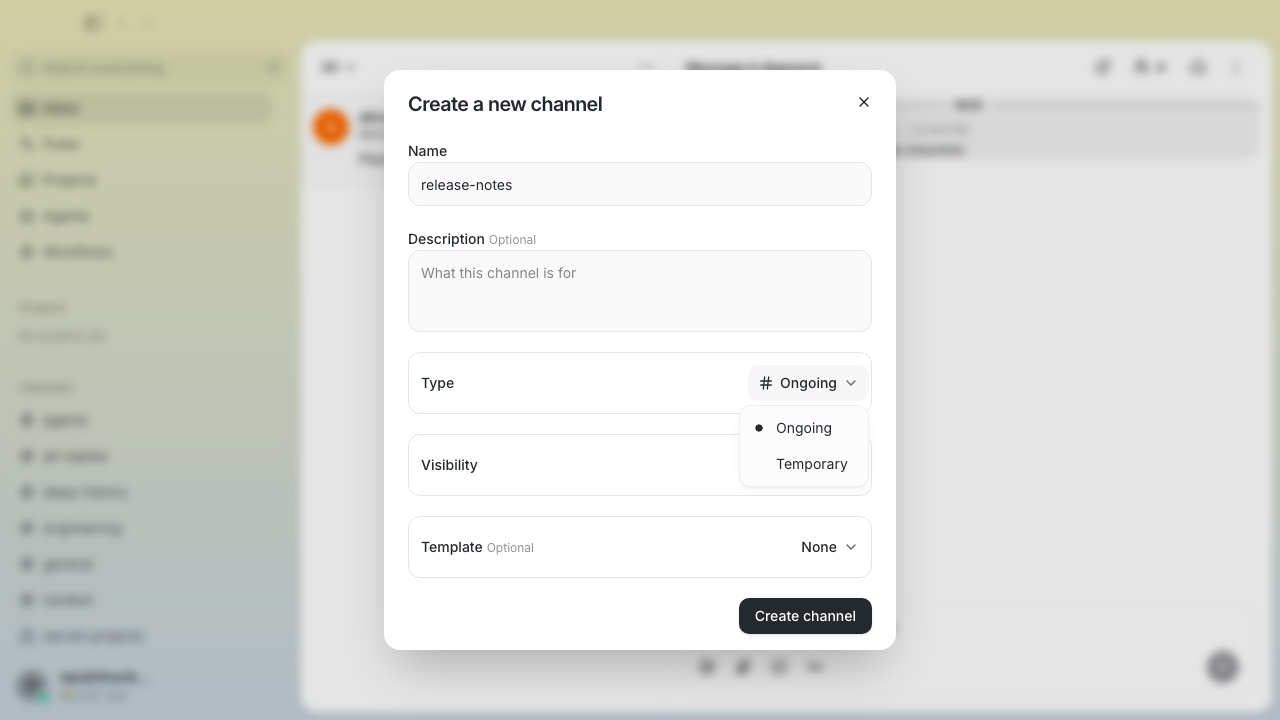 ## After Default Ongoing/Public state: 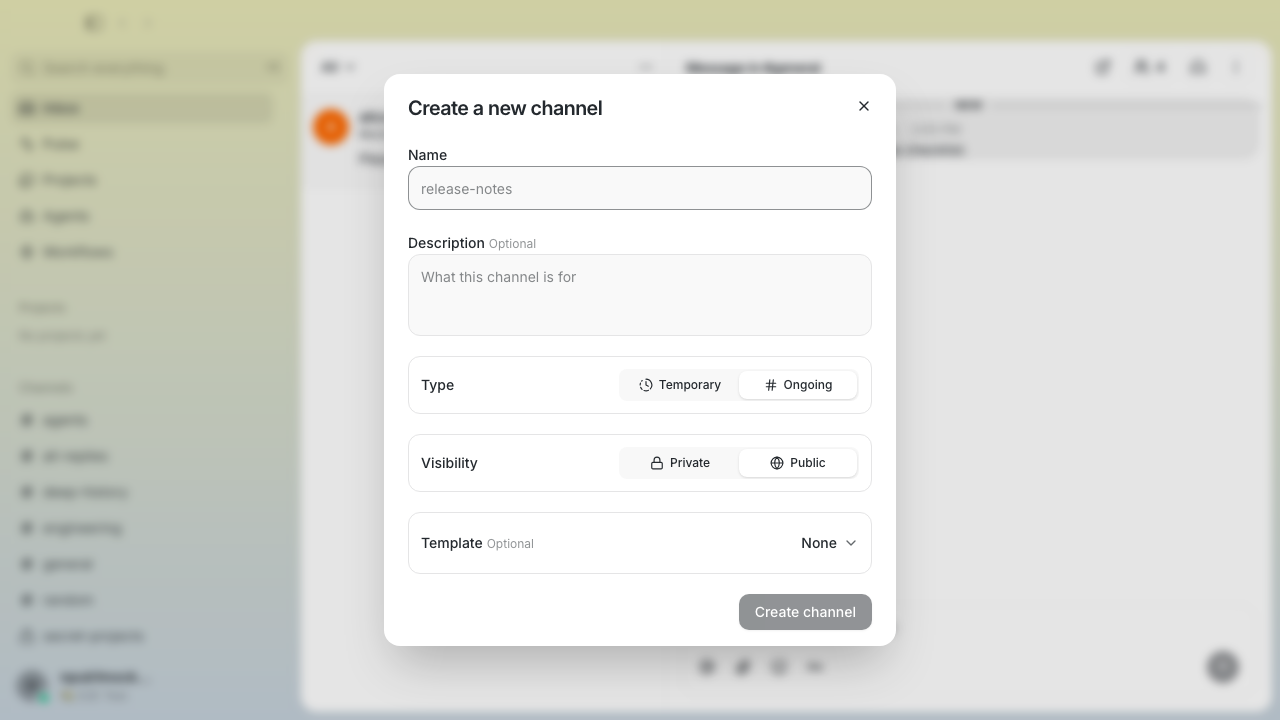 Temporary/Private state with the Expires after row visible: 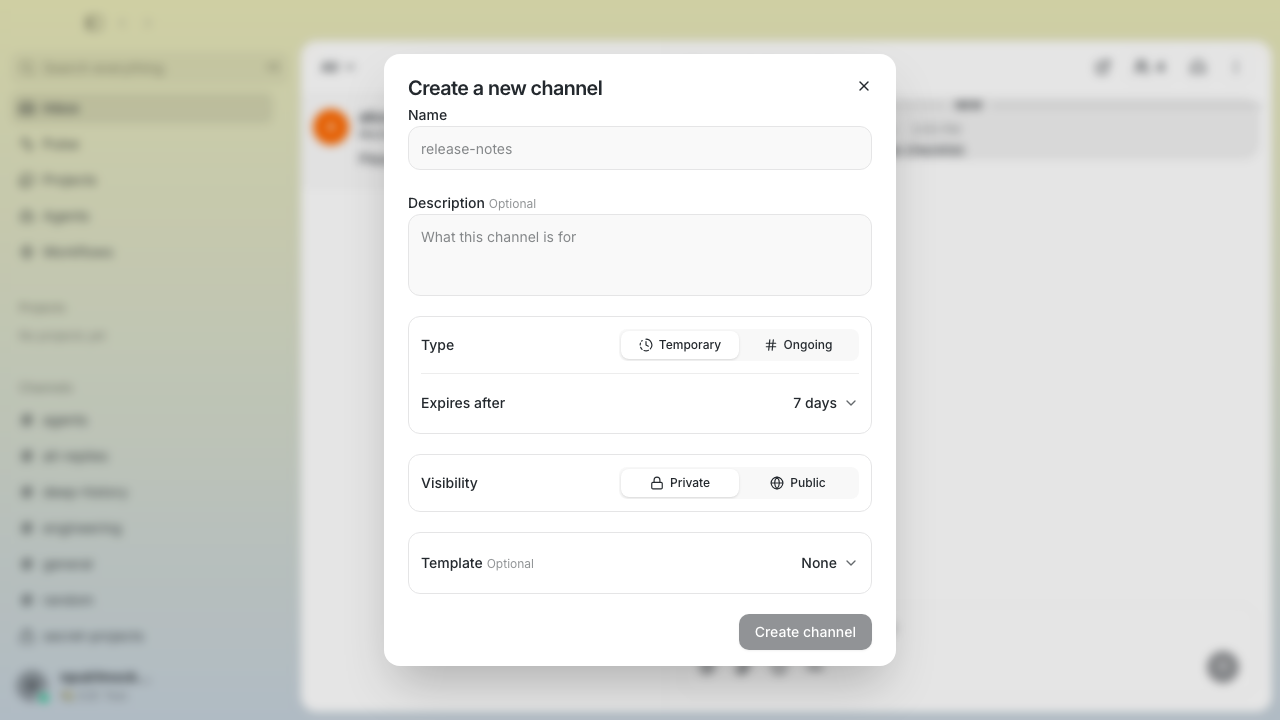 ## Verification - Biome and TypeScript checks pass - 5,508 desktop unit tests pass - 88 channel smoke tests pass - source guards pass --------- Signed-off-by: Matt Toohey <contact@matttoohey.com> Co-authored-by: Claude Fable 5 <noreply@anthropic.com>




# Conflicts:
#	.github/workflows/docker.yml
CI red — attributed, and it is not this diff
Three-way attribution:
The ratchet bases on This is a structural, recurring cost of the wholesale-sync strategy, not a defect in the merge, and it will fire again whenever upstream crosses a ratcheted threshold between two syncs. Written up: Flagging rather than resolving — whether to override, or to re-base the ratchet on the merge-base for merge commits, is the grader's call, not mine on my own PR. |
…arent

The ratchet bases on HEAD^1, which on a weekly upstream-sync merge is our
PRE-MERGE main -- so it reads ~100 upstream commits as this PR's own diff and
false-reds on desktop/src-tauri/src/commands/agent_models_tests.rs, a file with
zero lines of ours (1000 on upstream main, 964 on ours, absent from our delta).

Reproduced three times over the same merge tree, only the base changing:
  HEAD^1                 -> rc=1   (negative control: still fails when it should)
  merge-base 0720f53   -> rc=1   (holds the identical 964-line blob)
  upstream parent c3132c -> rc=0
Graded and independently derived by quinn on DIVE-3851.

resolveBaseRef reads CHECK_FILE_SIZES_BASE before the GITHUB_ACTIONS HEAD^1
branch, so this is configuration, not a change to the control's logic. Scoped to
dive-*-upstream-sync branches; every other PR gets an empty string, which is
falsy, and falls through to HEAD^1 unchanged.

Also deepens the `changes` checkout for sync branches only: the checker asserts
its base object exists (git cat-file -e) and that commit is outside a depth-2
clone. The guard there is inverted on purpose -- 0 is falsy in GitHub
expressions, so `cond && 0 || 2` would silently always yield 2.

The pinned sha is per-sync and must be updated by each weekly sync row.

Co-Authored-By: Claude Opus 5 <noreply@anthropic.com>

17 participants


Weekly wholesale upstream sync per buzz-fork-strategy-thin-fork-weekly-sync. Row: DIVE-3850.
Measurement
block/buzzmain, merge-base0720f5380(the base the 2026-08-24 sync advanced it to).5dive-ai/5dive-chatis also 100 behind off the same base — lockstep confirmed for a third measurement (57 → 121 → 100).--merge, never--squash, so the merge-base actually advances.Conflicts: 1
.github/workflows/docker.yml— upstream addedBUZZ_SOURCE_SHA/BUZZ_BUILD_ID/BUZZ_BUILD_URLbuild-args and relaxed the image push condition togithub.event_name != 'pull_request'.Resolved as upstream's build-args + our publish gate (
github.ref_type == 'tag' || github.event_name == 'workflow_dispatch'). That gate is the supply-chain control the strategy keeps forever — taking upstream's side would have started pushing images on every main commit.What upstream broke
Nothing. Our 12-file delta is unchanged and still additive:
Result: 33 ahead / 0 behind.