The ActivitySmith Node SDK provides convenient access to the ActivitySmith API from server-side JavaScript and TypeScript applications.
See API reference
npm install activitysmithimport ActivitySmith from "activitysmith";
const activitysmith = new ActivitySmith({
apiKey: process.env.ACTIVITYSMITH_API_KEY,
});CommonJS:
const ActivitySmith = require("activitysmith");

const activitysmith = new ActivitySmith({
  apiKey: process.env.ACTIVITYSMITH_API_KEY,
});
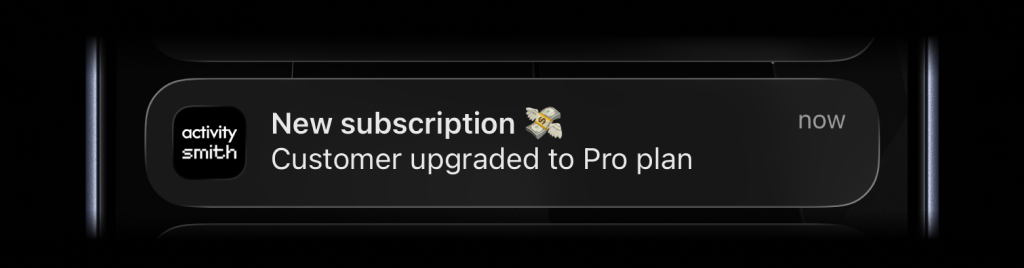
await activitysmith.notifications.send({
  title: "New subscription 💸",
  message: "Customer upgraded to Pro plan",
});
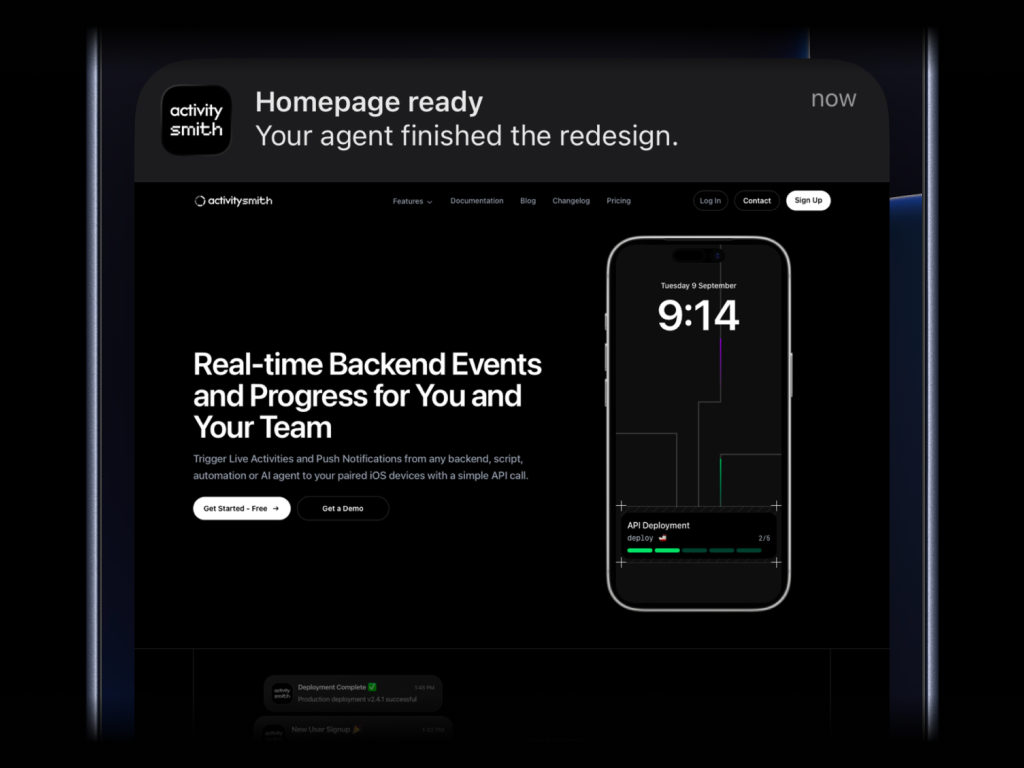
await activitysmith.notifications.send({
  title: "Homepage ready",
  message: "Your agent finished the redesign.",
  media: "https://cdn.example.com/output/homepage-v2.png",
  redirection: "https://github.com/acme/web/pull/482",
});
Send images, videos, or audio with your push notifications, press and hold to preview media directly from the notification, then tap through to open the linked content.
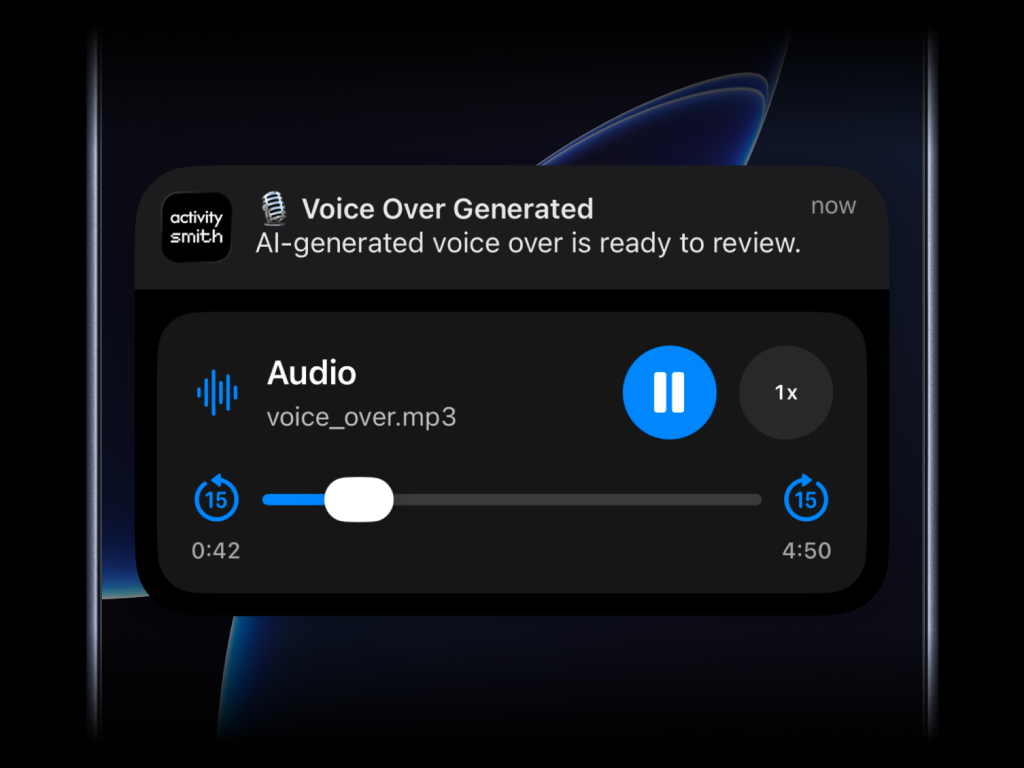
What will work:
- direct image URL:
.jpg,.png,.gif, etc. - direct audio file URL:
.mp3,.m4a, etc. - direct video file URL:
.mp4,.mov, etc. - URL that responds with a proper media
Content-Type, even if the path has no extension
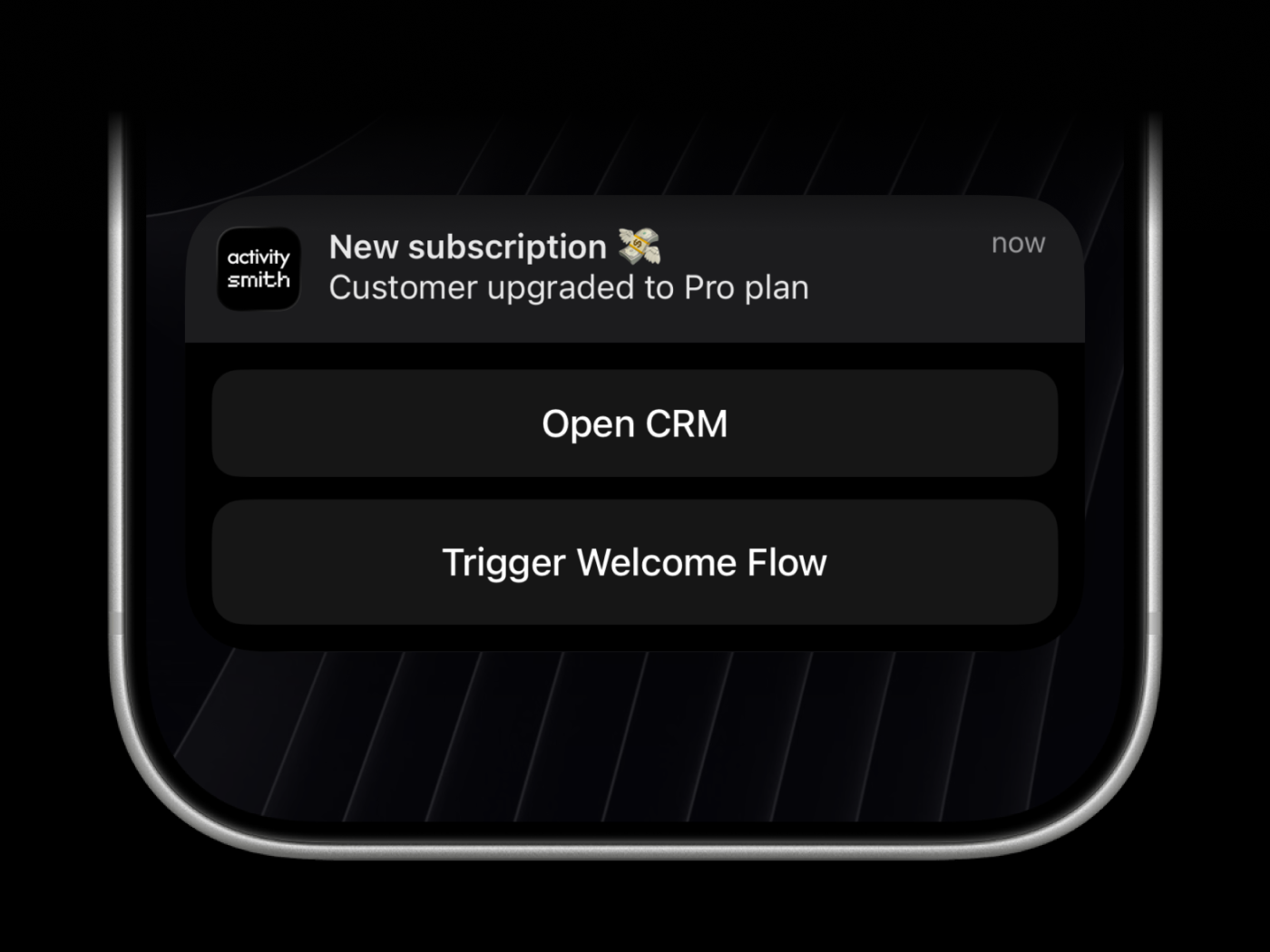
Actionable push notifications can open a URL on tap or trigger actions when someone long-presses the notification. Webhooks are executed by the ActivitySmith backend.
await activitysmith.notifications.send({
  title: "New subscription 💸",
  message: "Customer upgraded to Pro plan",
  redirection: "https://crm.example.com/customers/cus_9f3a1d", // Optional
  actions: [
    {
      title: "Open CRM Profile",
      type: "open_url",
      url: "https://crm.example.com/customers/cus_9f3a1d",
    },
    {
      title: "Start Onboarding Workflow",
      type: "webhook",
      url: "https://hooks.example.com/activitysmith/onboarding/start",
      method: "POST",
      body: {
        customer_id: "cus_9f3a1d",
        plan: "pro",
      },
    },
  ], // Optional (max 4)
});
There are four types of Live Activities:
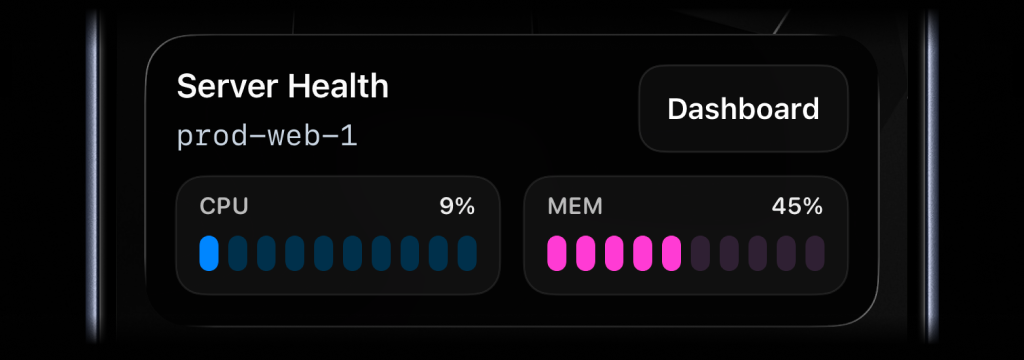
stats: best for compact business or product stats like revenue, orders, conversion, and average order valuemetrics: best for live operational stats like server CPU and memory, queue depth, or replica lagsegmented_progress: best for step-based workflows like deployments, backups, and ETL pipelinesprogress: best for continuous jobs like uploads, reindexes, and long-running migrations tracked as a percentage
When working with Live Activities via our API, you have two approaches tailored to different needs. First, the stateless mode is the simplest path - one API call can initiate or update an activity, and another ends it - no state tracking on your side.
This is ideal if you want minimal complexity, perfect for automated workflows like cron jobs.
In contrast, if you need precise lifecycle control, the classic approach offers distinct calls for start, updates, and end, giving you full control over the activity's state.
In the following sections, we'll break down how to implement each method so you can choose what fits your use case best.
Use a stable streamKey to identify the system or workflow you are tracking,
such as a server, deployment, or build pipeline.
This is especially useful for cron jobs and other scheduled tasks where you do
not want to store activity_id between runs.
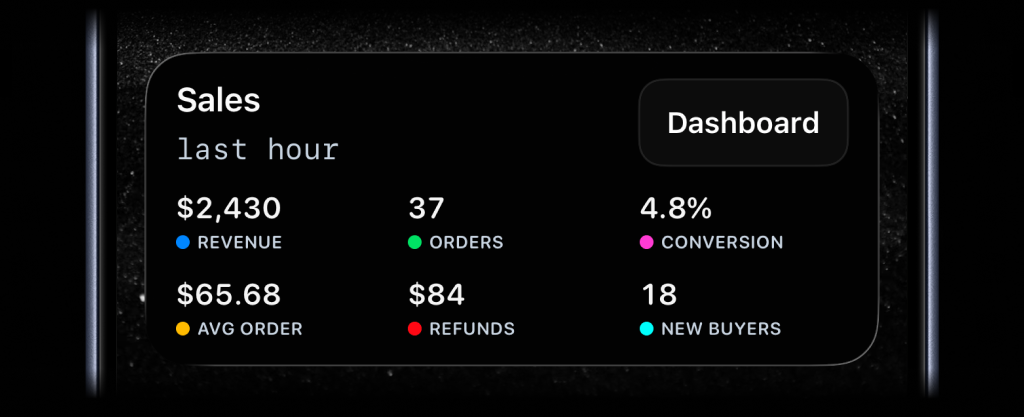
const status = await activitysmith.liveActivities.stream("sales-hourly", {
  content_state: {
    title: "Sales",
    subtitle: "last hour",
    type: "stats",
    metrics: [
      { label: "Revenue", value: "$2430", color: "blue" },
      { label: "Orders", value: "37", color: "green" },
      { label: "Conversion", value: "4.8%", color: "magenta" },
      { label: "Avg Order", value: "$65.68", color: "yellow" },
      { label: "Refunds", value: "$84", color: "red" },
      { label: "New Buyers", value: "18", color: "cyan" },
    ],
  },
});
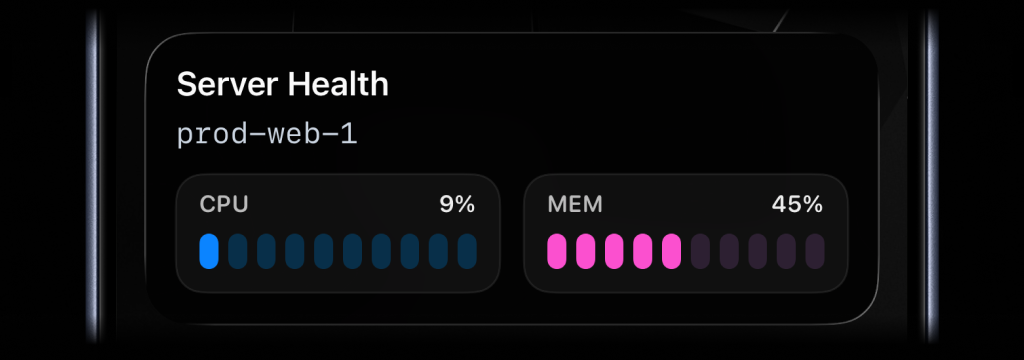
const status = await activitysmith.liveActivities.stream("prod-web-1", {
  content_state: {
    title: "Server Health",
    subtitle: "prod-web-1",
    type: "metrics",
    metrics: [
      { label: "CPU", value: 9, unit: "%" },
      { label: "MEM", value: 45, unit: "%" },
    ],
  },
});
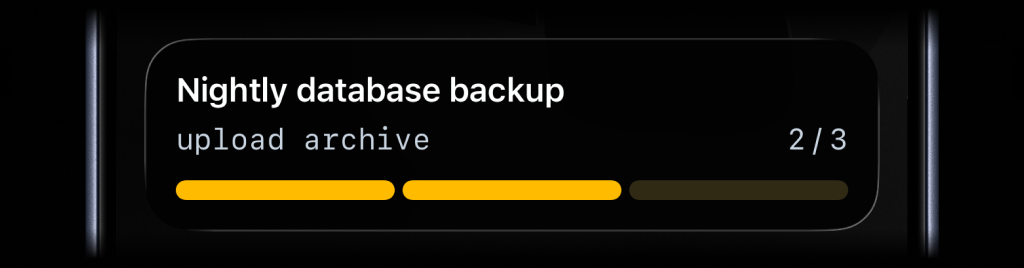
await activitysmith.liveActivities.stream("nightly-backup", {
  content_state: {
    title: "Nightly Backup",
    subtitle: "upload archive",
    type: "segmented_progress",
    number_of_steps: 3,
    current_step: 2,
  },
});
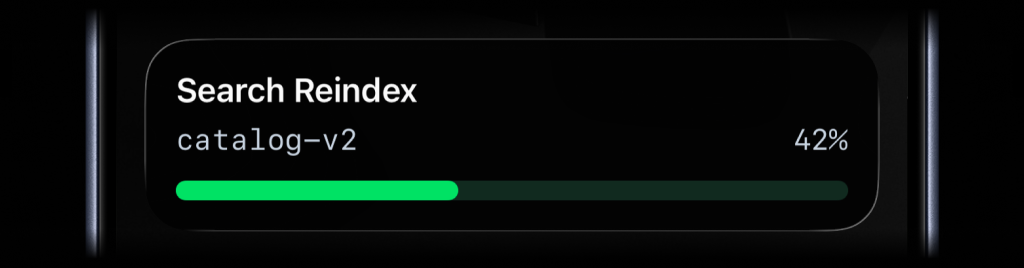
await activitysmith.liveActivities.stream("search-reindex", {
  content_state: {
    title: "Search Reindex",
    subtitle: "catalog-v2",
    type: "progress",
    percentage: 42,
  },
});
Call stream(...) again with the same streamKey whenever the state changes.
Use this when the tracked process is finished and you no longer want the Live
Activity on devices. content_state is optional here; include it if you want
to end the stream with a final state.
await activitysmith.liveActivities.endStream("prod-web-1", {
  content_state: {
    title: "Server Health",
    subtitle: "prod-web-1",
    type: "metrics",
    metrics: [
      { label: "CPU", value: 7, unit: "%" },
      { label: "MEM", value: 38, unit: "%" },
    ],
  },
});
If you later send another stream(...) request with the same streamKey,
ActivitySmith starts a new Live Activity for that stream again.
Stream responses include an operation field:
started: ActivitySmith started a new Live Activity for thisstreamKeyupdated: ActivitySmith updated the current Live Activityrotated: ActivitySmith ended the previous Live Activity and started a new onenoop: the incoming state matched the current state, so no update was sentpaused: the stream is paused, so no Live Activity was started or updatedended: returned byendStream(...)after the stream is ended
Use these methods when you want to manage the Live Activity lifecycle yourself:
- Call
activitysmith.liveActivities.start(...). - Save the returned
activity_id. - Call
activitysmith.liveActivities.update(...)as progress changes. - Call
activitysmith.liveActivities.end(...)when the work is finished.
Keep your key numbers on your Lock Screen. stats fits 1 to 8 labeled values,
such as revenue, orders, conversion, uptime, or any other business metric you
want visible at a glance. Each metric can use a formatted string or number as
its value. Add color to a metric to show an accent dot next to its label;
omit color to show the label without a dot.
const start = await activitysmith.liveActivities.start({
  content_state: {
    title: "Sales",
    subtitle: "last hour",
    type: "stats",
    metrics: [
      { label: "Revenue", value: "$2430", color: "blue" },
      { label: "Orders", value: "37", color: "green" },
      { label: "Conversion", value: "4.8%", color: "magenta" },
      { label: "Avg Order", value: "$65.68", color: "yellow" },
      { label: "Refunds", value: "$84", color: "red" },
      { label: "New Buyers", value: "18", color: "cyan" },
    ],
  },
});

const activityId = start.activity_id;await activitysmith.liveActivities.update({
activity_id: activityId,
content_state: {
title: "Sales",
subtitle: "last hour",
type: "stats",
metrics: [
{ label: "Revenue", value: "$3180", color: "blue" },
{ label: "Orders", value: "51", color: "green" },
{ label: "Conversion", value: "5.2%", color: "magenta" },
{ label: "Avg Order", value: "$62.35", color: "yellow" },
{ label: "Refunds", value: "$126", color: "red" },
{ label: "New Buyers", value: "24", color: "cyan" },
],
},
});await activitysmith.liveActivities.end({
activity_id: activityId,
content_state: {
title: "Sales",
subtitle: "last hour",
type: "stats",
metrics: [
{ label: "Revenue", value: "$3460", color: "blue" },
{ label: "Orders", value: "58", color: "green" },
{ label: "Conversion", value: "5.4%", color: "magenta" },
{ label: "Avg Order", value: "$59.66", color: "yellow" },
{ label: "Refunds", value: "$92", color: "red" },
{ label: "New Buyers", value: "31", color: "cyan" },
],
auto_dismiss_minutes: 2,
},
});Use metrics when you want to keep a small set of live stats visible, such as
server health, queue pressure, or database load.
const start = await activitysmith.liveActivities.start({
  content_state: {
    title: "Server Health",
    subtitle: "prod-web-1",
    type: "metrics",
    metrics: [
      { label: "CPU", value: 9, unit: "%" },
      { label: "MEM", value: 45, unit: "%" },
    ],
  },
});

const activityId = start.activity_id;
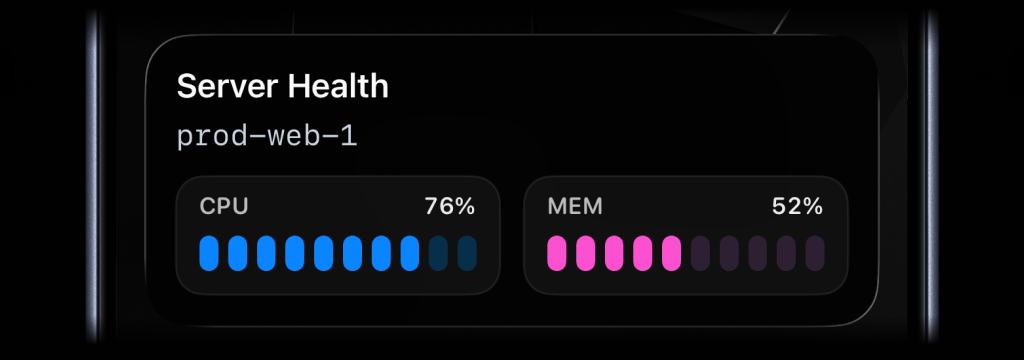
await activitysmith.liveActivities.update({
  activity_id: activityId,
  content_state: {
    title: "Server Health",
    subtitle: "prod-web-1",
    type: "metrics",
    metrics: [
      { label: "CPU", value: 76, unit: "%" },
      { label: "MEM", value: 52, unit: "%" },
    ],
  },
});
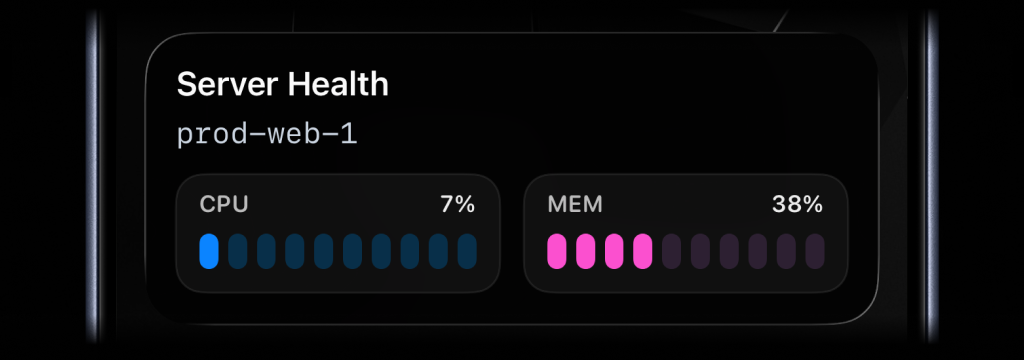
await activitysmith.liveActivities.end({
  activity_id: activityId,
  content_state: {
    title: "Server Health",
    subtitle: "prod-web-1",
    type: "metrics",
    metrics: [
      { label: "CPU", value: 7, unit: "%" },
      { label: "MEM", value: 38, unit: "%" },
    ],
    auto_dismiss_minutes: 2,
  },
});Use segmented_progress for jobs and workflows that move through clear steps or
phases. It fits jobs like backups, deployments, ETL pipelines, and checklists.
number_of_steps is dynamic, so you can increase or decrease it later if the
workflow changes.
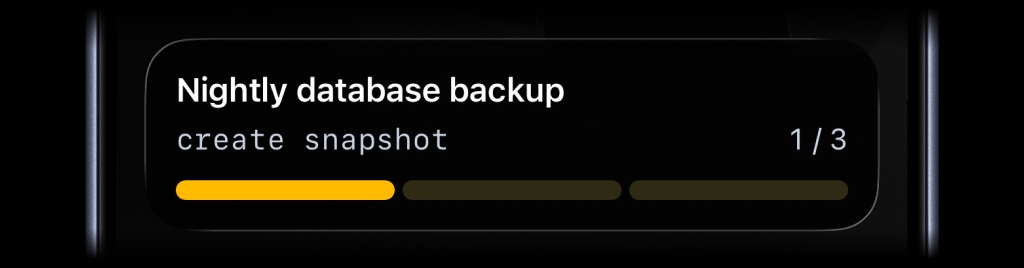
const start = await activitysmith.liveActivities.start({
  content_state: {
    title: "Nightly database backup",
    subtitle: "create snapshot",
    number_of_steps: 3,
    current_step: 1,
    type: "segmented_progress",
    color: "yellow",
  },
});

const activityId = start.activity_id;
await activitysmith.liveActivities.update({
  activity_id: activityId,
  content_state: {
    title: "Nightly database backup",
    subtitle: "upload archive",
    number_of_steps: 3,
    current_step: 2,
  },
});
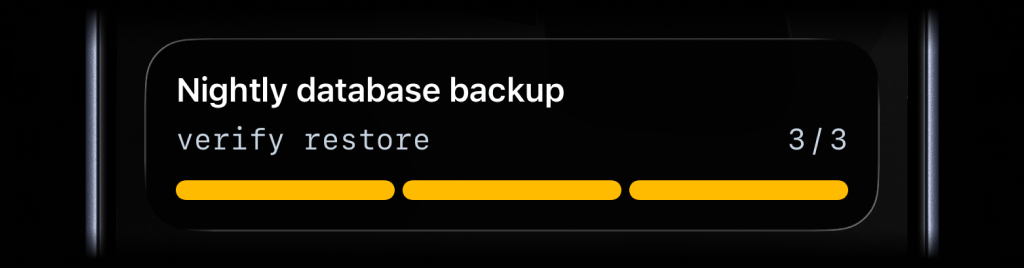
await activitysmith.liveActivities.end({
  activity_id: activityId,
  content_state: {
    title: "Nightly database backup",
    subtitle: "verify restore",
    number_of_steps: 3,
    current_step: 3,
    auto_dismiss_minutes: 2,
  },
});Use progress when the state is naturally continuous. It fits charging,
downloads, sync jobs, uploads, timers, and any flow where a percentage or
numeric range is the clearest signal.
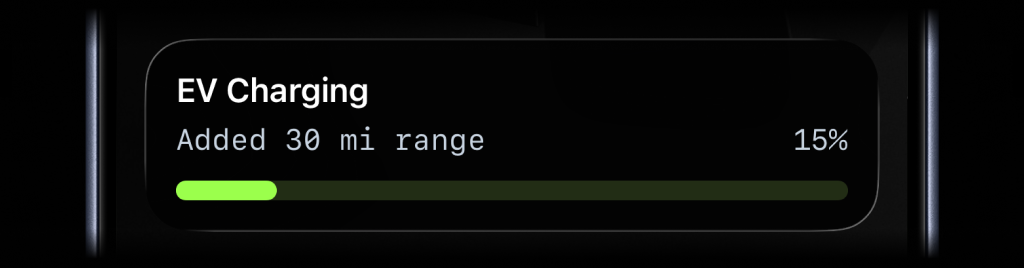
const start = await activitysmith.liveActivities.start({
  content_state: {
    title: "EV Charging",
    subtitle: "Added 30 mi range",
    type: "progress",
    percentage: 15,
    color: "lime",
  },
});

const activityId = start.activity_id;
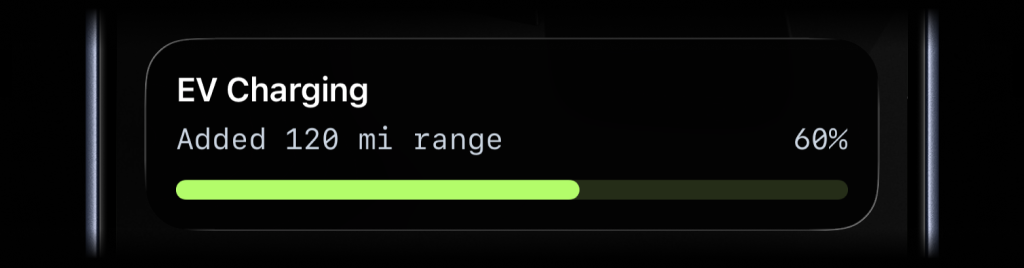
await activitysmith.liveActivities.update({
  activity_id: activityId,
  content_state: {
    title: "EV Charging",
    subtitle: "Added 120 mi range",
    percentage: 60,
  },
});
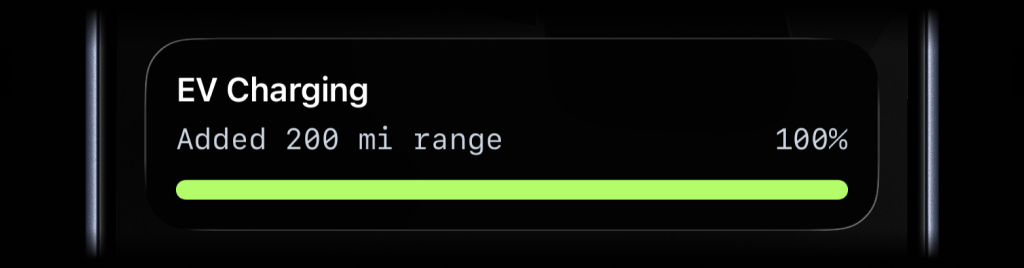
await activitysmith.liveActivities.end({
  activity_id: activityId,
  content_state: {
    title: "EV Charging",
    subtitle: "Added 200 mi range",
    percentage: 100,
    auto_dismiss_minutes: 2,
  },
});Just like Actionable Push Notifications, Live Activities can have a button that opens provided URL in a browser or triggers a webhook. Webhooks are executed by the ActivitySmith backend.
const start = await activitysmith.liveActivities.start({
  content_state: {
    title: "Server Health",
    subtitle: "prod-web-1",
    type: "metrics",
    metrics: [
      { label: "CPU", value: 76, unit: "%" },
      { label: "MEM", value: 52, unit: "%" },
    ],
  },
  action: {
    title: "Open Dashboard",
    type: "open_url",
    url: "https://ops.example.com/servers/prod-web-1",
  },
});

const activityId = start.activity_id;
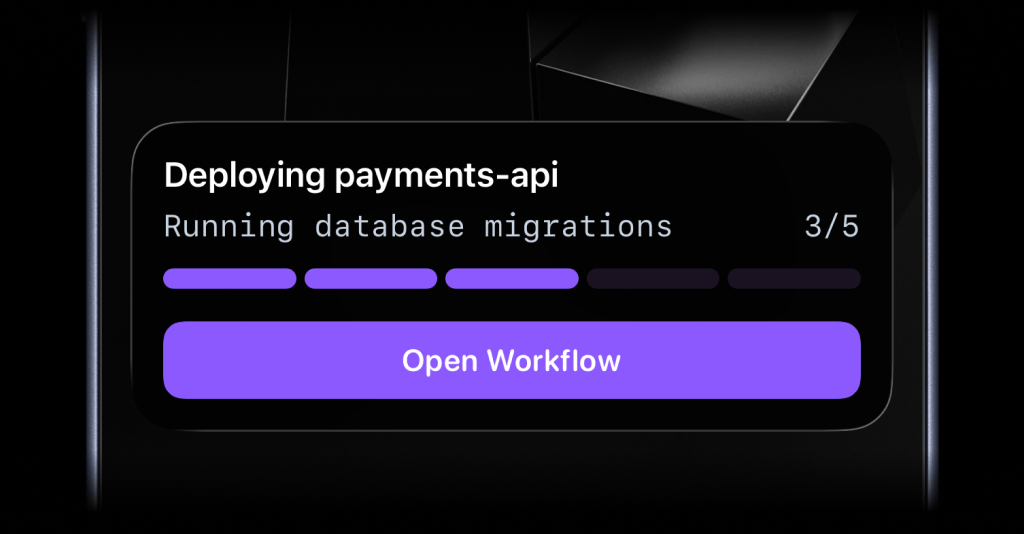
await activitysmith.liveActivities.update({
  activity_id: activityId,
  content_state: {
    title: "Reindexing product search",
    subtitle: "Shard 7 of 12",
    number_of_steps: 12,
    current_step: 7,
  },
  action: {
    title: "Pause Reindex",
    type: "webhook",
    url: "https://ops.example.com/hooks/search/reindex/pause",
    method: "POST",
    body: {
      job_id: "reindex-2026-03-19",
      requested_by: "activitysmith-node",
    },
  },
});
Channels are used to target specific team members or devices. Can be used for both push notifications and live activities.
await activitysmith.notifications.send({
  title: "New subscription 💸",
  message: "Customer upgraded to Pro plan",
  channels: ["sales", "customer-success"], // Optional
});
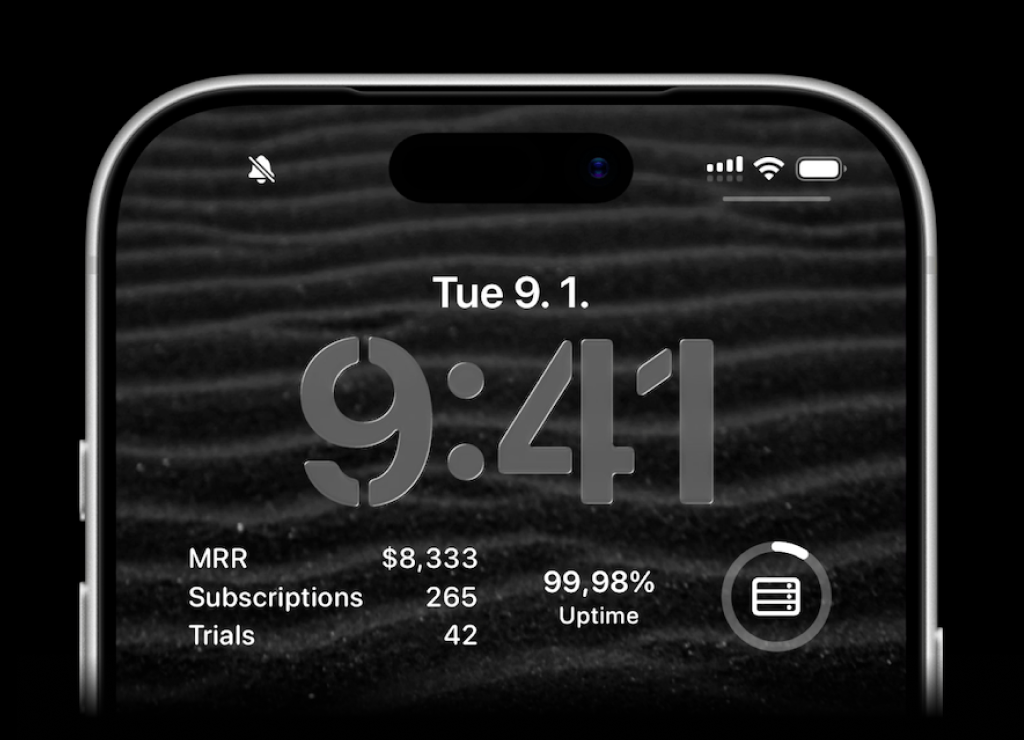
ActivitySmith lets you display any value on your Lock Screen with widgets - SaaS metrics, revenue, signups, uptime, habits, or anything else you want to track. Create a metric in the web app, then update the metric value using our API, add a widget to your lock screen and it will fetch the latest update automatically.
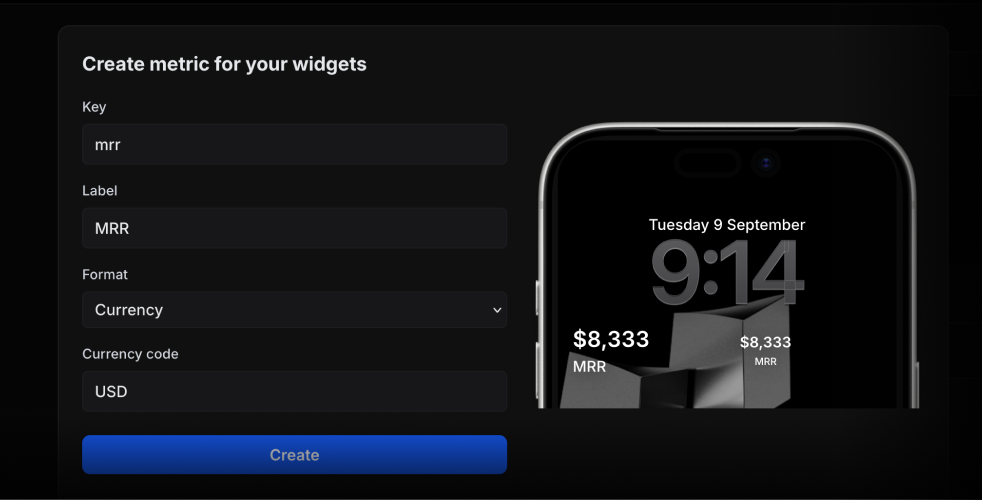
Use the metric key to update its value.
await activitysmith.metrics.update("deploy.success_rate", 99.9);String metric values work too.
await activitysmith.metrics.update("prod.status", "healthy");try {
await activitysmith.notifications.send({
title: "New subscription 💸",
});
} catch (error) {
console.error(error);
}This package is written in TypeScript and ships with type definitions out of the box.
- Node.js 18 or newer
MIT