



Quantum-assisted scientific machine learning · Computational physics · Scientific visualization

I build computational experiments that make difficult physics observable—and report what they reveal, even when the result is negative.


I'm a physics master's student at IISER Mohali. My work focuses on a practical question: how can computation help us test, visualize, and understand physical systems that resist simple intuition?
QAPINN-CFD is a controlled, multi-seed comparison of classical physics-informed neural networks and quantum-assisted PINNs for the viscous Burgers equation.
| Model | Mean relative L2 | Mean training time | Trainable parameters |
|---|---|---|---|
| Classical PINN | 0.0214 | 791 s | 50,049 |
| QAPINN · 4 qubits · depth 2 | 0.4769 | 4,237 s | 41 |
| QAPINN · 4 qubits · depth 4 | 0.4376 | 7,629 s | 65 |
Finding: the hybrid models achieved dramatic parameter reduction, but not better accuracy or wall-clock performance on PennyLane's analytic simulator. Greater circuit depth modestly improved hybrid accuracy while increasing runtime and memory. The evidence supports parameter efficiency—not quantum advantage.
Read the report · Explore the code
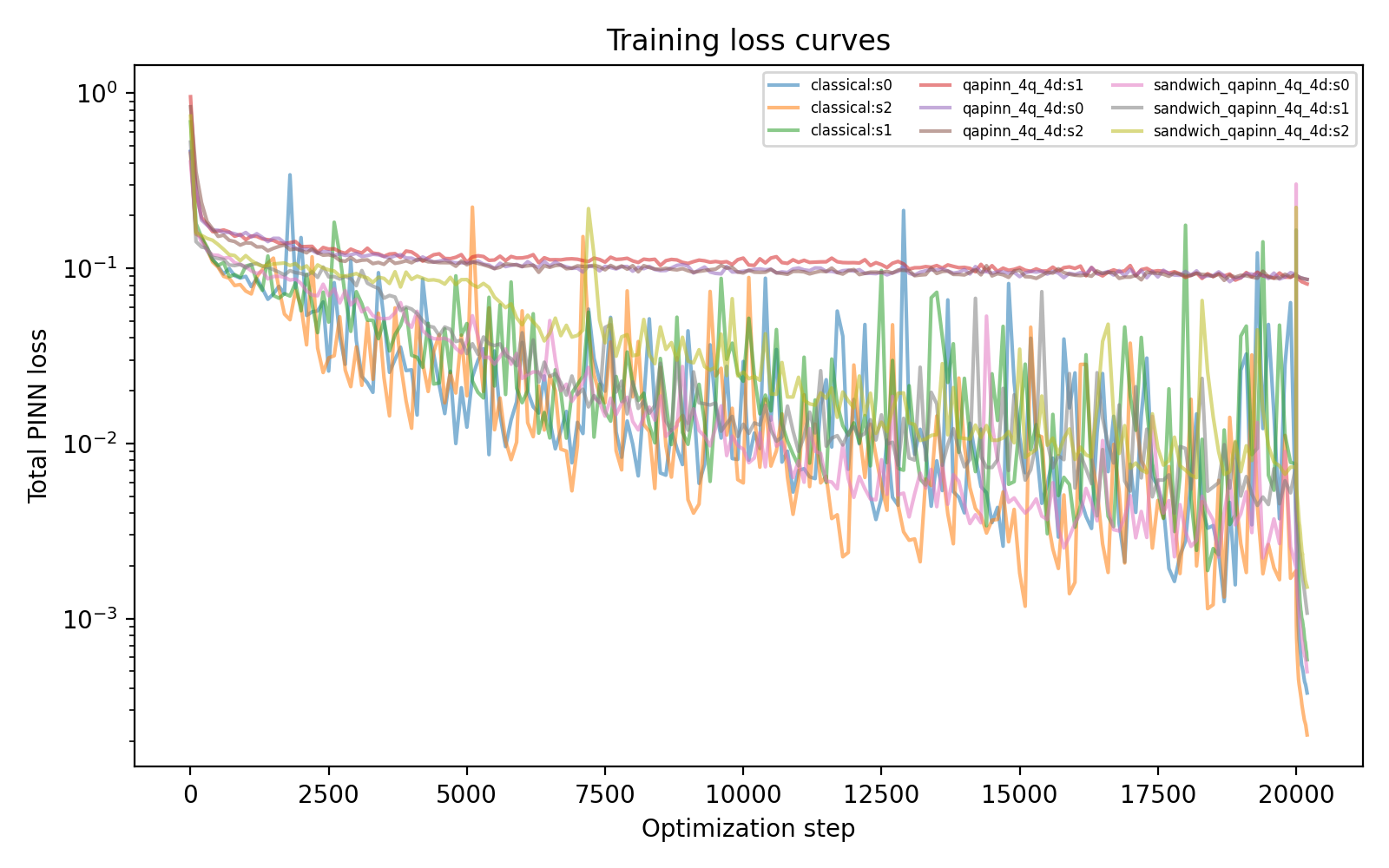
The framework uses matched sampling and loss definitions, end-to-end second-order automatic differentiation, fixed seeds, configuration-locked runs, diagnostic plots, and explicit accuracy gates. Failed or incomplete configurations remain visible rather than being filtered out after evaluation.
Real-Space Topological Invariants Visualization Suite computes the Bott index and spectral localizer for finite topological systems without relying on momentum-space or Bloch-wave methods. It is designed for disorder, open boundaries, and broken translational symmetry.
Source code → · Interactive demo →
| Project | What becomes observable | Try it |
|---|---|---|
| Quantum State Visualizer | Qubit states, gates, amplitudes, probabilities, and Bloch-sphere geometry | Live demo |
| Quantum Channel Visualization | How bit-flip, phase-flip, and depolarizing noise deform the Bloch sphere | Live demo |
| Vicsek Model Simulation | Collective motion and noise-driven ordering in active-particle systems | Live demo |
VectorHue is a browser-based design utility for IISER Mohali student clubs. It provides structure-aware asset editing, reusable presets, and high-resolution transparent exports. Try the live app →
| Area | Tools | Applied to |
|---|---|---|
| Scientific ML & quantum | Python, PyTorch, NumPy, SciPy, PennyLane, Qiskit | PINNs, PDEs, variational circuits, automatic differentiation, numerical experiments |
| Scientific visualization | JavaScript, Three.js, Plotly.js, Canvas, HTML/CSS | Interactive quantum, topology, and collective-dynamics tools |
| Reproducible research | Git, Linux, Jupyter, pytest, YAML | Multi-seed studies, configuration-locked runs, validation, and traceable results |
- 🥇 1st place, Bets & Bytes — Insomnia'24 Hackathon, building autonomous poker bots
- 🌐 Lead Developer and former Convener, Curie Club at IISER Mohali, developing its website and automating event and attendance workflows
I welcome conversations about quantum computing, scientific machine learning, computational physics, and research software. Email me or connect with me on LinkedIn.