
Important
This fork: native Windows + AMD ROCm port (FreeToken-rocm-test).
Verified end-to-end on an AMD Radeon RX 9070 XT (gfx1201 / RDNA4, 16 GB, Windows 11):
ft serve loads dense HF safetensors models, serves OpenAI-compatible chat
completions (including SSE token streaming) through Triton-on-AMD attention
kernels and hipcc/tvm-ffi JIT-compiled CUDA-C++ kernels. See
Windows ROCm port below for requirements, setup and switches.
| Download | Paper | Developer Slack | Community Discord | Community WeChat |

Unlock datacenter-class intelligence on the hardware you already own — Run 290B+ frontier MoE models locally on your gaming PC at blistering interactive speeds.
FreeToken is an edge-native Mixture-of-Experts (MoE) serving engine designed for running frontier-scale open-weight models on personal and consumer hardware. It treats heterogeneous edge resources—GPUs, CPUs, host memory, and interconnects—as a unified, elastic inference platform. Its core features include:
-
Fast Edge-Native Runtime: Provides efficient MoE serving with bandwidth-adaptive CPU–GPU co-execution (
$q^\star$ policy), full-layer double-buffered prefill streaming, global LRU expert caching, graph-compatible execution, and the FTW fast weight format. - Semantic-Aware Caching: Features semantic anchor checkpoints for recurrent state and KV caches, allowing agentic context edits (e.g., tool calls, thinking blocks) to avoid redundant context recomputation.
- Elastic Memory Management: Supports dynamic, runtime VRAM re-allocation between expert caches and KV memory without engine restarts or weight reloading.
- Broad MoE & Ecosystem Support: Supports frontier open-weight MoE models (e.g., DeepSeek-V4-Flash, Qwen3.6-35B-A3B, GLM-5.2) across various parameter scales and quantization formats (e.g., MXFP4, NVFP4, FP8, BF16), with Anthropic/OpenAI-compatible APIs for seamless integration with real-world coding and tool-calling agents (e.g., Codex, Claude Code, OpenCode, OpenClaw, DeepSeek Harness).
- Diverse Consumer Hardware: Scales across consumer laptops, gaming desktops, and workstation GPUs, with native support for NVIDIA RTX 30, RTX 40, and RTX 50 series GPUs.
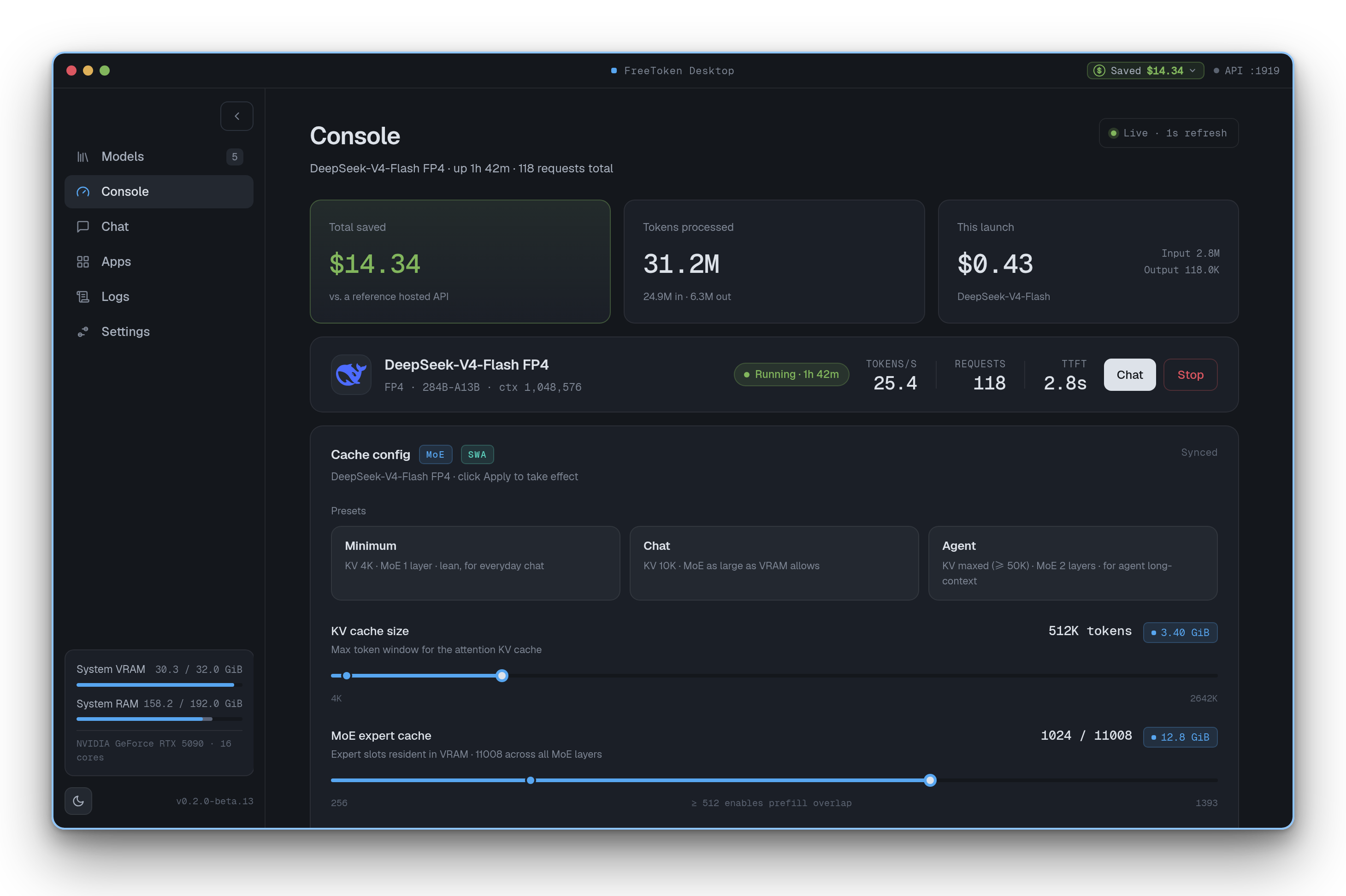
Download FreeToken for Windows or Linux at flashml.ai. It sets the engine up for you and gives you a GUI for running models, chatting, and tuning the engine.
Install FreeToken with uv (recommended) or pip:
uv pip install "freetoken[accel]"Or build from source:
git clone https://github.com/FlashML-org/FreeToken.git && cd FreeToken
uv venv && source .venv/bin/activate
uv pip install -e ".[accel]"
For More details:
This fork brings FreeToken up on Windows 11 + AMD ROCm with no NVIDIA toolchain.
Bring-up target: RX 9070 XT (gfx1201). Everything below was verified live: model load,
prefill, decode (~57 tok/s bf16 3B), SSE token streaming, and the bundled mini web UI.
| Model | Precision | Fit | Decode speed | Notes |
|---|---|---|---|---|
| Qwen2.5-3B-Instruct | BF16 | full VRAM | ~72 tok/s | stable, coherent; SSE first-token ~0.4 s |
| Qwen2.5-7B-Instruct | BF16 | --num-pages 4096 |
~16 tok/s | weights leave only ~1.5 GB headroom |
| gpt-oss-20b (MoE) | MXFP4 experts | --moe-backend fused --num-pages 4096 --cuda-graph-max-bs 0 |
~12 tok/s | stable in eager mode; see graph bug below |
| gpt-oss GGUF files | Q8_0 | - | - | rejected: GGUF loader supports gemma4 arch only |
Decode is memory-bandwidth-bound: BF16 3B moves ~6 GB/token against ~640 GB/s, so ~72 tok/s is near ceiling for this precision on one card. Quantized GGUF support (planned adapters) is the main lever for large-model speed.
mxfp4_splitk_gemv / swiglu Triton kernels run correctly eagerly but crash the
worker when executed via CUDA-graph replay on gfx1201 (dense models' graphs are
unaffected). Workaround until fixed upstream: --cuda-graph-max-bs 0 on MoE
models. The offload backend additionally fails at capture time (PAL failed to finalize a command buffer), so use --moe-backend fused on Windows for now.
A ready-made distribution kit lives in dist/ and PORT_REQUIREMENTS.md:
# once: clone + install deps, patches and freetoken
git clone https://github.com/Maxritz/FreeToken-rocm-test.git
cd FreeToken-rocm-test
powershell -ExecutionPolicy Bypass -File dist/install.ps1

# every session: engine + web UI
powershell -File dist/run-server.ps1 -Model <path-to-model>
# then open http://localhost:1420   (stop: dist/stop-server.ps1)
A fully portable bundle (embeddable Python + wheels, no clone needed) can be built with
dist/make-bundle.ps1; users then run its bundled install.ps1 instead.
- Windows 11, Python 3.12, VS Build Tools (for
vcvarsall.bat+ MSVC CRT link libs) - AMD ROCm runtime - TheRock nightly (
10.1.0a20260817, HIP 7.16) until ROCm 10.1 ships formally; setHIP_PATH=<your-rocm-root> - Wheels fetched from https://rocm.nightlies.amd.com/whl-multi-arch/
- Pip stack: torch
2.15.0a0+rocm10.1.0a20260816+amd-torch-device-gfx1201(install with--no-deps),triton-windows >= 3.7.1.post27,apache-tvm-ffi == 0.1.13.post3 - Install FreeToken itself without CUDA extensions:
$env:FREETOKEN_SKIP_CUDA_EXT = "1"
pip install -e <path-to-this-repo> --no-deps --no-build-isolation| Switch | Example value | Purpose |
|---|---|---|
HIP_PATH |
<rocm-root> |
locates hipcc, HIP libs for JIT builds and linking |
TRITON_OVERRIDE_ARCH |
gfx1201 |
forces Triton codegen target |
TVM_FFI_ROCM_ARCH_LIST |
gfx1201 |
tvm-ffi emits --offload-arch=<arch> (else gfx906 default -> broken kernels) |
ROCM_SDK_TARGET_FAMILY |
gfx1201 |
device family for the rocm-sdk wheel runtime (nightly-only) |
CC |
<rocm-root>\lib\llvm\bin\clang.EXE |
host compiler for JIT extensions |
FREETOKEN_SKIP_CUDA_EXT |
1 |
build-time: install without nvcc/CUDA extensions |
--num-pages N |
e.g. 4096 |
caps KV cache pages so large dense models fit in VRAM |
Launch recipe (what dist/run-server.ps1 does):
call "<vs>\VC\Auxiliary\Build\vcvarsall.bat" x64
set HIP_PATH=<rocm-root>
set TVM_FFI_ROCM_ARCH_LIST=gfx1201
set TRITON_OVERRIDE_ARCH=gfx1201
ft serve --model <model_path>
vcvarsall is required so the linker finds the MSVC CRT when producing JIT DLLs.
Three upstream packages need small patches until merged upstream - applied automatically
by dist/patch_upstream.py, documented in DIAGNOSTICS.md:
- tvm_ffi/cpp/extension.py - on Windows+HIP: use
hipccflags (no-fPIC, no MSVC-style-Xcompilerargs), emit--offload-arch, linkamdhip64.lib, and build host C++ with HIPclang++instead ofcl.exe(MSVC rejects theRuntimeCheckpack+default-arg idiom). - triton/backends/amd/compiler.py - add
launch_pdl: bool = FalsetoHIPOptionsso NVIDIA-only launch kwargs are accepted-and-ignored. - uvicorn/loops/asyncio.py - return
SelectorEventLoop(notProactorEventLoop) on win32;zmq.asynciorequiresadd_reader.
Engine-side patches included in this fork: HIP compat shim for CUDA-flavored kernel
headers (hip_compat.cuh), PTX inline-asm gated to NVIDIA with libdevice fallbacks,
WMMA-safe BLOCK_H padding in the grouped attention kernel, TCP loopback ZMQ
addresses with deterministic ports, Windows selector event-loop policy,
graceful CUDA-extension skipping, and a webui/ one-file chat client.
This fork runs natively on Windows 11 against an AMD Radeon RX 9070 XT (gfx1201,
RDNA4) using TheRock nightly ROCm runtime (HIP_PATH, TVM_FFI_ROCM_ARCH_LIST,
TRITON_OVERRIDE_ARCH=gfx1201, MSVC vcvars). Measured so far:
Qwen2.5-3B BF16 ~72 tok/s, Qwen2.5-7B BF16 ~15.8 tok/s, gpt-oss-20b fused-MoE
~12.2 tok/s (RDNA4 graph-replay MoE crash worked around via eager mode).
Current effort: packed GGUF loading for llama.cpp quant types — weights stay quantized in VRAM (no bf16 expansion). Approach and state:
- Vendored llama.cpp quant kernels (dequant/GEMV/MMQ/MoE) already cover all
classic, K-quant, and IQ types; the bottleneck was Python-side dispatch sets
in
layers/gguf.py, since widened (MMVQ = all kernel-covered types, MMQ = classic+K, chunked-GEMV fallback for IQ at prefill batch sizes). models/gguf/dense.pyrewritten: header-only type scan, packed.qweightemission, per-layer-correct module construction (real Q4_K_M files mix Q4_K/Q6_K per layer), fused groups load as per-slot splits when fully quantized.- Full 24-type tables in
models/gguf/dequant.py, verified against gguf-pyGGML_QUANT_SIZES; plus MXFP4 and ROCmFPX (types 100–108) dequant support. - Adapter hooks wired into llama / qwen2 / mistral / qwen3 families; static validation passes against a real Mistral-7B Q4_K_M checkpoint.
- Remaining: first GPU end-to-end run of the GGUF path. The vendored kernel is
built at runtime by PyTorch's JIT extension builder, whose Windows/HIP
toolchain assumptions are the current source of friction (nvcc-only flags,
hipcc wrapper arg-mangling); fixes land in
kernel/gguf.py, with a direct clang or hipRTC-based loader as fallback options. - Known RDNA4 issues parked upstream: Triton wave64 cross-lane reduction bug; Triton MXFP4 MoE crash under CUDA-graph replay.
If you use FreeToken for your research, please cite our paper:
@article{yang2026freetoken,
  title={FreeToken: Efficient Edge-Native MoE Serving with Bandwidth-Adaptive Execution},
  author={Yang, Shuo and Fan, Xiaoze and Pan, Melissa and Xi, Haocheng and Wang, Zhe and Sun, Shanlin and Keutzer, Kurt and Han, Song and Zaharia, Matei and Xu, Chenfeng and Stoica, Ion},
  journal={arXiv preprint arXiv:2608.16157},
  year={2026}
}FreeToken was deeply inspired by mini-sglang, and learned the design and reused code from the following projects: SGLang, vLLM, FlashInfer, flash-linear-attention, LightLLM and llama.cpp.