
Open-source, self-hosted web .docx editor with real-time co-editing — a Google Docs / Word Online / OnlyOffice alternative you run on your own server.



Live Demo → · Docker Hub → · Architecture →
The hosted demo is single-user (try the editor). Real-time co-editing runs in the Docker image — one container, share a link, edit together.
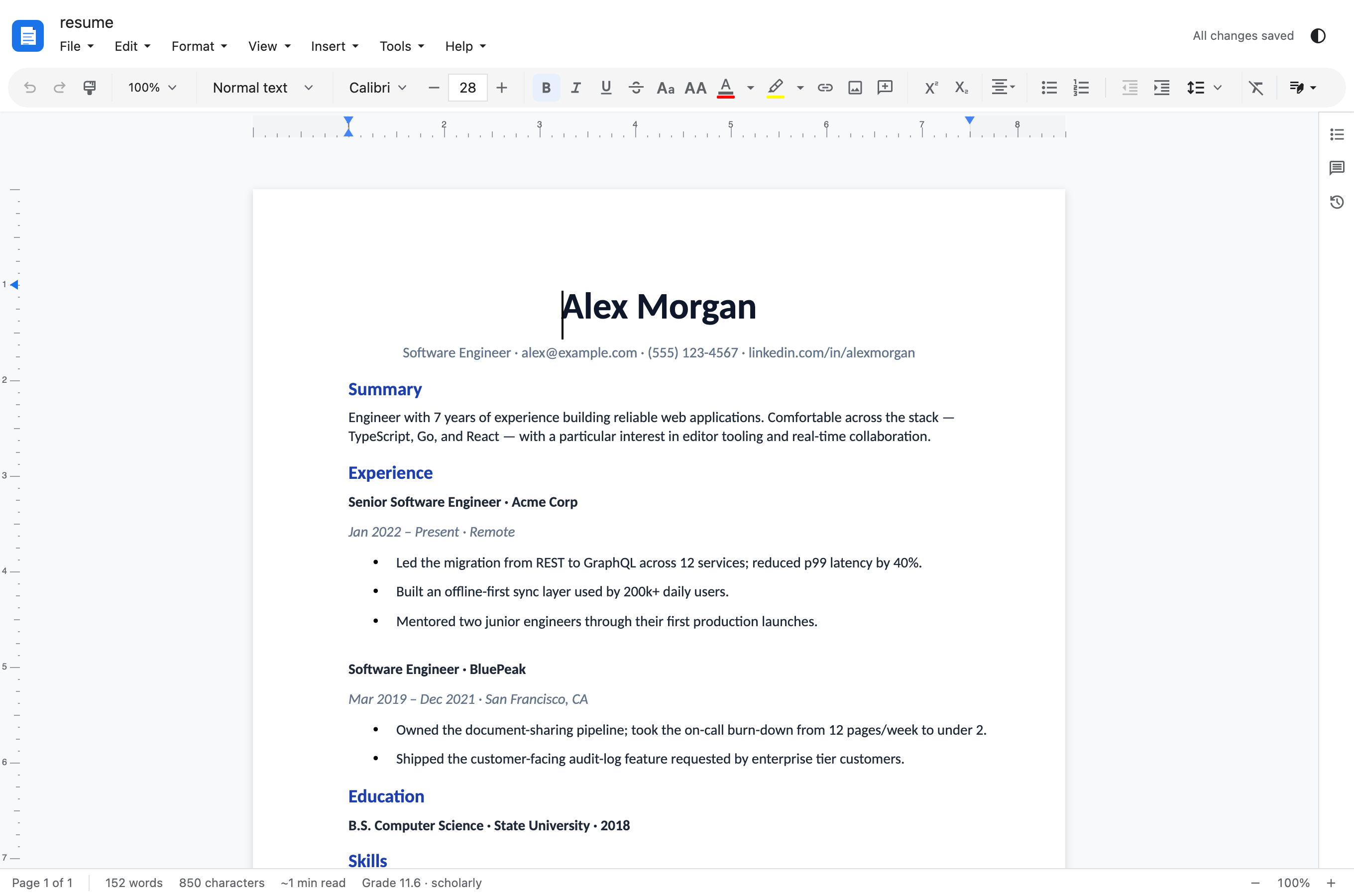
Casual Docs is a self-hostable, browser-based .docx editor that looks and behaves like Microsoft Word — ribbon-style toolbar, paginated WYSIWYG layout, file-centric workflow — with real-time multi-user co-editing built in. Upload a .docx, share a link, edit together instantly. No accounts, no Microsoft / Google login, no lock-in. One Docker container, a stateless Go gateway (~120 LOC of y-websocket protocol), in-memory rooms.
Sister projects: Casual Sheets (.xlsx) and Casual Slides (.pptx).
Core editing — a full Word-style writing surface
- Paragraphs, runs, tables (borders, shading, merged cells, header rows, table styles), lists (multi-level bullet/numbered), hyperlinks, footnotes/endnotes
- Full character formatting — bold/italic/underline (styled + colored), strike, super/subscript, small/all caps, character spacing, RTL/LTR; paragraph + character styles with inheritance
- Find & Replace (match-case / whole-word / regex), command palette (Ctrl+Shift+P), canonical Word keyboard shortcuts
- Writing aids — spell check (Hunspell), autocorrect + smart quotes, translate-selection, dictionary/explore lookup, citations, voice typing, document outline, live word/character/reading-time counts
- Autosave + restore (IndexedDB), recent files, Print / Export-as-PDF with page setup
Word compatibility — OOXML fidelity, not a lossy import
- Paginated WYSIWYG — true page breaks, headers/footers, page numbers, multi-column sections
- Full WordprocessingML core + DrawingML rendering: pictures, shapes, textboxes (modern + VML),
wpg:wgpgroups with per-child positioning/rotation, behind-text anchoring, math equations - Comments & tracked changes, theme colors/fonts, the style inheritance chain
- Tag-level round-trip audit (
roundtrip-audit.mjs) parses → re-serializes → diffsdocument.xml; each fidelity fix is pinned by a unit test and (where visible) an e2e/visual-fidelity spec against a LibreOffice reference
Collaboration — real-time, in the Docker image
- Share dialog — File → Share: get an edit URL and a view-only URL
- Presence avatars + live cursors (each peer's selection in their color, name-labeled)
- Full mutation sync — text, formatting, lists, tables, images, comments, headers/footers propagate cross-peer; view-only enforced at the Y.Doc layer
- Lightweight password-protected rooms for link sharing (constant-time compare on the WS upgrade). This is sharing-grade protection, not an identity system — for production auth, integrate through the WOPI / JWT-API host interface
- Stateless backend — no DB, no on-disk log; rooms live in memory, persistence delegated to the host (inline, WOPI, or JWT-API)
File formats — open & save round-trip
| Format | Open | Save / Export | Path |
|---|---|---|---|
.docx |
✅ | ✅ | native parser + serializer |
.odt |
✅ | ✅ | @casualoffice/core WASM worker (lazy) |
.md |
✅ | ✅ | @casualoffice/core WASM worker (lazy) |
.txt |
✅ | ✅ | @casualoffice/core WASM worker (lazy) |
| — | ✅ | browser print pipeline (Save as PDF) |
Non-DOCX formats convert to/from DOCX bytes in a Web Worker (Rust + WASM); the ~3.3 MB artifact is lazy-loaded so the initial bundle stays slim.
Developer & self-hosting — embeddable, extensible, one container
<DocxEditor>React component (@casualoffice/docs) + an extension system for custom nodes/marks/menus- i18n — translatable toolbar/dialog strings with a CI-enforced, auto-derived
LocaleStringstype - Single multi-arch Docker image (
linux/amd64+linux/arm64): editor SPA + Go gateway in one container behind one port - Material-Symbols icons bundled as SVGs (no font fetch)
See docs/ARCHITECTURE.md for the full design.
A single multi-arch image. Editor SPA and Go gateway run in one container behind a single port.
docker run --rm -p 8080:8080 casualoffice/docs:latestOpen http://localhost:8080. Upload a .docx, click Share, send the link.
services:
  app:
    image: casualoffice/docs:latest
    restart: unless-stopped
    ports: ['8080:8080']
    environment:
      GATEWAY_ADDR: ':8080'
ROOM_TTL_MIN: '15'- Open
http://localhost:8080. Upload a.docx, then File → Share for co-editing… to set a password and get two URLs. - Paste either URL into another browser or device — the joiner connects in under a second.
- Type — peers see characters appear in real time, with named cursors tracking selection.
| Method | Path | Description |
|---|---|---|
GET |
/ |
Serves the built editor SPA |
GET |
/d/:docId |
Same SPA; bridges into the named Y.Doc |
POST |
/api/docs |
Upload a .docx — returns {docId} |
GET |
/api/docs/:id/download |
Download the latest snapshot as .docx |
GET |
/health |
Liveness probe |
WS |
/doc/:docId |
y-websocket sync; ?p=<password> |
| Env var | Scope | Default | Description |
|---|---|---|---|
GATEWAY_ADDR |
server | :8080 |
HTTP + WebSocket listen address |
STATIC_DIR |
server | /srv/static |
Where the editor SPA is served from |
ROOM_TTL_MIN |
server | 15 |
Minutes a room stays alive after the last client leaves |
MAX_UPLOAD_MB |
server | 25 |
Upload cap for .docx |
HOST_INTEGRATION |
server | inline |
inline, wopi, or jwtapi |
VITE_COLLAB_ENABLED |
build | true in image |
Include co-edit code in the bundle |
Prerequisites: Bun ≥ 1.3.14, Go ≥ 1.25
# Editor (browser side)
cd docx-editor
bun install
bun run dev               # Vite dev server  →  http://localhost:5173
bun run typecheck         # tsc across all packages
bun test                  # unit tests
bun run test:e2e          # Playwright suite (Chromium)
bun run build             # build core + react libs

# Gateway (Go server)
cd backend
go vet ./...
go test -race ./...
go run ./cmd/gateway      # listens on :8080
Co-editing in dev requires both servers running. Open the Vite dev server, upload a doc, click Share — the editor proxies the y-websocket connection to :8080 automatically.
.
├── docx-editor/                  # Editor (browser side)
│   ├── packages/core/            # DOCX parser, serializer, layout engine, ProseMirror schema
│   ├── packages/react/           # React <DocxEditor> component (@casualoffice/docs)
│   ├── examples/vite/            # Demo app deployed at docs.casualoffice.org
│   └── e2e/                      # Playwright suite
├── backend/                      # Go gateway (this repo)
│   ├── cmd/gateway/              # Entry point, REST + WS handlers
│   └── internal/
│       ├── host/                 # host.Integration interface + impls (inline / wopi / jwtapi)
│       ├── room/                 # Per-docId room manager (in-memory Y.Doc lifecycle)
│       └── yws/                  # y-websocket protocol helpers
├── docs/                         # Architecture, co-editing, deployment, round-trip
├── Dockerfile                    # Multi-stage build (web → gateway → runtime)
└── docker-compose.yml            # Local dev stack
| Concern | Choice |
|---|---|
| Editor model | ProseMirror schema preserving OOXML round-trip |
| Layout | Custom paginated layout-painter (Word-fidelity output) |
| Frontend | React 18 + Vite + TypeScript (strict) |
| Collab transport | Yjs (CRDT) + y-prosemirror over y-websocket |
| Backend | Go 1.25 — stateless gateway, in-memory Y.Doc per room |
| Persistence | Delegated to host (inline, WOPI, or JWT-API) |
| E2E tests | Playwright (Chromium) |
| Editor toolchain | Bun |
- No database on the gateway — sessions are in-memory; persistence is the host's job. The gateway dies cleanly and restarts cleanly.
- No AI / LLM features — the editor is a pure document tool. Wire your own model in via the extension system if you need one.
- No mobile editor — desktop browsers only. The shell is responsive to 768 px, but the paginated editing UX assumes a pointer device.
The editor under docx-editor/ is a fork of eigenpal/docx-editor (MIT). The fork's modifications, the Go gateway, and this repository are Apache-2.0. The AGPL @eigenpal/docx-editor-agents package was removed; only MIT code remains in the editor tree.
Apache-2.0 for this repository — the Go gateway, Dockerfile, docker-compose, CI workflows, and project docs. See LICENSE and NOTICE.
The editor under docx-editor/ is based on eigenpal/docx-editor and remains under its original MIT terms — see docx-editor/LICENSE. Apache-2.0 + MIT are compatible; the combined work is distributed under Apache-2.0 with MIT attribution preserved.