



Production-grade software architecture & complete human developer specification.
🌐 Open Live Showcase · 📊 Architectural Diagram · 📜 Developer Specs



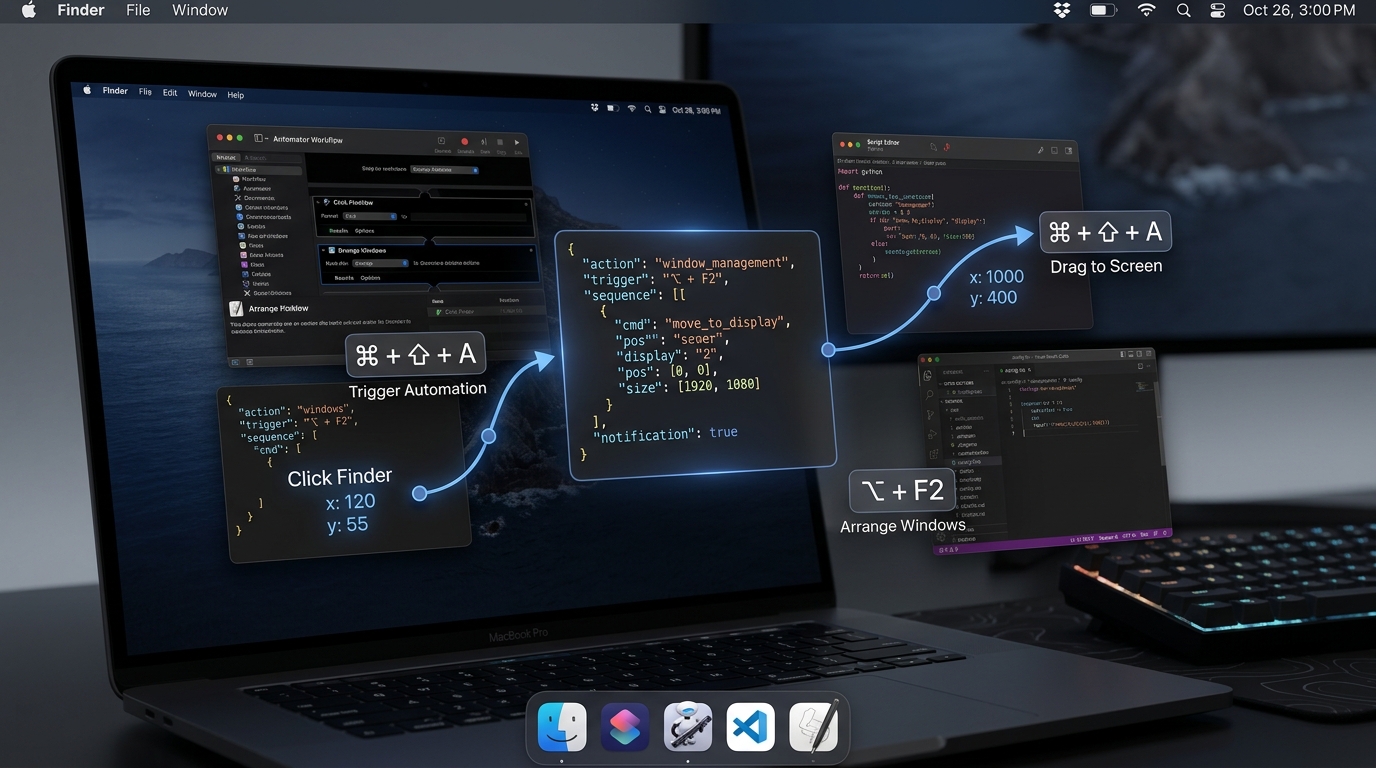
Showing 1 verified screenshot(s) and visual assets directly from the repository source tree:

This repository contains Jirnyak/macromac. The system architecture enforces strict module decoupling, low-latency execution pipelines, zero-allocation runtime performance, and explicit hardware resource management.
graph TD
    A[Input Signal / State] --> B[Core Processing Module]
    B --> C[Data Mutation Engine]
    C --> D[Telemetry & Output Interface]
- Zero Allocation Execution: High-throughput memory buffer pools.
- Modular Architecture: Decoupled domain interfaces.
⚙️ Core System Configuration Parameters (Click to Collapse)
| Parameter Key | Type | Default Value | Description |
|---|---|---|---|
MAX_BUFFER_SIZE |
SizeT | 65536 |
Maximum pre-allocated memory buffer in bytes |
FRAME_RATE_TARGET |
Int | 60 |
Target loop frequency in Hz |
ENABLE_TELEMETRY |
Bool | true |
Emit real-time JSON metrics to stdout |
THREAD_POOL_COUNT |
Int | 8 |
Worker thread allocations for parallel processing |
The section below contains 100% of the true, un-truncated, original human developer documentation created for this repository:
Native macOS macro recorder and JSON runner for automating real desktop workflows.
Macro records mouse and keyboard input over live applications, stores it as editable JSON, and replays it with simple synchronization blocks: delays, shell commands, file signals, and polling conditions.
It is universal in the low-level sense: it does not need app-specific APIs, browser extensions, or per-site integrations. If a workflow can be driven by mouse, keyboard, files, and shell commands, Macro can usually represent it.
It is not foolproof. Macro does not understand UI semantics, recover from changed layouts, or know whether the correct window is focused.
Experimental macOS tooling for personal automation, prototyping, and script-driven desktop workflows.
- Opens a native macOS launcher for choosing, editing, and running macro JSON files.
- Records live mouse, click, and keyboard input into
stepblocks. - Replays real input through macOS event APIs.
- Stores workflows as plain JSON in
blocks. - Supports fixed delays, shell commands, file-change signals, and shell polling conditions.
- Discards human recording time; playback timing is controlled by
pace. - Runs in a headless runner mode.
- Not image recognition.
- Not OCR.
- Not accessibility-tree automation.
- Not browser automation like Selenium or Playwright.
- Not an API replacement when a stable API exists.
- Not resilient to arbitrary app layout changes.
- Not safe to run with untrusted JSON.
- macOS 13 or newer.
- Swift 5.9+ / Xcode Command Line Tools.
Install command line tools if needed:
xcode-select --installMacro is powerful because it can observe and synthesize real desktop input.
macOS may ask for:
- Accessibility - allows Macro to move the cursor, click, and type.
- Input Monitoring - allows Macro to observe keyboard and hardware key events.
Grant permissions in
System Settings -> Privacy & Security -> Accessibility / Input Monitoring. Depending on how you launch Macro, macOS may ask you to grant permission to Terminal, the Swift-builtmacrobinary, or both. Relaunch Macro after changing permissions.
Macro JSON is trusted code:
stepblocks can click and type into real applications.commandandconditionblocks run through$SHELL -lc, falling back to/bin/zsh -lc.- Macros can alter the clipboard, move files, delete files, submit forms, or trigger app actions.
Only run macro files you understand. Do not run untrusted JSON.
Recorded macros can also reveal private workflow details: screen coordinates, app layout, keyboard actions, file paths, and shell commands. This repository intentionally ignores macros/*.json.
From the repository root:
swift run macroThis opens the native launcher. From there:
New / Overwriteopens the editor for a new or selected macro.Edit Stepsrewrites only the existingstepblocks in a selected macro.Runstarts the selected macro in runner mode.Open JSONopens the selected macro file in your default editor.
The launcher reads ./macros/*.json relative to the current working directory.
The repository includes simple double-click launchers:
Macro.command- opens the launcher.Example.command- runs the safe example macro frommacros/example.json.
These are plain shell scripts. macOS may require confirmation the first time you open them.
The development launchers use swift run, so the development machine needs the Swift toolchain.
To create a folder that can be copied to another Mac without installing Swift there:
./PackageRelease.commandThis creates dist/Macro/ with:
macro- release executable.Macro.command- opens the launcher using the bundled executable.Example.command- runs the bundled example macro.macros/example.json- safe sample macro.
The target Mac still needs compatible macOS permissions for Accessibility and Input Monitoring. For public distribution outside your own machines, code signing and notarization are recommended to avoid Gatekeeper warnings.
In the overlay editor:
F1- start or stop recording the currentstep.F2- cancel the current recordedstepand record the same step again.F3- run or stop playback.F4- quit.
In runner mode:
F3- run or stop the loaded macro.F4- quit.
Top-row function keys are fragile on macOS. Depending on keyboard settings and hardware, brightness/Mission Control/Launchpad keys may map to the same physical keys. Input Monitoring permission may be required for reliable handling.
Open launcher:
swift run macroOpen editor directly:
swift run macro -- --editorRecord into a specific file:
swift run macro -- --editor --macro my-flow.jsonRewrite only existing step blocks:
swift run macro -- --editor --rewrite-steps --macro my-flow.jsonRun a macro in headless mode and wait for F3:
swift run macro -- --runner --macro my-flow.jsonRun immediately:
swift run macro -- --runner --play --macro my-flow.jsonLocal shortcut mode:
swift run macro -- --dialog dialog.json--dialog is a shortcut for headless runner plus immediate play. If no file is provided, it uses macros/dialog.json. This is intended for local custom scenarios; dialog.json is ignored by git.
- Record one or more
stepblocks in the overlay editor. - Edit the JSON manually or with another tool.
- Add
delay,command,condition, orsignalblocks between steps. - Run the JSON through the launcher, runner, or a
.commandscript. - If the UI moved, use
Edit Stepsto rewrite only the recorded input while keeping the surrounding logic.
The editor records input order, not human timing. If you pause while thinking during recording, that pause is not stored.
A macro is a flat ordered list of blocks.
{
  "version": 3,
  "sourceScreen": { "width": 1512, "height": 982 },
  "loop": true,
  "blocks": [
    {
      "kind": "step",
      "name": "open field",
      "pace": 0.1,
      "actions": [
        { "kind": "move", "x": 0.5, "y": 0.5 },
        { "kind": "leftClick", "x": 0.5, "y": 0.5 },
        { "kind": "keyDown", "x": 0.5, "y": 0.5, "keyCode": 49, "modifiers": 0 },
        { "kind": "keyUp", "x": 0.5, "y": 0.5, "keyCode": 49, "modifiers": 0 }
      ]
    },
    { "kind": "condition", "command": "test -f ready.txt", "poll": 1, "timeout": 60 },
    { "kind": "command", "command": "cp ready.txt output.txt", "timeout": 10 },
    { "kind": "delay", "seconds": 1 }
  ]
}
If loop is true, playback returns to block 0 after the final block. A pause before the next cycle should be modeled as the final delay.
Recorded input: cursor movement, mouse down/up, clicks, and key down/up actions.
Important fields:
actions- ordered input actions.pace- synthetic seconds between actions. Default:0.1.compactMoves- if true, consecutive movement-only runs are compacted.
Playback begins with the first action. Include an initial move action when the cursor should move before the first click or key event.
Slow or animated UI often needs pace around 0.2 to 0.35.
Fixed wait:
{ "kind": "delay", "seconds": 5 }Use this only when fixed time is the right synchronization primitive.
Run one shell command once:
{ "kind": "command", "command": "cp input.txt output.txt", "timeout": 10 }The macro continues only if the command exits with code 0. A non-zero exit stops playback.
Poll a shell command until it exits with code 0:
{ "kind": "condition", "command": "test -s answer.txt", "poll": 1, "timeout": 120 }Use condition when another system needs time to produce a file, text, state, or any shell-checkable result.
Wait for a file to be created or modified:
{ "kind": "signal", "path": "signal.txt", "poll": 0.1 }Macro snapshots file existence, size, and modification time on entry. It continues only after that state changes. Another process can release the macro with:
date +%s%N > signal.txtSupported action.kind values inside a step:
moveleftClickrightClickleftDownleftUprightDownrightUpkeyDownkeyUp
Coordinates are normalized from 0 to 1 against the source screen. Playback maps them to the current main display. This helps with screen size differences, but it does not make workflows layout-independent.
For exact playback, keep the same:
- main display
- app/window placement
- focused app
- keyboard layout/input source
- macOS Space/full-screen state
- target app state
Normal recording happens over the real desktop. The overlay ignores mouse events and uses a listen-only event tap, so input continues to reach the real applications. F2 clears only the currently recording step; already saved steps and non-step blocks stay unchanged.
- Main-display oriented.
- Coordinate-based, not semantic UI automation.
- No built-in image recognition or OCR.
- No automatic recovery if a window, dialog, or loading state changes.
- No per-action recorded timing.
- Runner errors currently go to system logs / Terminal output, not a rich run report.
- Shell commands are trusted code.
- macOS permissions can silently break capture or playback if not granted.
Macro works best for controlled, repeatable workflows where you can express readiness with files, shell checks, or explicit waits.
This repository ignores generated and personal files:
.build/.DS_Store*.logDialog.commandtmp/macros/*.jsonexceptmacros/example.json
Do not commit personal macro JSON or local launcher scripts. Recorded macros may contain private screen coordinates, app workflows, file paths, prompt paths, clipboard logic, or destructive shell commands.
Build:
swift buildRun launcher:
swift run macroRun the safe committed example:
swift run macro -- --runner --play --macro example.jsonRun a macro immediately:
swift run macro -- --runner --play --macro my-flow.jsonMacro intentionally stays small. More intelligent layers, such as OCR, image matching, LLM processing, or app-specific logic, should live outside the core and communicate through files, shell commands, condition, or signal.
Distributed under the True People's License v2.0 / Open License — Authors: Jirnyak & Adolf Petushkov (2026). Free for all maintainers, developers, and AI research. Zero paywalls.