



Figure 1. Engineering interests spanning intelligent vision, learning systems, electronics, and telecommunications.

Electronics and Telecommunications Engineering Student
Computer Vision | Machine Learning | Computer Networks | Telecommunications


I am a senior undergraduate in Electronics and Telecommunications Engineering at the Faculty of Electronics and Telecommunications, University of Science, Viet Nam National University Ho Chi Minh City (VNUHCM-US). My current work centers on computer vision and machine learning, supported by coursework in computer networks and telecommunications. I value careful experimentation, reproducible results, and clear technical communication.
I defended my undergraduate thesis on August 15, 2026, and I am open to internship opportunities in computer vision, machine learning, computer networks, network communications, and telecommunications.
| Profile | Details |
|---|---|
| School | VNUHCM-University of Science |
| Faculty | Faculty of Electronics and Telecommunications (FETEL) |
| Program | Electronics and Telecommunications Engineering |
| Current focus | Computer vision and machine learning |
| Engineering foundation | Computer networks and telecommunications |
| Location | Ho Chi Minh City, Vietnam |
| Time zone | Indochina Time, UTC+7 (GMT+7) |
- Apply computer vision and machine learning to practical engineering problems.
- Strengthen reliable data, experimentation, and model-evaluation workflows.
- Build deeper expertise in connected systems, networks, and telecommunications.
- Present technical work with concise documentation and reproducible evidence.


My one-page resume uses a simple, single-column Typst layout designed for applicant tracking systems and internship applications. It includes only confirmed skills, dates, project responsibilities, tools, and clearly attributed quantitative results.


Last updated: August 25, 2026.
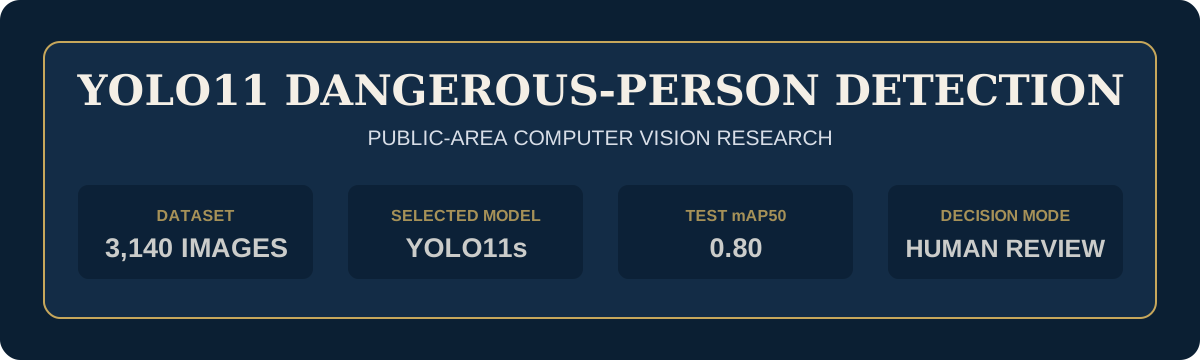
A responsible computer-vision research prototype that identifies people associated with potentially dangerous objects in public-area imagery. The repository presents the thesis evidence, held-out test results, reproducibility guidance, documented limitations, and versioned research artifacts.
| Dataset | Instances | Selected model | Held-out test result |
|---|---|---|---|
| 3,140 images | 10,595 labeled people | YOLO11s | mAP50 0.80; mAP50-95 0.64 |


This prototype supports human review; it must not be used as proof of identity, intent, guilt, or future behavior.


A seven-person Introduction to Artificial Intelligence course project developed from January through April 2026. The pipeline uses YOLO to localize Vietnamese license plates, FastALPR and fast-plate-ocr to decode cropped plates, normalization for consistent plate strings, and annotated image or video output for a LAN-based whitelist demonstration.
| Team | My confirmed responsibilities | Team-reported validation results | Scope |
|---|---|---|---|
| Seven students | Dataset and YOLO-label review, data-configuration checks, multi-format FFmpeg and annotated-output testing, and error-case validation | Precision 99.45%; recall 99.37%; mAP50 99.45%; mAP50-95 77.01% | Academic dataset and LAN prototype |


The original team-repository URL is retained while it is being restored; the case study remains available as the stable reviewer link. The prototype was not validated for production traffic enforcement or unattended access control.

Figure 2. A disciplined workflow for developing and communicating engineering results.
I approach technical work through four principles: define the problem clearly, select methods deliberately, test claims against evidence, and communicate results so that others can reproduce them.
| Channel | Contact |
|---|---|
| linkedin.com/in/nambekai | |
| Work email | nambekai123@gmail.com |
| Academic email | 22207062@student.hcmus.edu.vn |
| Telephone | +84 91 555 1529 |
| nam.tran.331598 |
For professional inquiries, email or LinkedIn is preferred. My working time zone is UTC+7 (GMT+7).
What areas are you developing?
My primary areas are computer vision and machine learning, with a broader engineering foundation in computer networks and telecommunications.
What kind of work do you value?
I value technically sound work with explicit assumptions, measurable results, reproducible methods, and clear documentation.
What is the best way to make contact?
For professional communication, use LinkedIn or the work email address above. For university matters, use the academic email address.
Engineering with rigor. Learning with purpose. Communicating with clarity.