Install once, get governed AI.
PII redacted · Injections blocked · Loops broken · Actions audited · EU AI Act tracked














Scaffold a project and boot the governed proxy + dashboard — no Docker:

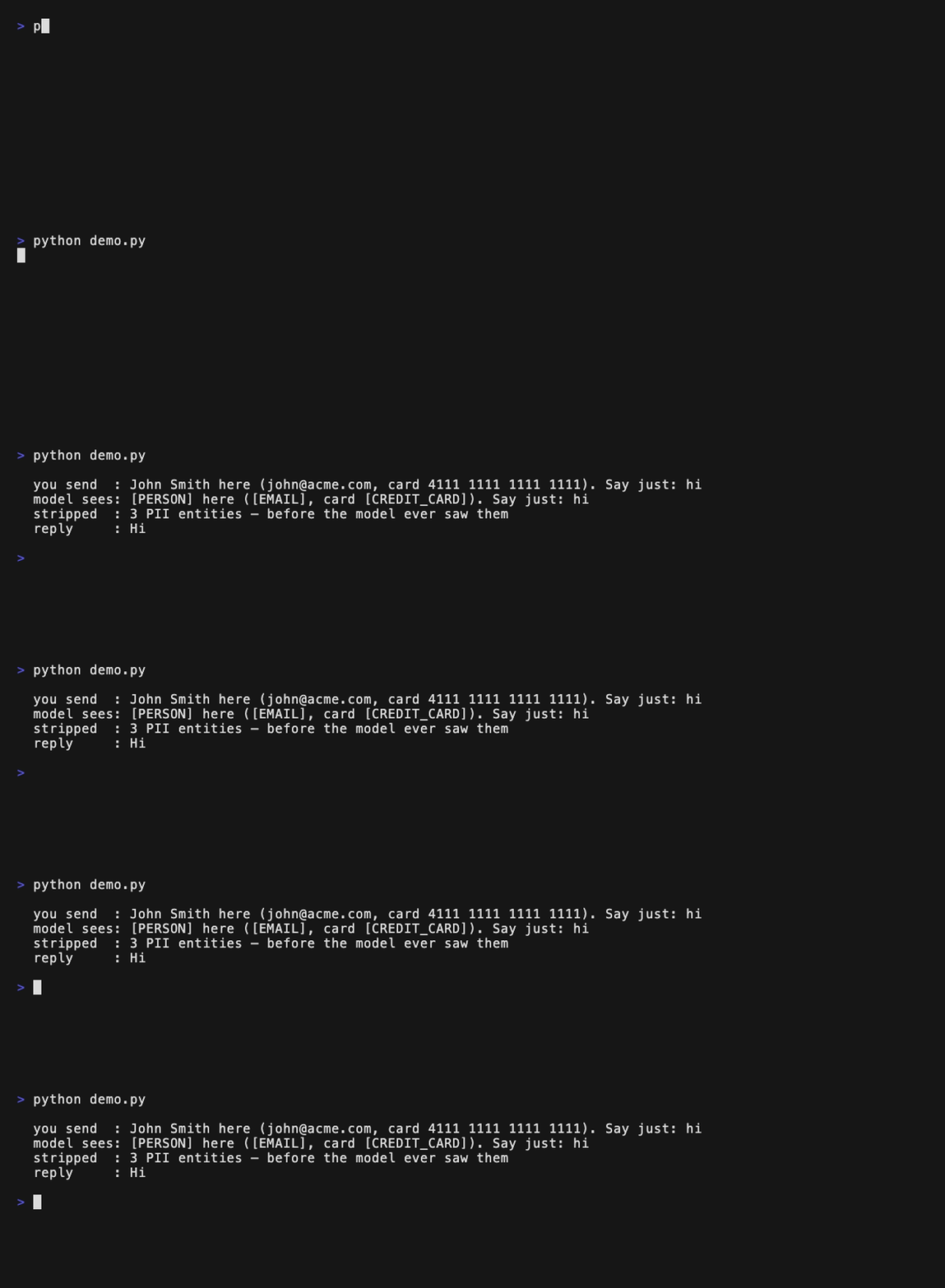
Wrap any model in a few lines — PII is stripped before the model ever sees it:
The governance dashboard, before and after simulated traffic — Admina Score 40 → 60:
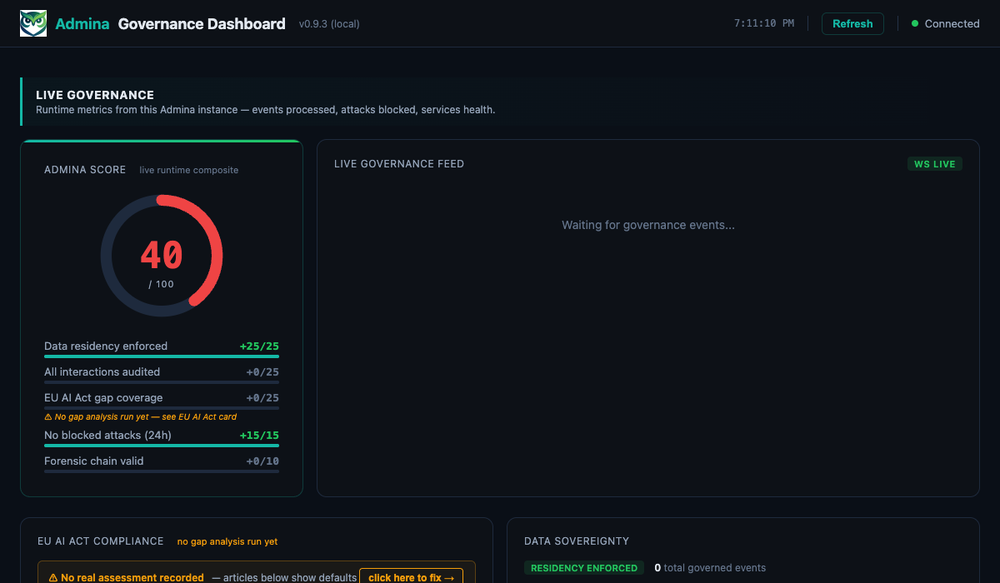 First boot — Admina Score 40/100 |
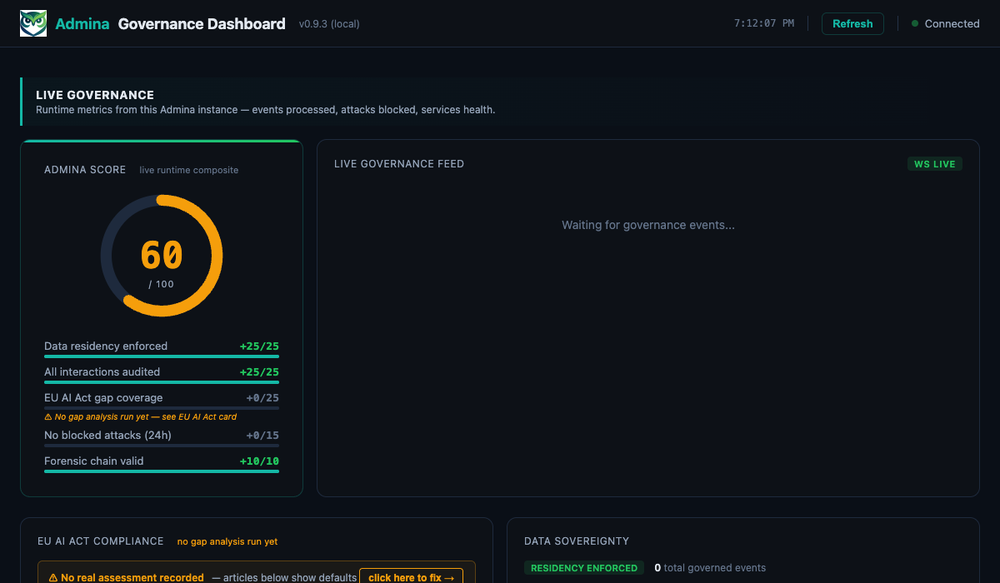 After python scripts/simulate.py — 60/100
|
| Plain LLM / RAG app | With Admina | |
|---|---|---|
| PII in prompts/responses | leaks unless you build redaction | Redacted by default — email, SSN, IBAN, phone, IP, names |
| Prompt injections | reach the model | Blocked at the proxy — 15 regex + Rust heuristic scoring |
| Agent tool calls | unaudited | Validated pre-action + logged post-action (forensic chain) |
| Loop / runaway agents | burn tokens / budget | Broken — TF-IDF cosine similarity over the action stream |
| EU AI Act readiness | manual | Gap analysis + risk classification built-in |
| Audit trail | logs you hope nobody deletes | SHA-256 hash chain — tamper-evident by design |
| Adding governance to existing code | rewrite the call sites | Zero code changes via proxy, or 3 lines via SDK |
| Performance overhead | unknown | ~6 µs per pipeline (Rust engine), in-process or networked |
| License | varies | Apache 2.0, open core |
Admina is decision-support and defense-in-depth, not legal advice. See Compliance scope for the full disclaimer and limitations.
from admina import GovernedModel, GovernedData, GovernedAgent, ComplianceKit
from admina.plugins.builtin.adapters.ollama import OllamaAdapter
from admina.plugins.builtin.connectors.chromadb import ChromaDBConnector

# Every call is governed: PII redacted, injections blocked, audited
adapter = OllamaAdapter(host="http://localhost:11434")
model = GovernedModel(model_name="llama3.1:8b", adapter=adapter)
response = await model.ask("Summarize this document")

# Data governance: residency enforcement, PII classification
connector = ChromaDBConnector(host="localhost", port=8000)
data = GovernedData(connector=connector, residency_zone="eu")
await data.ingest(documents)

# Agent governance: validate every tool call before execution
async def my_upstream(method, params, **kw): ...  # your MCP/HTTP client
agent = GovernedAgent(upstream=my_upstream)
result = await agent.call("tools/call", {"name": "read_file", "arguments": {}})

# Compliance: EU AI Act gap analysis and risk classification
kit = ComplianceKit()
report = kit.gap_analysis(risk_category="high", current_compliance={...})# Recommended for new users: SDK + proxy + dashboard.
# Lets you run `admina dev` and see the dashboard out of the box.
pip install "admina-framework[proxy]"
# Everything (proxy + NLP + telemetry). Use this if you also want
# spaCy-based NER for PII detection or OpenTelemetry export.
pip install "admina-framework[full]"
python -m spacy download en_core_web_sm # for [full] only
# Model-adapter provider SDKs (per-provider extras):
pip install "admina-framework[openai]" # openai>=1.0
pip install "admina-framework[ollama]" # ollama>=0.3
pip install "admina-framework[anthropic]" # anthropic>=0.39
pip install "admina-framework[mistral]" # mistralai>=1.0
pip install "admina-framework[gemini]" # google-genai>=1.0
pip install "admina-framework[bedrock]" # boto3>=1.34 (AWS Bedrock)
# All provider SDKs at once:
pip install "admina-framework[adapters]"
# Everything (proxy + NLP + telemetry + all adapters):
pip install "admina-framework[all]"
python -m spacy download en_core_web_sm # for [all] only
# Optional: Rust-accelerated engine (auto-detected at runtime).
# Opt-in extra — pulls in the admina-core wheel from PyPI.
pip install "admina-framework[rust]"
# Advanced: SDK only (no proxy, no dashboard, no `admina dev`).
# Use this when embedding the SDK into another service and you don't
# need the local dev server.
pip install admina-frameworkThe PyPI distribution name is
admina-framework; the Python import name isadmina(e.g.from admina import GovernedModel). This is a normal Python pattern — same aspython-dateutil→import dateutil.
The Rust engine is an optional, opt-in accelerator. The default
pip install admina-frameworkships only the pure-Python implementation;admina-framework[rust]adds theadmina-corewheel, which Admina auto-detects at runtime (falling back to pure Python if it's absent).The default is pure Python on purpose: the Python injection firewall currently has broader detection coverage than the Rust one (it adds obfuscation-normalisation — homoglyph, leetspeak, base64, ROT13 — and a wider multilingual pattern set). Enable
[rust]when per-request latency matters more than that extra coverage. See Performance for the trade-off.
git clone https://github.com/admina-org/admina.git
cd admina

# Recommended: proxy + dashboard + infra deps (enables `admina dev`)
pip install -e ".[proxy]"

# Everything (proxy + NLP + telemetry)
pip install -e ".[full]"

# All model-adapter SDKs
pip install -e ".[adapters]"

# Everything (proxy + NLP + telemetry + all adapters)
pip install -e ".[all]"

# CLI workflow
admina init my-project   # Scaffold a governed AI project
cd my-project            # admina dev runs from the project directory
admina dev               # Start the local proxy + dashboard

# Full stack via Docker (no [proxy] extra required)
./scripts/bootstrap-secrets.sh   # Auto-generate .env with random credentials
docker compose up --build        # Credentials printed at bootstrap

# Note: To use the OllamaAdapter, install Ollama (https://ollama.ai)
# and pull a model first: ollama pull llama3.1:8b

# Advanced: SDK only (no proxy, no dashboard)
pip install -e .
python -c "from admina import GovernedModel; print('SDK ready')"
Dashboard: http://localhost:3000 | API docs: http://localhost:8080/docs
Admina runs in dual mode — in-process via SDK or networked via proxy — but both modes feed the same governance pipeline.
flowchart LR
    A1["your code → GovernedModel.ask()"] --> P
    A2["AI agent → POST /mcp"] --> P
    P["governance pipeline"]
    P --> U1["Ollama / OpenAI"]
    P --> U2["MCP server / LLM"]
    classDef pipe fill:#0ea5e9,stroke:#0369a1,color:#fff;
    class P pipe;
Pipeline (identical in both modes): loop-breaker → firewall → PII redaction → guards → audit → forensic chain (SHA-256) → OTEL
| Domain | Capabilities | Engine |
|---|---|---|
| Agent Security | Anti-injection firewall (15 regex + heuristic scoring), loop breaker (TF-IDF cosine similarity) | Rust + Python |
| Data Sovereignty | PII redaction (email, SSN, credit cards, IBAN, phone, IP), residency enforcement, data classification | Rust + spaCy NER |
| Compliance | EU AI Act risk classification (Art. 6) and gap analysis (Art. 9-15), forensic black box (SHA-256 hash chain), OTEL native spans | Rust + Python |
| AI Infrastructure | LLM engine (Ollama, OpenAI), RAG pipeline (ChromaDB), Open WebUI | Python |
All governance domains operate bidirectionally — scanning both outbound requests and inbound responses.
Four governed primitives, each with async + sync interfaces:
from admina import GovernedModel, GovernedData, GovernedAgent, ComplianceKit| Primitive | Purpose | Governance applied |
|---|---|---|
GovernedModel |
LLM calls (Ollama, OpenAI) | PII redaction on prompts and responses, event audit |
GovernedData |
Data ingestion and queries | PII classification, residency enforcement, access audit |
GovernedAgent |
MCP/A2A agent calls | Firewall, PII, loop breaker — full proxy pipeline in-process |
ComplianceKit |
Regulatory compliance | EU AI Act risk classification, gap analysis, report generation |
9 plugin interfaces, auto-discovered from plugins/builtin/ or installed via CLI:
| Interface | Builtin implementations |
|---|---|
| Model Adapter | Ollama, OpenAI |
| Data Connector | ChromaDB, Filesystem |
| Governance Domain | GuardrailsAI (toxic, jailbreak, bias, PII) |
| Compliance Template | EU AI Act |
| Transport Adapter | MCP, HTTP REST |
| Forensic Store | Filesystem, S3-compatible (boto3 — AWS S3, MinIO, R2, …) |
| Auth Provider | API Key |
| PII Engine | spaCy + Regex |
| Alert Channel | Log, Webhook |
admina plugin list                    # List registered plugins
admina plugin install ./my-plugin     # Install a custom plugin
admina plugin create my-domain # Scaffold a new pluginadmina init my-project # Scaffold project with admina.yaml + docker-compose.yml
admina dev # Local mode: proxy + dashboard on :3000 (no Docker)
admina dev --stack # Docker stack: + redis + clickhouse + grafana
admina dev --with-llm # --stack + ollama + chromadb + open-webui
admina plugin list # List all registered plugins
admina plugin install X # Install a plugin from path or registry
admina plugin create X # Scaffold a new plugin from templateadmina dev defaults to a single-process local mode with zero Docker
dependency: one uvicorn serves the proxy API and the dashboard SPA on the
same port. Use --stack for the production-like Docker compose, or
--with-llm to also boot local LLM services.
Real-time governance dashboard on port 3000:
- Governance Score — 0-100 composite metric (data residency, audit coverage, attack rate, forensic integrity, EU AI Act compliance)
- Live Feed — streaming governance events via WebSocket
- Compliance Gaps — EU AI Act gap analysis with article-level detail
- Infrastructure Health — proxy, Redis, forensic store, ClickHouse, OTEL status
API backend: GET /api/dashboard/score, /feed, /compliance, /sovereignty, /infra, /models
Admina uses admina.yaml as the primary config file (with .env fallback for backward compatibility):
cp admina.yaml.example admina.yaml # Copy and customizeSee admina.yaml.example for all options including domains, AI infra, plugins, dashboard, forensic storage, alert channels, and integrations.
⚖️ Compliance scope & legal disclaimer — what Admina does and does not do legally
Admina is a self-assessment and defense-in-depth tool. The EU AI Act gap-analysis and risk classification features are decision-support aids, not legal advice. They do not replace the conformity assessment required under EU AI Act Art. 43 for high-risk systems, nor the involvement of a notified body where the regulation requires one.
EU AI Act timeline (after the Omnibus VII agreement of 7 May 2026): Art. 5 prohibitions in force since 2 February 2025; GPAI obligations in force since 2 August 2025; Art. 50 transparency for synthetic content and the new NCII / synthetic-CSAM prohibition apply from 2 December 2026; Annex III high-risk obligations from 2 December 2027 (postponed from 2 Aug 2026); Annex I high-risk from 2 August 2028 (postponed from 2 Aug 2027). The full machine-readable timeline ships with Admina as
admina.domains.compliance.eu_ai_act.EU_AI_ACT_DEADLINES. SeeMODEL_CARD.mdfor the full scope, limitations, and known failure modes of every Admina component.
GuardrailsAI — ML-based content validation as a governance plugin
ML-based content validation (toxic language, jailbreak, bias, PII via Presidio) as a governance domain plugin:
# Upstream guardrails-ai is currently in PyPI quarantine. Install it
# manually from your local mirror or wheel cache; once available, the
# plugin in admina/plugins/builtin/guards/guardrailsai_guard.py will
# detect it automatically.
pip install <your-guardrails-ai-wheel>
Enable in admina.yaml under agent_security.domains.guardrailsai. All inference runs locally by default — no data leaves the deployment perimeter.
OpenClaw — govern OpenClaw agent actions via pre/post-action hooks
Govern OpenClaw agent actions through the Admina proxy. Every tool call, shell command, and API request is validated before execution:
cd integrations/openclaw/admina-governance
chmod +x setup.sh && ./setup.sh
The skill uses POST /api/v1/validate (pre-action) and POST /api/v1/audit (post-action) endpoints.
n8n — community nodes for n8n workflow automation
| Node | Purpose |
|---|---|
| Admina Govern | Inline governance check — validates workflow data, blocks injections, redacts PII |
| Admina Audit | Logs workflow events to forensic black box with EU AI Act risk classification |
| Admina Dashboard | Trigger node — fires on governance events via WebSocket |
Install: npm install n8n-nodes-admina in your n8n instance.
Cheshire Cat AI — govern all Cheshire Cat interactions via Python hooks
Three Python hooks (agent_fast_reply, before_cat_sends_message, before_cat_recalls_memories):
cd integrations/cheshirecat/admina-plugin
./setup.sh    # Start Admina sidecar
# Copy plugin into Cheshire Cat plugins/ directory
LangChain — drop-in callback handler
Governs every LLM call and tool invocation in-process:
from admina.integrations.langchain.callbacks import AdminaCallbackHandler

handler = AdminaCallbackHandler()
llm = ChatOpenAI(callbacks=[handler])
CrewAI — step and task callbacks for multi-agent governance
from admina.integrations.crewai.callbacks import admina_step_callback, admina_task_callback

agent = Agent(role="Researcher", step_callback=admina_step_callback)
crew = Crew(agents=[agent], tasks=[task], task_callback=admina_task_callback)
See full integration docs for details.
The Rust core engine is an optional accelerator. The default
pip install admina-framework ships only the pure-Python implementation;
enable the Rust engine with the opt-in extra pip install "admina-framework[rust]" (or build from source for local development —
maturin develop --release --manifest-path core-rust/Cargo.toml, see
CONTRIBUTING.md). At runtime Admina auto-detects
whichever is available and falls back transparently to Python if the Rust
extension is not installed.
Detection trade-off (why Rust is opt-in, not the default). The Rust firewall is faster but currently detects a narrower set of attacks than the pure-Python firewall. The Python engine normalises common evasions before matching (homoglyph, leetspeak, char-by-char hyphenation, base64, ROT13) and carries a wider multilingual pattern set; the Rust engine does not yet. On an internal 14-attack evasion corpus the Python firewall blocks all 14 while the Rust firewall blocks 7 (the plain-text and multilingual-keyword attacks), with no false positives on either side. Full Rust↔Python detection parity is tracked for 0.10. Until then, keep the default (pure Python) when detection breadth matters; opt into
[rust]when latency dominates.
Measured numbers below assume the Rust engine is loaded:
Component          Rust (median)   P95        P99
-----------------  -------------   ---------  ---------
Firewall (regex)   2.08us          2.33us     2.50us
PII Scanner        0.62us          0.67us     0.71us
Loop Breaker       2.38us          2.67us     2.75us
Hash Chain         1.00us          1.12us     1.25us
-----------------  -------------   ---------  ---------
4-Domain pipeline  6.25us          7.04us     7.29us
Rust vs Python comparison (click to expand)
Component          Python (median)   Rust (median)   Speedup
-----------------  ---------------   -------------   --------
Firewall           7.79us            2.08us          3.7x
PII (regex-only)   8.21us            0.62us          13.2x
PII (with spaCy)   1 992us           0.62us          3 213x
Loop (sklearn)     505us             2.38us          212x
-----------------  ---------------   -------------   --------
Full pipeline      2 261us           5.21us          434x
Generate realistic governance traffic to test and demo the platform:
# Start the proxy
docker compose up -d

# Default: 60s at 2 req/s
python scripts/simulate.py

# Intense: 5 minutes at 10 req/s
python scripts/simulate.py --duration 300 --rate 10
Generates a weighted mix of: clean MCP requests, injection attempts, PII content, loop triggers, REST validate/audit calls, EU AI Act classifications, and dashboard reads. Colored terminal output with per-event action and summary counters.
The full stack (docker compose up) runs 9 containers:
| Port | Service | Description |
|---|---|---|
8080 |
Proxy | MCP proxy + REST API + OpenAPI docs |
3000 |
Dashboard | Real-time governance web UI |
3001 |
Grafana | Metrics dashboards |
4317 |
OTEL Collector | OTLP gRPC ingestion |
ClickHouse and Redis are internal only (not exposed to host).
🗄️ Forensic backends (4 options) — choose deliberately
The forensic blackbox (the SHA-256 hash chain that makes the audit trail tamper-evident) supports three backends. Read this before picking one for production.
| Backend | License | When to use | Caveats |
|---|---|---|---|
memory (default) |
n/a | Local development, tests, demos | Records are LOST on restart — no audit persistence. Loud warning at startup. |
filesystem |
n/a | Single-host on-prem, air-gapped, smaller deployments | Persistence depends on the host filesystem; not ideal for HA. Requires FORENSIC_BASE_DIR. |
s3 (boto3) |
Apache 2.0 (boto3) | Production / HA / multi-region | Works with any S3-compatible service — AWS S3, MinIO servers, Cloudflare R2, Backblaze B2, SeaweedFS (Apache 2.0), Garage (AGPLv3), Ceph RGW (LGPLv2). Supports WORM Object Lock. |
Using MinIO? Point the
s3backend at your MinIO server viaFORENSIC_S3_ENDPOINT— MinIO speaks the S3 API, so no MinIO-specific client is needed. The legacyminio-SDK backend was removed in 0.9.5 (the MinIO Python SDK is archived);FORENSIC_BACKEND=minionow transparently routes to thes3backend with a migration warning.
⚙️ Environment variables (Docker / .env)
| Variable | Default | Description |
|---|---|---|
ADMINA_API_KEY |
(empty) | API key for all endpoints |
UPSTREAM_MCP_URL |
http://localhost:9000 |
Default upstream MCP server |
REDIS_URL |
redis://localhost:6379/0 |
Session state + rate limiting |
FORENSIC_BACKEND |
memory |
Forensic store: memory | filesystem | s3 |
LOG_LEVEL |
INFO |
Logging verbosity |
📁 Full project structure
admina/
+-- admina/                 SDK package (GovernedModel, GovernedData, GovernedAgent, ComplianceKit)
|   +-- plugins/            Plugin base classes + registry
+-- domains/                4 governance domains
|   +-- data_sovereignty/   PII, residency, classification
|   +-- ai_infra/           LLM engine, RAG pipeline, Web UI
|   +-- agent_security/     Firewall, loop breaker, proxy
|   +-- compliance/         EU AI Act, forensic, OTEL
+-- plugins/builtin/        Reference plugin implementations
|   +-- adapters/           Ollama, OpenAI
|   +-- connectors/         ChromaDB, Filesystem
|   +-- domains/            GuardrailsAI
|   +-- compliance/         EU AI Act template
|   +-- transports/         MCP, HTTP REST
|   +-- forensic/           Filesystem
|   +-- auth/               API Key
|   +-- pii/                spaCy + Regex
|   +-- alerts/             Log, Webhook
+-- proxy/                  FastAPI proxy + Rust engine bridge
|   +-- api/                Dashboard + integration REST endpoints
+-- cli/                    CLI commands (init, dev, plugin)
+-- core/                   Config, types, event bus
+-- core-rust/              Rust governance engines (PyO3)
+-- dashboard/              Real-time governance web UI
+-- integrations/
|   +-- openclaw/           OpenClaw governance skill
|   +-- n8n/                n8n community nodes
+-- tests/                  800+ tests (pytest)
+-- docker-compose.yml      Full stack deployment (9 containers)
🔌 API examples (curl)
# Health check (always public)
curl http://localhost:8080/health

# Governance stats
curl http://localhost:8080/api/stats -H "X-API-Key: $ADMINA_API_KEY"

# Proxy an MCP call (all governance domains applied)
curl -X POST http://localhost:8080/mcp \
  -H "Content-Type: application/json" \
  -d '{"jsonrpc":"2.0","id":1,"method":"tools/call","params":{...}}'

# Validate content (REST API for integrations)
curl -X POST http://localhost:8080/api/v1/validate \
  -H "Content-Type: application/json" \
  -d '{"content": "Check this text for governance issues"}'

# Audit an action (forensic logging)
curl -X POST http://localhost:8080/api/v1/audit \
  -H "Content-Type: application/json" \
  -d '{"event": {"action": "llm_call", "status": "success"}}'

# EU AI Act risk classification
curl -X POST http://localhost:8080/api/compliance/classify \
  -H "Content-Type: application/json" \
  -d '{"description":"AI credit scoring","use_case":"lending","data_types":["financial"]}'

# Dashboard governance score
curl http://localhost:8080/api/dashboard/score- CONTRIBUTING.md — development setup, testing, and pull request workflow
- MODEL_CARD.md — transparency artifact for every Admina governance component (intended use, scope, limitations, known failure modes), aligned with EU AI Act Art. 13 and NIST AI RMF
- ROADMAP.md — planned milestones from 0.9.x to 1.0 and beyond
- CHANGELOG.md — release notes
- SECURITY.md — coordinated disclosure policy
- CODE_OF_CONDUCT.md — Contributor Covenant 2.1
- Browse the AI-generated wiki → deepwiki.com/admina-org/admina
Admina is Apache 2.0. Contributions are welcome.
Copyright © 2025–2026 Stefano Noferi & Admina contributors
Licensed under the Apache License, Version 2.0. See LICENSE for the full text.
Heimdall — the Governance Owl
admina.org · Created by Stefano Noferi · Pisa, Italy