a libre, massive footprinting tool


Website · Source · GitHub · Contact
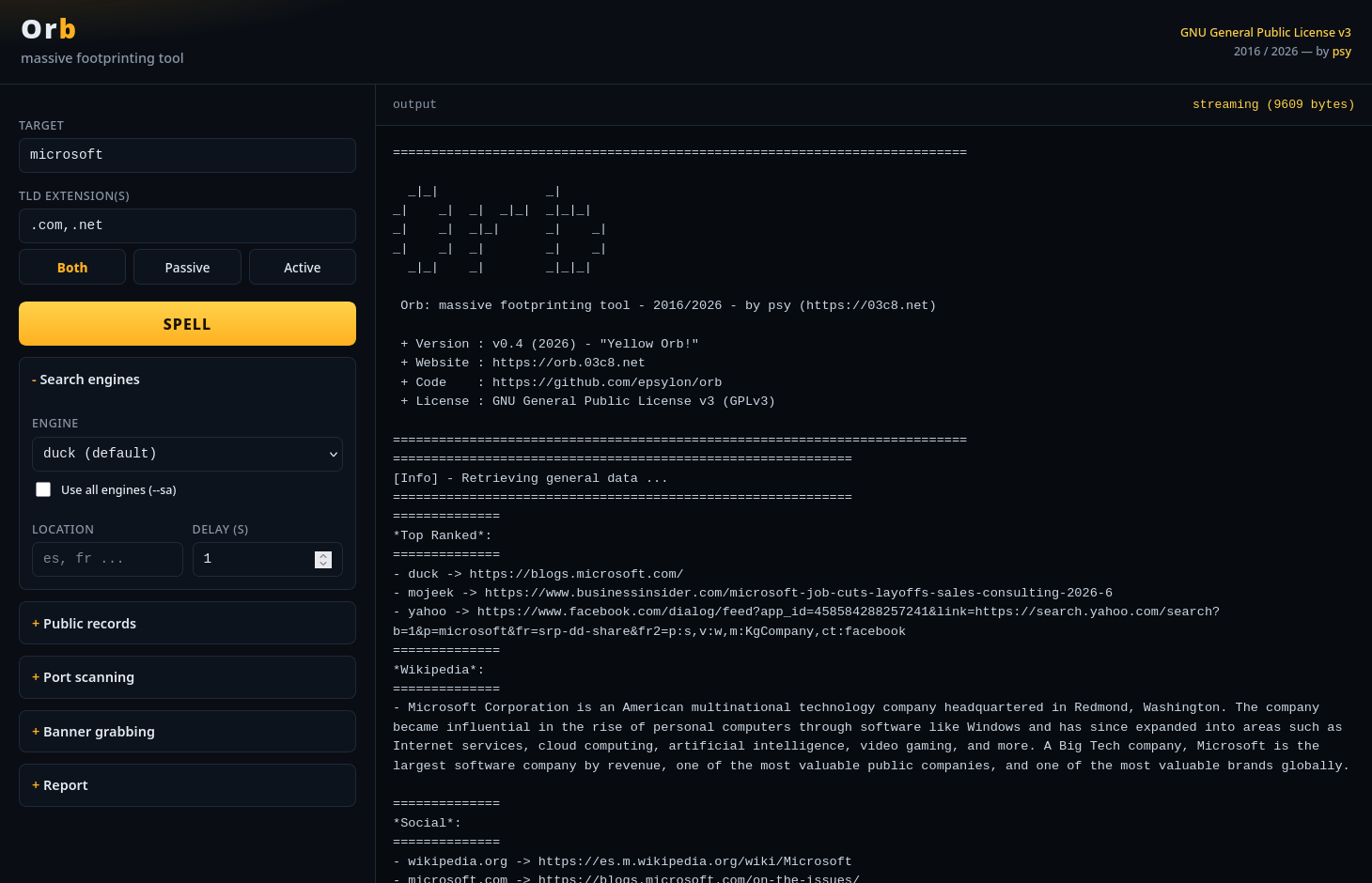
Orb is a massive footprinting tool. It uses passive and active —automated— methods to provide real information about a target. You only need to set a concept to start gathering data. When finished, Orb builds you some fancy reports.
Passive
- Crawl search engines for public records (deep web included)
- Search for registered domains
- Extract whois info (owners, dates)
- Discover subdomains
- Find machines running services
- Resolve DNS records (A, NS, MX, TXT)
- Extract CVE / CVS vulnerability records
Active
- Scan for open ports (TCP/UDP, 1–65535)
- Fingerprint banners (state, vendor, OS, version, CPE)
- Multiple search engines — query one source or all of them at once
- Deep web — onion (Tor) records through the Ahmia gateway
- Whois — registrant, creation, expiration and last-update dates
- Subdomains — passive discovery from search-engine results (no bruteforcing)
- DNS records — resolve A, NS, MX and TXT, with custom resolvers
- Port scanning — Nmap-powered TCP/UDP scanning with service detection
- Banner grabbing — state, product, version, name, extra info and CPE
- CVE / CVS — vulnerability lookups powered by the NVD API
- Reports — raw text and, optionally, structured JSON per target
- Web GUI — optional local interface
- Tor aware — built-in Tor connection check
- Self-update — pull the latest stable version from git
Orb runs on many platforms. It requires Python 3 and a few libraries:
ddgs, whois, dnspython, python-nmap and requests.
git clone https://github.com/epsylon/orb
cd orb

sudo apt-get install nmap python3-pip
pip3 install -r orb/docs/requeriments.txt

# or install the libraries manually
pip3 install ddgs whois dnspython python-nmap requests --user
The Nmap system binary is required for the active port-scanning features.
Source libs:
- Python — https://www.python.org/downloads/
- ddgs — https://pypi.org/project/ddgs/
- whois — https://pypi.org/project/whois/
- dnspython — https://pypi.org/project/dnspython/
- python-nmap — https://pypi.org/project/python-nmap/
- requests — https://pypi.org/project/requests/
# full footprinting of a target
python3 orb --spell='target'

# massive run across several TLDs, using all engines
python3 orb --spell='target' --ext='.com,.net,.org' --sa

# passive-only reconnaissance with a chosen engine
python3 orb --spell='target' --passive --se='bing'

# active only, TCP scan on a custom port range
python3 orb --spell='target' --active --scan-tcp --scan-ports='1-1024'

# custom DNS resolvers and a JSON report
python3 orb --spell='target' --resolver='1.1.1.1,8.8.8.8' --json='target.json'

# pace requests to avoid rate limiting (seconds between requests)
python3 orb --spell='target' --delay='2'

# extra utilities
python3 orb --gui            # local web interface
python3 orb --list-engines   # list supported search engines
python3 orb --check-tor      # verify Tor is used properly
python3 orb --update # update to the latest stable version ./orb --help
Usage: Orb.py [options]
Options:
--version show program's version number and exit
-h, --help show this help message and exit
-v, --verbose active verbose on requests
--check-tor check to see if Tor is used properly
--update check for latest stable version
--spell=TARGET start complete footprinting on this target
--gui run GUI (Orb Web Interface)
--delay=DELAY set delay in seconds between requests (default: 1)
*Methods*:
These options can be used to set some footprinting interaction
restrictions with target(s). You only can set one:
--passive use only -passive- methods
--active use only -active- methods
*Search Engines*:
These options can be used to specify which search engines use to
extract information:
--se=ENGINE set search engine (default: DuckDuckGo)
--se-ext=ENGINELOC set location for search engine (ex: 'fr')
--sa search massively using all search engines
--list-engines list all supported search engines
*Public*:
Orb will search for interesting public records. You can choose
multiple:
--no-public disable search for public records
--no-deep disable deep web records
--no-social disable social records
--social-f=SOCIALF set a list of social sources from file
--no-news disable news records
--news-f=NEWSF set a list of news sources from file
*Domains*:
Orb will search on different databases for registered domains using
IANA supported by default. You only can set one:
--ext=EXT set extensions manually (ex: --ext='.com,.net,.es')
--ext-f=EXTFILE set a list of extensions from file
*Whois*:
Orb will search on 'Whois' records for registrant information:
--no-whois disable extract whois information
*Subdomains*:
Orb will try to discover info about subdomains:
--no-subs disable try to discover subdomains
*DNS*:
Orb will try to discover info about DNS records and machines running
them. You can choose multiple:
--no-dns disable try to discover DNS records
--resolver=RESOLV specify custom DNS servers (ex: '8.8.8.8,8.8.8.4')
*Port Scanning*:
These options can be used to specify how to perfom port scanning
tasks. You can choose multiple:
--no-scanner disable scanner
--no-scan-dns disable scan DNS machines
--no-scan-ns disable scan NS records
--no-scan-mx disable scan MX records
--scan-tcp set scanning protocol to only TCP (default TCP+UDP)
--scan-ports=PORTS set range of ports to scan (default 1-65535)
--show-filtered show 'filtered' ports on results
*Banner grabbing*:
Orb will try to extract interesting information about services running
on machines discovered (ex: OS, vendor, version, cpe, cvs):
--no-banner disable extract banners from services
--no-cve disable extract vulnerabilities from CVE
--no-cvs disable extract CVS description
*Reporting*:
These options can be used to specify exporting methods for your
results. You can choose multiple:
--no-log disable generate reports
--json=JSON generate json report (ex: --json='foo.json')
You can select a set of options organized by footprinting method:
-
Passive — public, deep web, social, news, whois and subdomain discovery (non-intrusive); no port/DNS scanning and no banner grabbing.
python3 orb --spell='target' --passive -
Active — the opposite of passive.
python3 orb --spell='target' --active
Gather public records from multiple sources. Pick one with --se, or query them all at once
with --sa:
duck · bing · brave · mojeek · yahoo · startpage · ecosia
Deep web (onion) records are retrieved through Ahmia (ahmia.fi). List all supported engines
with python3 orb --list-engines.
python3 orb --spell='target' --se='bing'
python3 orb --spell='target' --sa
You can also target a location with --se-ext (france=fr, italy=it, ...):
python3 orb --spell='target' --se-ext='es'Orb searches the WWW for interesting public records. You decide what is "interesting" by building lists of sources organized in two categories: social and news. An example folder for Spain is included:
python3 orb --spell='target' --social-f='core/sources/spain/social.txt' --news-f='core/sources/spain/news.txt'By default it uses a set of most ranked global services sorted by category, so you get a nice global scope from the beginning.
By default Orb uses IANA-supported TLDs, but you can set your own:
python3 orb --spell='target' --ext='.com,.net,.org'
python3 orb --spell='target' --ext-f='core/sources/user-exts.txt'Orb searches 'Whois' records for registrant information.
- Domain: microsoft.com
- Registrant: MarkMonitor Inc.
- Creation date: 1991-05-02 00:00:00
- Expiration: 2025-05-03 00:00:00
- Last update: 2024-10-09 00:00:00
Orb discovers subdomains using a passive method with search engines (no bruteforcing).
Orb resolves DNS records (A, NS, MX, TXT) and the machines running them. You can set custom resolvers (Google is used by default):
python3 orb --spell='target' --resolver='8.8.8.8,8.8.4.4'Orb uses the Nmap Python wrapper to perform port-scanning tasks. Set TCP only (TCP+UDP by default), choose a port range, and optionally show 'filtered' ports:
python3 orb --spell='target' --scan-tcp
python3 orb --spell='target' --scan-ports='21-443'
python3 orb --spell='target' --scan-ports='21-443' --show-filtered
Only 'Open' ports are shown by default.
Orb extracts information about services running on discovered machines (OS, vendor, version, CPE) and correlates them with known vulnerabilities from the NVD:
- IP: XXX.XXX.XXX.XXX
  * State : up
   - Protocol : tcp
     + Port: 80 ( open ) - IBM WebSEAL reverse http proxy  |  http-proxy
       + CVE-2014-0963 -> https://nvd.nist.gov/vuln/detail/CVE-2014-0963
         The Reverse Proxy feature in IBM Global Security Kit (aka GSKit) in IBM Security Access
         Manager (ISAM) for Web 7.0 and 8.0 allows remote attackers to cause a denial of service.
Orb logs all tasks and results per target under a reports/ folder.
python3 orb --spell='target' --no-log          # no reports
python3 orb --spell='target' -v                # verbose output
python3 orb --spell='target' --json='target.json' # JSON reportOrb is free software. If it is useful to you, consider supporting its development:
- Bitcoin [BTC]:
19aXfJtoYJUoXEZtjNwsah2JKN9CK5Pcjw - ECOin [ECO]:
EZnYs33TG87ZzBWgADrj8653s3bPUqreW9
Found a bug, have a patch or an idea? Reach out to psy (epsylon@riseup.net).
Orb — massive footprinting tool · 2016 / 2026 · by psy · Released under the GNU GPLv3