



Applied AI / GenAI Engineer — Document AI, RAG systems, agentic automation (Python, FastAPI, LangGraph)



Outcomes · Featured · Stack · Activity
GenAI Engineer at Deloitte (Jul 2025–present), building production document intelligence pipelines, agentic automation, and healthcare AI on Azure. Previously Associate Data Scientist at Cognizant (Sep 2022–May 2025) across warranty analytics, conversational AI, and data pipelines.
I treat LLM outputs as unverified signals. Systems ship with structured validation, evaluation loops, and deterministic guardrails.
- Improved task completion from 38% → 80% on a 200-task internal evaluation by engineering a Milvus-backed RAG layer for multi-agent reasoning.
- Reduced browser-agent prompt-token consumption by ~40% by replacing raw DOM dumps with accessibility-tree snapshots + compressed observations (Playwright MCP tooling).
- Improved structured extraction accuracy from 80–81% → 90%+ (multi-pass extraction with confidence-aware retries + routing).
- Raised policy-entity extraction accuracy from 90% → 99% via model + validation iteration (prompting, canonical comparisons, and evaluation).
These are the repos I recommend pinning (recruiter-first, “proof in the repo”).

|

|

|

|

|

|
Other highlights:
genai-systems-lab(collection of production-grade GenAI systems behind one repo contract)pypi-ahmad.github.io(portfolio site code + tests)Clinical-Decision-Support-System(CDS-style document pipeline with strong security + LangGraph story)
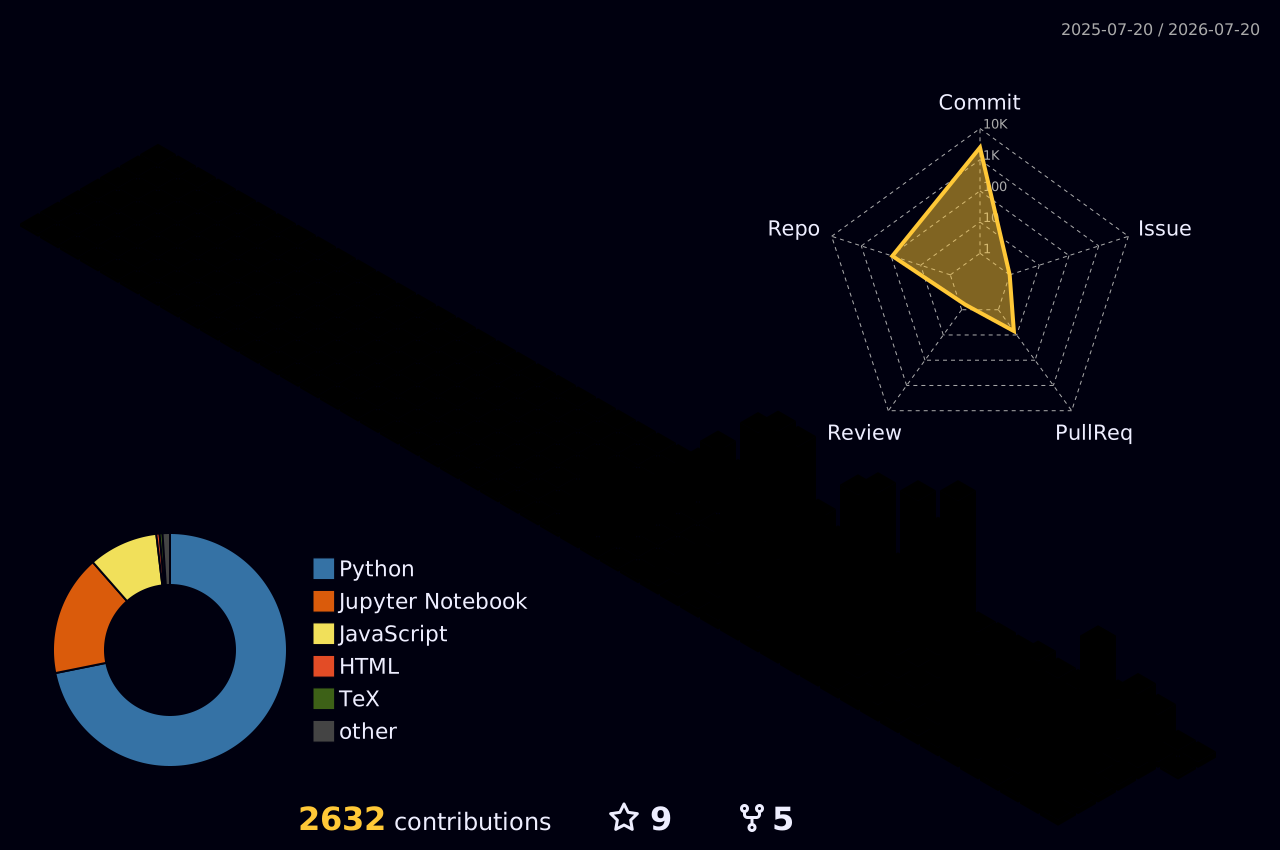
GitHub stats (collapsible)



How I build RAG systems that don’t lie by default
I structure RAG as an engineering system: retrieval quality + grounded generation + evaluation + guardrails.
flowchart TD
  A[Documents] --> B[Chunk + Index]
  B --> C[Retrieve: dense + sparse + rerank]
  C --> D{Context sufficient?}
  D -->|No| E[Corrective fallback: expand query / graph / web]
  D -->|Yes| F[Generate answer]
  F --> G[Grounding + schema validation]
  G --> H{Pass?}
  H -->|No| I[Retry / route / human review]
  H -->|Yes| J[Ship response + citations + logs]
If you want concrete, reproducible examples, see: