


A batteries-included authentication and authorization library for Python. JWT access tokens with refresh rotation, TOTP MFA with recovery codes, WebAuthn/passkey support, RBAC, API key management, password security with HIBP breach checking, and pluggable storage — all framework-agnostic.
More screenshots in docs/screenshots.md
- Features
- Requirements
- Installation
- Quick Start
- Async Usage
- Framework Integrations
- MFA Setup
- RBAC
- API Keys
- Event System
- Configuration
- Interface
- Architecture
- Documentation
- Development
- Contributing
- Security
- License
- JWT Authentication — Access tokens (HS256) with short-lived expiry and opaque refresh tokens with rotation, family tracking, and reuse detection
- TOTP MFA — Time-based one-time passwords with Fernet-encrypted secrets and single-use recovery codes
- WebAuthn / Passkeys — Registration and authentication via the WebAuthn standard
- RBAC — Role-based access control with granular permissions
- API Keys — Prefix-based lookup, scoped keys with optional expiry
- Password Security — Configurable complexity rules, password history enforcement, and HIBP breach checking via k-anonymity
- Pluggable Storage — Sync and async SQLite backends included; implement
StorageInterfaceorAsyncStorageInterfacefor any database - Event Bus — Typed lifecycle events (login, MFA, token refresh, RBAC changes, audit, etc.) with sync and async handler support
- Audit Logging — Append-only audit trail with optional chain hashing for tamper evidence
- Framework-Agnostic — First-party integrations for FastAPI, Flask, Django, and Starlette, plus generic ASGI/WSGI middleware for everything else
- Full Async Support —
AsyncAuthManagerwithAsyncSQLiteStoragefor async-first applications
- Python 3.10+
- SQLite (included in Python standard library)
pip install authority-authOptional extras:
| Extra | Provides |
|---|---|
async |
aiosqlite-backed AsyncSQLiteStorage |
fastapi |
FastAPI integration (authority.fastapi) |
flask |
Flask integration (authority.flask) |
django |
Django integration (authority.django) |
starlette |
Starlette integration (authority.starlette) |
quart |
Quart is supported through the ASGI middleware |
dev |
Development tooling (pytest, ruff, pyright, test frameworks) |
docs |
MkDocs + Material for building the documentation site |
pip install "authority-auth[async]"
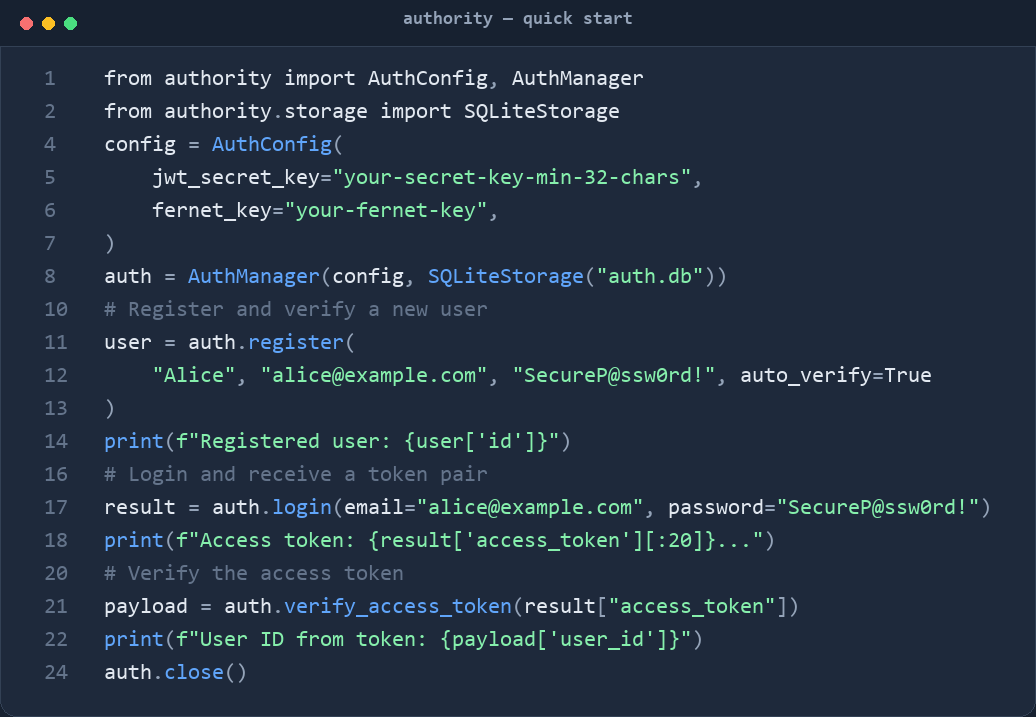
pip install "authority-auth[fastapi,flask]"from authority import AuthConfig, AuthManager
from authority.storage import SQLiteStorage
# Configure
config = AuthConfig(
jwt_secret_key="your-secret-key-min-32-chars",
fernet_key="your-fernet-key", # Generate with: python -c "from cryptography.fernet import Fernet; print(Fernet.generate_key().decode())"
)
# Initialize storage (creates/opens the database)
storage = SQLiteStorage("auth.db")
# Create the auth manager
auth = AuthManager(config, storage)
# Register a user
user = auth.register(
name="Alice",
email="alice@example.com",
password="SecureP@ssw0rd!",
auto_verify=True,
)
print(f"Registered user: {user['id']}")
# Login
result = auth.login(email="alice@example.com", password="SecureP@ssw0rd!")
print(f"Access token: {result['access_token'][:20]}...")
print(f"Refresh token: {result['refresh_token'][:20]}...")
# Verify an access token
payload = auth.verify_access_token(result["access_token"])
print(f"User ID from token: {payload['user_id']}")
# Refresh tokens
new_tokens = auth.refresh_access_token(result["refresh_token"])
# Logout
auth.logout(
user_id=user["id"],
refresh_token=result["refresh_token"],
access_token_jti=payload["jti"],
)
# Clean up
auth.close()import asyncio
from authority import AuthConfig, AsyncAuthManager
from authority.storage import AsyncSQLiteStorage
async def main():
config = AuthConfig(
jwt_secret_key="your-secret-key-min-32-chars",
fernet_key="your-fernet-key",
)
storage = AsyncSQLiteStorage("auth.db")
await storage.connect()
auth = AsyncAuthManager(config, storage)
# Register
user = await auth.register(
name="Bob",
email="bob@example.com",
password="SecureP@ssw0rd!",
auto_verify=True,
)
# Login
result = await auth.login(email="bob@example.com", password="SecureP@ssw0rd!")
print(f"Access token: {result['access_token'][:20]}...")
# Verify
payload = await auth.verify_access_token(result["access_token"])
print(f"User ID: {payload['user_id']}")
# Refresh
new_tokens = await auth.refresh_access_token(result["refresh_token"])
# Logout all devices
count = await auth.logout_all(user_id=user["id"])
print(f"Revoked {count} tokens")
await auth.close()
asyncio.run(main())Each integration ships in its own module and requires the matching framework
extra. Fully working apps for every framework live in
examples/apps/ — see the
examples documentation for run instructions,
endpoints, and the demo account.
pip install "authority-auth[flask]"    # Flask
pip install "authority-auth[django]"   # Django
pip install "authority-auth[starlette]"  # Starlette
pip install "authority-auth[fastapi]" # FastAPIfrom fastapi import FastAPI, Depends
from authority import AuthConfig, AsyncAuthManager
from authority.storage import AsyncSQLiteStorage
from authority.fastapi import get_current_user, init_auth
app = FastAPI()
config = AuthConfig(
jwt_secret_key="your-secret-key-min-32-chars",
fernet_key="your-fernet-key",
)
storage = AsyncSQLiteStorage("auth.db")
auth = AsyncAuthManager(config, storage)
init_auth(auth)
@app.on_event("startup")
async def startup():
await storage.connect()
@app.on_event("shutdown")
async def shutdown():
await auth.close()
@app.get("/me")
async def me(user: dict = Depends(get_current_user)):
return {"id": user["id"], "name": user["name"], "email": user["email"]}from flask import Flask, jsonify
from authority import AuthConfig, AuthManager
from authority.storage.sqlite import SQLiteStorage
from authority.flask import FlaskAuth
app = Flask(__name__)
app.secret_key = "app-session-secret"
auth = FlaskAuth(
app,
AuthManager(
AuthConfig(jwt_secret_key="your-secret-key-min-32-chars", fernet_key="your-fernet-key"),
SQLiteStorage("auth.db"),
),
)
@app.route("/me")
@auth.login_required
def me():
user = auth.current_user() # full user dict, or None
return jsonify({"id": user["id"], "email": user["email"]})
@app.route("/admin")
@auth.require_permission("admin.access")
def admin():
return "Welcome, admin!"Tokens are read from the Authorization: Bearer <token> header, or from
session["access_token"] for session-based flows. Module-level helpers
(init_auth, login_required, require_permission, require_role,
current_user) are also available.
from django.contrib.auth import authenticate
from django.http import JsonResponse
from django.urls import path
from authority.django import get_current_user, init_auth, login_required, require_permission

init_auth(auth_manager)  # an authority.AuthManager

@login_required
def me(request):
    user = get_current_user(request)
    return JsonResponse({"email": user["email"]})

urlpatterns = [path("me", me)]
Add authority.django.AuthorityBackend to AUTHENTICATION_BACKENDS to
authenticate Django users with authority credentials, and use
authority_user_to_django_user() to mirror authority users into
django.contrib.auth.models.User (same primary key, unusable password).
from starlette.applications import Starlette
from starlette.routing import Route
from starlette.responses import JSONResponse
from authority.starlette import StarletteAuth

auth = StarletteAuth(async_manager)  # an authority.AsyncAuthManager

@auth.require_role("admin")
async def admin(request):
    return JSONResponse({"message": "Welcome, admin!"})

app = Starlette(routes=[Route("/admin", admin)])For frameworks without a dedicated helper (or for bare applications), use the
framework-agnostic middleware. Both attach the auth result to the request
(scope["authority"] / environ["authority"]) and provide get_user_state,
is_authenticated, user_id_from_scope / user_id_from_environ, and
get_current_user helpers.
# ASGI (works with Starlette, FastAPI, Quart, bare ASGI apps)
from authority.asgi import AuthorityASGIMiddleware

app = AuthorityASGIMiddleware(inner_app, async_manager, auth_required=True)
# WSGI (works with Flask, Django, bare WSGI apps)
from authority.wsgi import AuthorityWSGIMiddleware
app = AuthorityWSGIMiddleware(inner_app, manager, auth_required=True)With auth_required=True unauthenticated requests are rejected with a 401 JSON
response before reaching the application.
TOTP-based multi-factor authentication with encrypted secret storage and recovery codes:
# Initiate MFA setup -- returns secret and provisioning URI
setup = auth.setup_mfa(user_id=user["id"])
print(f"Secret: {setup['secret']}")
print(f"URI: {setup['provisioning_uri']}")
# Show this URI as a QR code in your frontend

# User scans QR code, enters 6-digit code to confirm
result = auth.verify_and_enable_mfa(user_id=user["id"], code="123456")
print(f"Recovery codes (store these!): {result['recovery_codes']}")

# During login, after password succeeds:
login_result = auth.login(email="alice@example.com", password="...")
if login_result.get("mfa_required"):
    # Ask user for TOTP code or recovery code
    tokens = auth.verify_mfa_login(
        user_id=login_result["user_id"],
        code="654321",  # TOTP code or recovery code
    )

# Check MFA status
status = auth.get_mfa_status(user_id=user["id"])
print(f"MFA enabled: {status['mfa_enabled']}")
print(f"Recovery codes remaining: {status['recovery_codes_remaining']}")

# Disable MFA (requires password re-authentication)
auth.disable_mfa(user_id=user["id"], password="...")Role-based access control with permissions:
# Create roles
admin_role = auth.create_role("admin", "Full system access")
editor_role = auth.create_role("editor", "Can edit content")

# Create permissions
read_perm = auth.create_permission("posts:read")
write_perm = auth.create_permission("posts:write")
delete_perm = auth.create_permission("posts:delete")

# Assign permissions to roles
auth.assign_permission_to_role(admin_role["id"], read_perm["id"])
auth.assign_permission_to_role(admin_role["id"], write_perm["id"])
auth.assign_permission_to_role(admin_role["id"], delete_perm["id"])
auth.assign_permission_to_role(editor_role["id"], read_perm["id"])
auth.assign_permission_to_role(editor_role["id"], write_perm["id"])

# Assign roles to users
auth.assign_role_to_user(user_id=1, role_id=admin_role["id"])

# Check permissions
if auth.has_permission(user_id=1, permission_code="posts:delete"):
    print("User can delete posts")

# Get all effective permissions
perms = auth.get_user_permissions(user_id=1)
# ["posts:read", "posts:write", "posts:delete"]Scoped API keys with prefix-based lookup:
# Create an API key
key_result = auth.create_api_key(
    user_id=user["id"],
    description="Production API access",
    scopes=["read", "write"],
    expires_in_days=90,
)
print(f"Key (save this, shown only once): {key_result['key']}")
print(f"Prefix: {key_result['prefix']}")

# Verify an API key (e.g., from a request header)
key_info = auth.verify_api_key(key_result["key"])
print(f"User: {key_info['user_id']}, Scopes: {key_info['scopes']}")

# List all API keys for a user
keys = auth.list_api_keys(user_id=user["id"])
for k in keys:
    print(f"{k['key_prefix']}... - {k['description']}")

# Revoke an API key
auth.revoke_api_key(user_id=user["id"], key_prefix=key_result["prefix"])Subscribe to lifecycle events for logging, notifications, analytics, or custom workflows:
from authority import EventBus, Event

bus = EventBus()

# Sync handler
def on_login(data):
    print(f"Login: user {data['user_id']} from {data.get('ip_address')}")

# Async handler
async def on_register(data):
    await send_welcome_email(data["email"])

bus.on(Event.USER_LOGIN_SUCCESS, on_login)
bus.on(Event.USER_REGISTERED, on_register)

# Pass the event bus when creating the manager
auth = AuthManager(config, storage, event_bus=bus)
All 22 event types:
| Event | Payload summary |
|---|---|
USER_REGISTERED |
new user |
USER_LOGIN_SUCCESS |
user id, IP, user agent |
USER_LOGIN_FAILED |
email, reason |
USER_LOGOUT |
user id |
USER_PASSWORD_CHANGED |
user id |
USER_PASSWORD_RESET |
user id, email |
USER_EMAIL_CHANGED |
user id |
USER_DELETED |
user id |
MFA_SETUP_INITIATED |
user id |
MFA_ENABLED |
user id |
MFA_DISABLED |
user id |
MFA_FAILED |
user id, reason |
TOKEN_REFRESHED |
user id, token family |
TOKEN_REUSE_DETECTED |
user id, token family |
TOKEN_REVOKED |
user id |
WEBAUTHN_CREDENTIAL_ADDED |
user id |
WEBAUTHN_CREDENTIAL_REMOVED |
user id |
RBAC_ROLE_ASSIGNED |
user id, role |
RBAC_ROLE_REVOKED |
user id, role |
API_KEY_CREATED |
user id |
API_KEY_REVOKED |
user id |
AUDIT_EVENT_LOGGED |
audit entry |
AuthConfig accepts values via constructor arguments, environment variables
(prefixed with AUTHORITY_), or defaults. Constructor kwargs take highest
priority.
| Parameter | Env Var | Default | Description |
|---|---|---|---|
db_path |
AUTHORITY_DB_PATH |
"authority_data.db" |
Path to the SQLite database file |
prune_tokens_on_startup |
-- | True |
Prune expired tokens when the manager opens |
jwt_secret_key |
AUTHORITY_JWT_SECRET_KEY |
"" |
Required. Secret key for signing JWTs |
fernet_key |
AUTHORITY_FERNET_KEY |
"" |
Required. Fernet key for encrypting MFA secrets |
jwt_algorithm |
-- | "HS256" |
JWT signing algorithm |
jwt_access_token_expiry_minutes |
-- | 15 |
Access token lifetime in minutes |
jwt_refresh_token_expiry_days |
-- | 7 |
Refresh token lifetime in days |
jwt_refresh_token_absolute_max_days |
-- | 30 |
Maximum refresh token age regardless of rotation |
password_min_length |
-- | 12 |
Minimum password length |
password_history_depth |
-- | 5 |
Number of previous passwords to remember |
password_require_complexity |
-- | True |
Enforce complexity regex |
password_complexity_regex |
-- | see below | Regex used for complexity checks |
password_prevent_email_username_use |
-- | True |
Reject passwords containing the email or username |
hibp_check_enabled |
-- | False |
Check passwords against HIBP breach database |
hibp_api_key |
AUTHORITY_HIBP_KEY |
"" |
Optional HIBP API key |
hibp_failure_mode |
-- | "warn" |
"reject", "warn", or "ignore" |
failed_login_lockout_threshold |
-- | 5 |
Failed attempts before lockout |
failed_login_lockout_minutes |
-- | 15 |
Lockout duration in minutes |
email_verification_required |
-- | True |
Require email verification on signup |
verification_token_expiry_minutes |
-- | 1440 |
Email verification token lifetime |
password_reset_token_expiry_minutes |
-- | 30 |
Password reset token lifetime |
email_change_token_expiry_minutes |
-- | 60 |
Email change token lifetime |
mfa_issuer_name |
-- | "Authority Powered App" |
Issuer name shown in authenticator apps |
mfa_recovery_code_count |
-- | 10 |
Number of recovery codes generated |
mfa_totp_valid_window |
-- | 1 |
TOTP valid window (±1 step = 30s each) |
refresh_token_rotate |
-- | True |
Rotate refresh tokens on use |
refresh_token_reuse_grace_seconds |
-- | 10 |
Grace period for legitimate refresh retries |
webauthn_rp_id |
AUTHORITY_WEBAUTHN_RP_ID |
"" |
WebAuthn relying party ID |
webauthn_rp_name |
-- | "My Application" |
WebAuthn relying party name |
webauthn_expected_origin |
AUTHORITY_WEBAUTHN_ORIGIN |
"" |
Expected origin for WebAuthn |
webauthn_timeout_ms |
-- | 60000 |
WebAuthn ceremony timeout |
audit_log_enabled |
-- | True |
Enable audit logging |
default_user_role |
-- | "user" |
Default role assigned to new users |
api_key_byte_length |
-- | 32 |
Byte length of generated API keys |
The default complexity regex is
^(?=.*[a-z])(?=.*[A-Z])(?=.*\d)(?=.*[\W_]).{12,}$ — at least 12 characters
containing lowercase, uppercase, a digit, and a special character.
Authority exposes a small, stable public API surface.
AuthManager(authority.core) — synchronous manager. Construct withAuthManager(config, storage, event_bus=None); open with.open(), close with.close().AsyncAuthManager(authority.async_core) — asyncio-native equivalent with the same 55-method surface as coroutines.
Both expose methods grouped by concern:
- Users —
register,get_user,get_profile,update_user,update_profile,delete_user,request_email_verification,verify_email,request_email_change,confirm_email_change,request_password_reset,reset_password,change_password - Authentication —
login,logout,logout_all,verify_access_token,refresh_access_token,require_permission - Sessions —
list_sessions,revoke_session_by_id,revoke_all_sessions_for_user - MFA —
setup_mfa,verify_and_enable_mfa,get_mfa_status,disable_mfa,verify_mfa_login,verify_mfa_recovery_code,regenerate_recovery_codes - WebAuthn —
start_webauthn_registration,complete_webauthn_registration,start_webauthn_authentication,complete_webauthn_authentication,list_webauthn_credentials,delete_webauthn_credential - RBAC —
create_role,delete_role,list_roles,create_permission,delete_permission,list_permissions,assign_permission_to_role,remove_permission_from_role,get_role_permissions,assign_role_to_user,remove_role_from_user,get_user_roles,has_permission,get_user_permissions - API keys —
create_api_key,verify_api_key,list_api_keys,revoke_api_key - Audit —
get_audit_log
See docs/api.md for the complete reference.
AuthConfig(authority.config) — dataclass of all knobs; see Configuration.
Event(authority.events) — enum of the 22 lifecycle events.EventBus(authority.events) —.on(event, handler),.emit(event, data)with sync and async handler support.
AuthError is the base of a 24-class hierarchy. Public exceptions include
ConfigurationError, DatabaseError, ValidationError, UserExistsError,
UserNotFoundError, InvalidCredentialsError, AccountInactiveError,
AccountNotVerifiedError, AccountLockedError, InvalidTokenError,
TokenExpiredError, MFARequiredError, MFAFailedError,
InvalidRecoveryCodeError, MFANotEnabledError, PasswordPwnedError,
PermissionError, InsufficientPermissionsError, WebAuthnError,
WebAuthnRegistrationError, WebAuthnVerificationError,
InvalidAPIKeyError, and RateLimitExceededError. All are importable from
authority; see docs/api.md for the full hierarchy.
StorageInterface(authority.storage.base) — abstract sync storage contract.AsyncStorageInterface(authority.storage.base) — abstract async storage contract.SQLiteStorage(authority.storage.sqlite) — sync SQLite implementation.AsyncSQLiteStorage(authority.storage.aiosqlite) — async SQLite implementation.
generate_secure_token, hash_token, encrypt_data, decrypt_data,
reset_fernet_cache, check_password_pwned, estimate_password_strength,
validate_email_format — all importable from authority.
┌────────────────────────────────────────────────────────────────────┐
│                        Your Application                            │
│                  routes / handlers / middlewares                   │
└───────────────┬───────────────────────────────────┬────────────────┘
                │                                   │
                ▼                                   ▼
  ┌──────────────────────────┐       ┌───────────────────────────┐
  │    Framework Adapters     │       │   Generic Middleware      │
  │  authority.fastapi        │       │   authority.asgi          │
  │  authority.flask          │       │   authority.wsgi          │
  │  authority.django         │       │  (any ASGI / WSGI app)    │
  │  authority.starlette      │       └─────────────┬─────────────┘
  └─────────────┬────────────┘                     │
                │                                   │
                └────────────────┬──────────────────┘
                                 ▼
                    ┌─────────────────────────┐
                    │   authority.core        │
                    │  AuthManager (sync)     │
                    │  AsyncAuthManager       │
                    │  AuthConfig             │
                    │  EventBus / Event       │
                    │  Exceptions             │
                    └───────────┬─────────────┘
                                │
                     ┌──────────┴──────────┐
                     ▼                     ▼
        ┌──────────────────────┐  ┌───────────────────────┐
        │ StorageInterface     │  │ AsyncStorageInterface │
        │ SQLiteStorage (sync) │  │ AsyncSQLiteStorage    │
        │   or your own        │  │   or your own         │
        └──────────────────────┘  └───────────────────────┘
Mermaid equivalent:
flowchart LR
    App[Your Application] --> Integrations
    subgraph Integrations[Framework Integrations]
        FastAPI["authority.fastapi"]
        Flask["authority.flask"]
        Django["authority.django"]
        Starlette["authority.starlette"]
        ASGI["authority.asgi"]
        WSGI["authority.wsgi"]
    end
    subgraph Core[Core]
        AM[AuthManager]
        AAM[AsyncAuthManager]
        Cfg[AuthConfig]
        Events[EventBus / Event]
        Exc[Exceptions]
    end
    subgraph Storage[Storage]
        SI[StorageInterface]
        ASI[AsyncStorageInterface]
        SQL[SQLiteStorage]
        ASQL[AsyncSQLiteStorage]
    end
    Integrations --> AM & AAM
    Cfg --> AM & AAM
    AM --> SQL & SI
    AAM --> ASQL & ASI
    AM -.emit.-> Events
    AAM -.emit.-> Events
    AM & AAM -.raise.-> Exc
Full documentation is built with MkDocs Material and published to https://rkriad585.github.io/authority/.
| Page | Description |
|---|---|
| Home | Landing page with logo, overview, and quick links |
| Getting Started | First steps with authority |
| Installation | Install options and extras |
| Usage | Sync & async usage, tokens, MFA, RBAC, API keys |
| Configuration | Every AuthConfig option and env var |
| API Reference | Full public API inventory |
| Architecture | Design overview and module map |
| Development | Setup, testing, linting, CI |
| Deployment | Production guidance |
| Screenshots | All generated screenshots |
| FAQ | Frequently asked questions |
| Troubleshooting | Common issues and fixes |
| Examples | All example applications |
| App | Stack | Docs |
|---|---|---|
| Flask | Flask + SQLite (sync) | flask.md |
| Django | Django + SQLite (sync) | django.md |
| WSGI | Bare WSGI + middleware (sync) | wsgi.md |
| FastAPI | FastAPI + aiosqlite (async) | fastapi.md |
| Starlette | Starlette + aiosqlite (async) | starlette.md |
| ASGI | Bare ASGI + middleware (async) | asgi.md |
See docs/development.md for the full guide.
git clone https://github.com/rkriad585/authority.git
cd authority

# Create a virtual environment
python -m venv .venv
.venv\Scripts\activate   # Windows
# source .venv/bin/activate  # macOS / Linux

# Install in editable mode with dev extras
pip install -e ".[dev]"

# Run the test suite
pytest

# Lint and type-check
ruff check .
pyrightContributions are welcome. Please read CONTRIBUTING.md for guidelines, and note that this project adheres to a Code of Conduct.
See SECURITY.md for the full security policy, vulnerability reporting process, and security considerations.
Key security properties:
- Algorithm pinned in every
jwt.decode()call to prevent algorithm confusion - Refresh tokens stored as SHA-256 hashes, never plaintext
- Token rotation with family tracking and automatic revocation on reuse
- MFA secrets encrypted at rest with Fernet (AES-128-CBC)
- Passwords hashed with bcrypt (cost factor 12+)
- HIBP integration uses k-anonymity (only SHA-1 prefix sent)
- Audit log is append-only with chain hashing for tamper evidence
MIT — authority-auth (c) 2023 rkriad585.