
Read The Papers (PDF): Aldous 1-2.0 Primer | Splinter (File Format & Semantic Breadboard)
Aldous 1_1-2.0 is the first (.0 = Research/Beta) release in the Aldous 1_1-2
line of Diagnoal Emotional Covariance Estimation models (DECE).
Aldous is an open-source, zero-shot semantic telemetry and guardrail engine that
analyzes text purely through geometry, completely bypassing generative AI.
Instead of relying on unpredictable LLM reasoning or rigid string matching, it
uses Diagonal Emotional Covariance Estimation (DECE) to transform concepts into
independent multivariate Gaussian distributions. By defining emotions, intents,
and safety guardrails as stretched, elliptical boundaries in latent space,
Aldous evaluates incoming text against these curves in constant
This approach yields precise similarity and distance floats in milliseconds, without ever putting your text into a black box. Because it measures the geometry of language rather than keywords, it is incredibly lightweight—capable of training on a Chromebook and perfectly suited for high-frequency event streams or massive, multi-part summary tasks.
Crucially, this centroid-weighted architecture unlocks Latent Concept Erasure (LCE). Aldous can mathematically project an offending geometry—like hate speech or toxicity—out of a text vector and re-score the residual signal to see if any genuine, constructive meaning remains, bringing unprecented nuance to organizational health and community moderation systems.
Aldous' returned values for the emotional sensors are best visualized just like audio frequencies are in stereo systems. In fact, just like that is the best way that we've found:
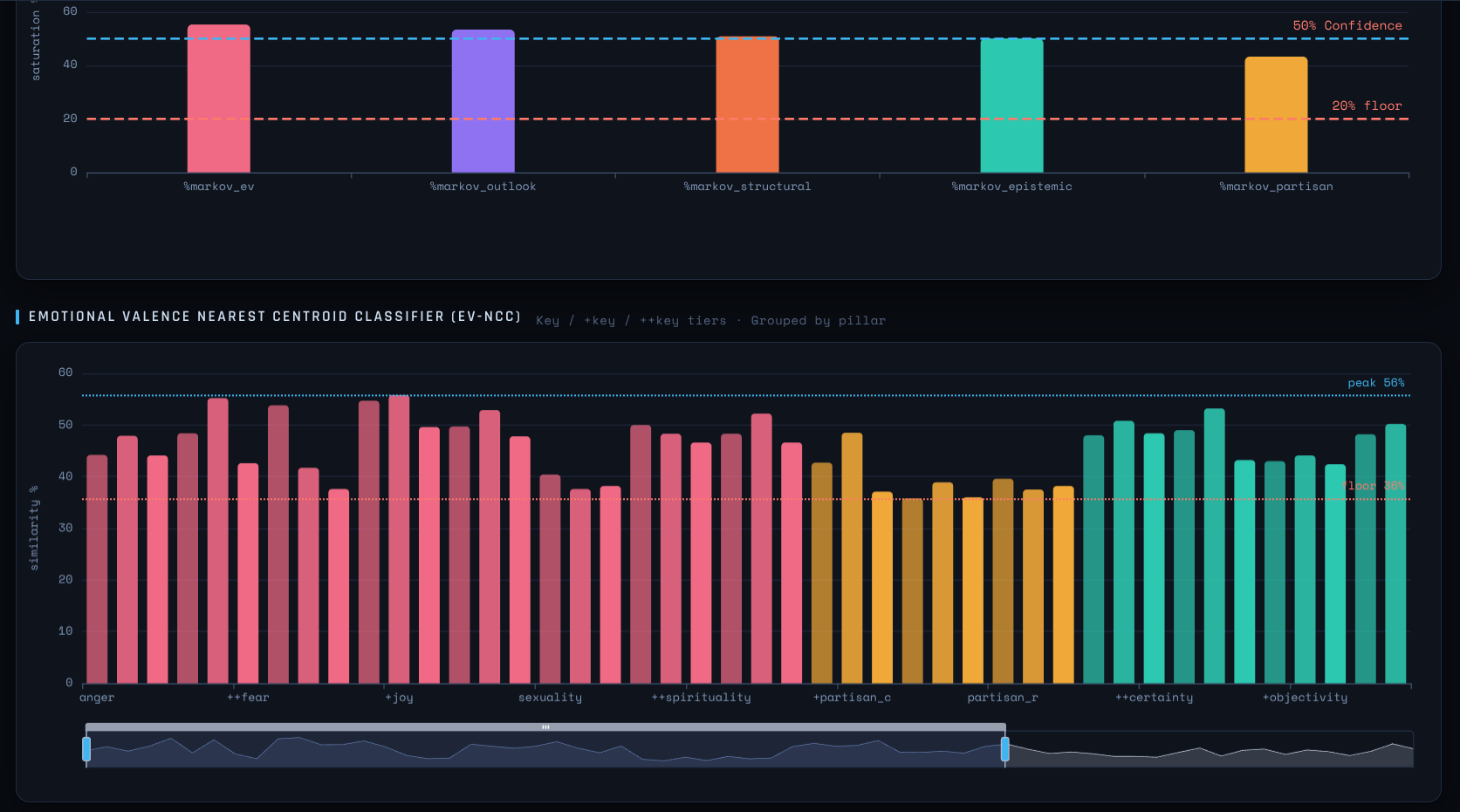
You'll have to be the judge: the visualizer shows shunts and signed intent indexes differently, as well as the estimated Mahalanobis spread.
Aldous is the most ambitious purely-geometric emotional valence and Trust & Safety model that we know of (July 2026).
| Metric | Value |
|---|---|
| Graduated Dimensions | 21 |
| Key Sensors | 63 |
| Signed Indexes | 2 |
| Signed Key Centroids | 10 |
| SENSOR calls | 82 |
| SENSOR phrases | 688 |
| INTRINSIC_SHUNT calls | 2 |
| INTRINSIC_SHUNT phrases | 26 |
| MONOLITHIC_SHUNT calls | 18 (1 highly-condensed phrase each) |
| Embedding passes | 732 |
| Compiler passes | 168 |
Stats are available via util/dece-stats train/Aldous_1-2 from the root of the
downloaded repo.
One bar represents 10% of checks. Bars to the left have very little tolerance left; re-tuning will likely cause them to break. Bars to the right are unlikely to change much due to tuning and may even be a little too tolerant (some are unavoidable).
Center is better.

Mean adhesion by specimen tracks how well sensors adhere across a dynamic variety of samples; some that excite them significantly, some that just seem like noise. It's important that the adhesion to response remains within expected parameters for each one.
This should be as close to uniform distribution as possible, while the top bars should more closely resemble a Cauchy distribution for reliable broad tunability.
This model will be further harnessed and tuned in the upcoming .1 and .2 releases
planned over the summer.
Below is the full test run output:
Full Adhesion Battery Run Results
scorer: http://127.0.0.1:3271   specimens: 7

  fdr_inaugural.txt  [ok]  mean adhesion   47%
      ✓ %markov_structural                     simi min  62.0  value   67.1  adhesion  39%
      ✓ %markov_structural                     simi max  75.0  value   67.1  adhesion  61%
      ✓ ++change_existential                   simi min  62.0  value   67.7  adhesion  44%
      ✓ ++change_existential                   simi max  75.0  value   67.7  adhesion  56%
      ✓ ++tension                              simi min  60.0  value   67.0  adhesion  47%
      ✓ ++tension                              simi max  75.0  value   67.0  adhesion  53%
      ✓ +fear                                  simi min  60.0  value   66.6  adhesion  44%
      ✓ +fear                                  simi max  75.0  value   66.6  adhesion  56%
      ✓ +fear                                  dist max  40.0  value   34.5  adhesion  14%
      ✓ ~~shunt_coercion_from_or_against_guardian simi min  25.0  value   43.9  adhesion  54%
      ✓ ~~shunt_coercion_from_or_against_guardian simi max  60.0  value   43.9  adhesion  46%
      ✓ ~~shunt_inciting_violent_action        simi min  25.0  value   63.5  adhesion  96%
      ✓ ~~shunt_inciting_violent_action        simi max  65.0  value   63.5  adhesion   4%

  fdr_pearl_harbor.txt  [ok]  mean adhesion   47%
      ✓ %markov_ev                             simi min  56.0  value   61.6  adhesion  40%
      ✓ %markov_ev                             simi max  70.0  value   61.6  adhesion  60%
      ✓ %markov_ev                             dist max  40.0  value   34.8  adhesion  13%
      ✓ %markov_partisan                       simi min  56.0  value   61.2  adhesion  37%
      ✓ %markov_partisan                       simi max  70.0  value   61.2  adhesion  63%
      ✓ ++conflict                             simi min  56.0  value   61.3  adhesion  38%
      ✓ ++conflict                             simi max  70.0  value   61.3  adhesion  62%
      ✓ ++tension                              simi min  58.0  value   63.1  adhesion  43%
      ✓ ++tension                              simi max  70.0  value   63.1  adhesion  57%
      ✓ ~~shunt_coercion_from_or_against_guardian simi min  25.0  value   47.1  adhesion  63%
      ✓ ~~shunt_coercion_from_or_against_guardian simi max  60.0  value   47.1  adhesion  37%
      ✓ ~~shunt_inciting_violent_action        simi min  25.0  value   59.9  adhesion  87%
      ✓ ~~shunt_inciting_violent_action        simi max  65.0  value   59.9  adhesion  13%

  gherig_luckiest_man.txt  [ok]  mean adhesion   48%
      ✓ %markov_ev                             simi min  63.0  value   68.5  adhesion  46%
      ✓ %markov_ev                             simi max  75.0  value   68.5  adhesion  54%
      ✓ +joy                                   simi min  62.0  value   67.2  adhesion  40%
      ✓ +joy                                   simi max  75.0  value   67.2  adhesion  60%
      ✓ +joy                                   dist max  50.0  value   37.7  adhesion  25%
      ✓ +sadness                               simi min  60.0  value   66.0  adhesion  50%
      ✓ +sadness                               simi max  72.0  value   66.0  adhesion  50%
      ✓ @Gratitude                             simi min  58.0  value   64.8  adhesion  57%
      ✓ @Gratitude                             simi max  70.0  value   64.8  adhesion  43%
      ✓ ~~shunt_coercion_from_or_against_guardian simi min  25.0  value   54.7  adhesion  85%
      ✓ ~~shunt_coercion_from_or_against_guardian simi max  60.0  value   54.7  adhesion  15%
      ✓ ~~shunt_inciting_violent_action        simi min  25.0  value   52.6  adhesion  69%
      ✓ ~~shunt_inciting_violent_action        simi max  65.0  value   52.6  adhesion  31%

  lincoln_gettysburg_hay_copy.txt  [ok]  mean adhesion   48%
      ✓ %markov_ev                             simi min  62.0  value   67.8  adhesion  45%
      ✓ %markov_ev                             simi max  75.0  value   67.8  adhesion  55%
      ✓ %markov_ev                             dist max  40.0  value   29.9  adhesion  25%
      ✓ %markov_partisan                       simi min  60.0  value   65.3  adhesion  35%
      ✓ %markov_partisan                       simi max  75.0  value   65.3  adhesion  65%
      ✓ %markov_structural                     simi min  60.0  value   65.4  adhesion  49%
      ✓ %markov_structural                     simi max  71.0  value   65.4  adhesion  51%
      ✓ ++joy                                  simi min  60.0  value   65.6  adhesion  47%
      ✓ ++joy                                  simi max  72.0  value   65.6  adhesion  53%
      ✓ ~~shunt_coercion_from_or_against_guardian simi min  25.0  value   47.5  adhesion  64%
      ✓ ~~shunt_coercion_from_or_against_guardian simi max  60.0  value   47.5  adhesion  36%
      ✓ ~~shunt_inciting_violent_action        simi min  25.0  value   64.2  adhesion  98%
      ✓ ~~shunt_inciting_violent_action        simi max  65.0  value   64.2  adhesion   2%

  poe_anabelle_lee.txt  [ok]  mean adhesion   49%
      ✓ %markov_ev                             simi min  58.0  value   63.6  adhesion  47%
      ✓ %markov_ev                             simi max  70.0  value   63.6  adhesion  53%
      ✓ %markov_ev                             dist max  50.0  value   33.5  adhesion  33%
      ✓ +sadness                               simi min  56.0  value   61.9  adhesion  49%
      ✓ +sadness                               simi max  68.0  value   61.9  adhesion  51%
      ✓ +spirituality                          simi min  57.0  value   62.8  adhesion  45%
      ✓ +spirituality                          simi max  70.0  value   62.8  adhesion  55%
      ✓ +tension                               simi min  54.0  value   60.3  adhesion  39%
      ✓ +tension                               simi max  70.0  value   60.3  adhesion  61%
      ✓ ~~shunt_coercion_from_or_against_guardian simi min  25.0  value   51.4  adhesion  75%
      ✓ ~~shunt_coercion_from_or_against_guardian simi max  60.0  value   51.4  adhesion  25%
      ✓ ~~shunt_inciting_violent_action        simi min  25.0  value   48.8  adhesion  60%
      ✓ ~~shunt_inciting_violent_action        simi max  65.0  value   48.8  adhesion  41%

  poe_the_raven.txt  [ok]  mean adhesion   48%
      ✓ %markov_ev                             simi min  56.0  value   61.8  adhesion  41%
      ✓ %markov_ev                             simi max  70.0  value   61.8  adhesion  59%
      ✓ %markov_ev                             dist max  40.0  value   31.4  adhesion  21%
      ✓ +fear                                  simi min  54.0  value   60.0  adhesion  50%
      ✓ +fear                                  simi max  66.0  value   60.0  adhesion  50%
      ✓ +sadness                               simi min  51.0  value   56.9  adhesion  42%
      ✓ +sadness                               simi max  65.0  value   56.9  adhesion  58%
      ✓ +tension                               simi min  54.0  value   59.6  adhesion  35%
      ✓ +tension                               simi max  70.0  value   59.6  adhesion  65%
      ✓ ~~shunt_coercion_from_or_against_guardian simi min  25.0  value   44.2  adhesion  55%
      ✓ ~~shunt_coercion_from_or_against_guardian simi max  60.0  value   44.2  adhesion  45%
      ✓ ~~shunt_inciting_violent_action        simi min  25.0  value   45.8  adhesion  52%
      ✓ ~~shunt_inciting_violent_action        simi max  65.0  value   45.8  adhesion  48%

  stackoverflow_bobince_regex_html_parsing.txt  [ok]  mean adhesion   47%
      ✓ %markov_ev                             simi min  46.0  value   51.9  adhesion  42%
      ✓ %markov_ev                             simi max  60.0  value   51.9  adhesion  58%
      ✓ %markov_ev                             dist max  50.0  value   42.1  adhesion  16%
      ✓ %markov_structural                     simi min  46.0  value   51.8  adhesion  48%
      ✓ %markov_structural                     simi max  58.0  value   51.8  adhesion  52%
      ✓ @Reactionary                           simi min  43.0  value   49.0  adhesion  50%
      ✓ @Reactionary                           simi max  55.0  value   49.0  adhesion  50%
      ✓ @Sarcasm                               simi min  43.0  value   48.2  adhesion  43%
      ✓ @Sarcasm                               simi max  55.0  value   48.2  adhesion  57%
      ✓ ~~shunt_coercion_from_or_against_guardian simi min  25.0  value   40.3  adhesion  44%
      ✓ ~~shunt_coercion_from_or_against_guardian simi max  60.0  value   40.3  adhesion  56%
      ✓ ~~shunt_inciting_violent_action        simi min  25.0  value   46.3  adhesion  53%
      ✓ ~~shunt_inciting_violent_action        simi max  65.0  value   46.3  adhesion  47%

report: sensor-report.html

summary: 7 scored, 0 failing check(s), peak adhesion 98%
The Full Generated HTML Report Is included in
train/tests/release-benchmarks/.
(More samples coming in the .1 release)
While Aldous demonstrates amazing consistency and accuracy across a wide variety of well-known samples, there are things to understand:
-
THIS IS A RESEARCH PREVIEW. It has been tested on a huge volume of known emotional target texts that unfortunately can't be included with the repoistory because they're still technically in copyright, but Aldous has not been tested nearly as thoroughly on human-originated off-the-hip phrasing. Each miss or overzealous classification report right now is the instrumentation that points out and closes gaps. Please set your expectations and know that we count on cooperation at this stage, in addition to (and hopefully commensurate with) any critcism you have.
-
You are limited to the embedder context window (typically small, 8-32k), so you have to use TKM on a dedicated GPU for an emotional summary of a long novel. Whereas, if you were sampling a live event every 30 seconds and analyzing it as a large JSONL series, you'd use something like a leaky integrator. tl;dr: doing seemingly orinary things with semantic analysis requires math. Not hard math, but there's more to it than adding up the parts.
-
Mean-pooled monolithic shunts are not meant to trigger automation; they are meant to trigger further review. "Strange Fruit" by Billie Holiday will trigger on the presence of anti-Black and anti-Romani sentiment. That doesn't make the words objectionable content.
-
Semantic models are meant for use in settings where you want to give receipts. One of their most compelling features is the ability for community moderation or infosec teams to be able to quickly find out when new concepts start flying around their communication spaces. Theyr'e specifically designed to not be fooled by simply turning phrases or changing strings. The incentive for participation is a lack of surprise or "opperession" by the system that's supposed to be keeping people safe. If an "open" system doesn't explain itself, it feels like a Trojan horse. Aldous' primary goals surround putting governance back in the hands of the people that are vulnerable to these systems.
-
More coverage is needed by the included test harness. This is planned for the
.1release when more samples are also available. Until then, a limited number of keys are being tracked for limit adhesion.
Aldous helps LLMs know how their output is likley going to be felt. This includes sensors for both Human and synthethic sycophancy. Detection requires brutal honesty, which is why Aldous does it purely with math.
But you can't "semantically-self-analyze" something, and even though Aldous classifies things with stunning accuracy, AI reasoning spots patterns fast, just like in medical imaging. LLMs should never be used for emotional classifications, but interpreting them? With solid training, it opens many possibilities.
In the future, Aldous_1-x.gguf as a companion instruct model that can examine flagged specimens for human escalation, or just help narrate the results of analysis, is on the roadmap. It will be a highly-adapted tuning of a Qwen (7B or below) model, or possibly a fewer paramater but more ambitiously-trained 3B-instruct.
Auditing and narration are first.
Semsage is a collection of Tools and services for the lifecycle of DECE
models — semantic classifiers that score text against a set of centroid
sensors. Aldous is a DECE (prounounced dee see) model, and semsage provides
the harness to use it.
A DECE model is multiple parts: a compiled Splinter store; a local or remote embedder and a diagonal covariance (estimated Mahalanobis) scoring system that understands the relationship between semantic pre-populated centroid-weighted emotional valence concepts and the specimen text being examined.
Models are best explored through a web-based visualizer that shows not just the diagonal intensity spread, but also the individual sensors as input signals that change dynamically.
semsage is the single command that ties it together: it wires the install into
systemd, raises the shared-memory bus the embedder and scorer talk over, starts
and stops the per-model services, and fine-tunes individual keys.
Models carry an explicit type suffix that is never inferred — you always
pass it. A .dece model named Aldous_1-2 lives at
dece/Aldous_1-2/Aldous_1-2.dece, and you refer to it as Aldous_1-2.dece.
The scorer needs a compiled .dece model to serve. util/install_splinter
checks dece/ at the end and, if it's empty, points you at the two ways to get
the reference model Aldous_1-2 (embedded with Nomic Text 1.5). Run either
from the project root, once you have gotten through step 6 of the quick start.
1. Train it yourself — takes ~15 minutes on a typical laptop, and you get to watch it build. (First, do steps 1-6 of the quick start below, then return here.):
util/install_nomic        # once, if you haven't fetched the embedder model yet
train/Aldous_1-2          # compiles dece/Aldous_1-2/Aldous_1-2.dece
2. Download the pre-trained binary — ready to use immediately; verify the checksum after decompressing if you wish (you can do this at any time, even as other things build):
mkdir -p dece/Aldous_1-2
curl -fL -o dece/Aldous_1-2/Aldous_1-2.dece.xz \
    https://annex.foreshock.io/bin/models/aldous/1-2/Aldous_1-2.dece.xz
curl -fL -o dece/Aldous_1-2/Aldous_1-2.dece.sha256 \
    https://annex.foreshock.io/bin/models/aldous/1-2/Aldous_1-2.dece.sha256
xz -d dece/Aldous_1-2/Aldous_1-2.dece.xz
Either way you end up with dece/Aldous_1-2/Aldous_1-2.dece, ready for
semsage uplink Aldous_1-2.dece. How you get there is up to how fast your
computer is and how much time you have to spend.
Assumes a clean machine with sudo. Every step below is needed the first time.
# 1. Get the source tree.
git clone <your-fork-url> semsage
cd semsage

# 2. Install the full toolchain: system packages, llama.cpp, and libsplinter.
#    Interactive — it asks before each sudo step, and takes a few minutes.
util/install_splinter

# 3. Fetch the embedding model (nomic-embed-text v1.5 -> gguf/nomic.gguf).
util/install_nomic

# 4. Build the scoring gateway (-> app/inf/dece-semsaged).
make -C app/inf

# 5. Wire semsage into your systemd user session. Nothing is started yet.
util/semsage install

# 6. Optional: put semsage on your PATH (it still finds its install root).
ln -s "$PWD/util/semsage" $HOME/.local/bin/semsage

#
# 7 - GO GET ALDOUS (train it or download it)
#

# 8. Bring Aldous up. If dece/ is empty, see "Training or obtaining Aldous"
semsage uplink Aldous_1-2.dece    # raise the shared-memory bus
semsage enable Aldous_1-2.dece    # start on login
semsage start  Aldous_1-2.dece    # start now
semsage status Aldous_1-2.dece

# 8. Explore in the browser
semsage visualizeUse the Github facilities for now. The company behind Aldous is in the midst of a rather large launch on their end; We'll have a Discord server up as soon as we can responsibly keep an eye on it.
Github is the best place for things to not get lost right now.
Aldous is Free Software under the terms of the Apache 2 software license, where applicable, or CC-0 where the content is prosaic, not code, and not describing the creation of code. The vector substrate and file system backing Aldous, which is named Splinter, is also free software under the terms of the Apache 2 software license.
Unless otherwise explicitly marked, supporting code, scripts and utilities are released under the terms of the MIT software license, with all documentation and other creatives under the terms of CC-0.
Aldous comes with no warranty or guarantee of suitability for any purpose.
Aldous does not run on its own. It needs somewhere to keep vectors, key-value state, relation graphs, epoch counters, atomics, and an embedded scripting runtime, all in a footprint small enough to sit on whatever hardware it is handed. That substrate is Splinter (Post, 2026), a lock-free shared-memory manifold that holds every one of those things with no database server and no socket in the path. To Splinter, DECE is only one pose it can hold: the engine that does Aldous' emotional scoring is, from the substrate's point of view, a single arrangement of slots and vectors among the many it could carry. That generality is why Aldous can be as light as it is. None of the machinery it leans on had to be built into it.
The same substrate is also why Aldous is not bounded by the hardware it can train on. Because a governing process can read the same physical memory an inference engine writes into, the observation gap that forces most oversight to happen after the fact closes as a property of the address space rather than as a matter of policy. On larger hardware, that is what lets Aldous observe generation while it is still in flight, at a latency and scale the single-machine framing understates. We link to the Splinter thesis rather than restate it here, but the ceiling it raises for this kind of work sits well above the modest hardware floor it advertises.
Aldous does not introduce new math; it reimagines settled, peer-reviewed ideas and aims them at a problem they were not originally built for: fast, honest emotional and intent telemetry. Its scoring rule is a variance-scaled distance from a specimen to a concept's centroid, which is the diagonal case of the Mahalanobis distance (Mahalanobis, 1936) and a close relative of the diagonal discriminant classifiers and nearest-shrunken-centroid methods that statisticians refined for high-dimensional data (Fisher, 1936; Dudoit et al., 2002; Tibshirani et al., 2002; Bickel & Levina, 2004). What Aldous adds is the embedder: it computes those centroids and variances over independently embedded phrases rather than raw features, which is the same technique the few-shot learning community applied with matching, prototypical, and Gaussian-prototypical networks (Vinyals et al., 2016; Snell et al., 2017; Fort, 2017).
We don't state the lineage defensively other than to state that Aldous' design is based on very grounded, accepted, published and peer-reviewed research. Aldous' returned responses are the result of measurements that other people have studied and validated independently across decades. We aren't changing measurements; we're just applying them to a different, perhaps unconventional, class of problem.
Aldous' most exciting trust & safety features are also not new art: Latent Concept Erasure is the smallest, single-direction case of linear concept erasure, a technique the interpretability community has developed with real rigor (Ravfogel et al., 2020, 2022; Belrose et al., 2023). Aldous applies it to re-scoring rather than debiasing, but the geometry is theirs. Furthermore, the tolerance harness that gates every release is behavioral testing in the tradition of CheckList (Ribeiro et al., 2020), carried into trust and safety, where reproducible receipts matter themost.
Their work matters every bit as much as Aldous' core mission to remain transparent, deterministic and auditable. We are glad to build in the open on foundations that were shared with so much care and respect for our collective sum of knowledge.
The references below are here so that anyone can follow a claim back to its source.
Bickel, P. J., & Levina, E. (2004). Some theory for Fisher's linear discriminant function, "naive Bayes," and some alternatives when there are many more variables than observations. Bernoulli, 10(6), 989–1010.
Dudoit, S., Fridlyand, J., & Speed, T. P. (2002). Comparison of discrimination methods for the classification of tumors using gene expression data. Journal of the American Statistical Association, 97(457), 77–87.
Fisher, R. A. (1936). The use of multiple measurements in taxonomic problems. Annals of Eugenics, 7(2), 179–188. (Journal now published as Annals of Human Genetics.)
Fort, S. (2017). Gaussian prototypical networks for few-shot learning on Omniglot. arXiv:1708.02735. Bayesian Deep Learning Workshop, NIPS 2017.
Mahalanobis, P. C. (1936). On the generalised distance in statistics. Proceedings of the National Institute of Sciences of India, 2, 49–55.
Snell, J., Swersky, K., & Zemel, R. (2017). Prototypical networks for few-shot learning. Advances in Neural Information Processing Systems (NeurIPS) 30. arXiv:1703.05175.
Tibshirani, R., Hastie, T., Narasimhan, B., & Chu, G. (2002). Diagnosis of multiple cancer types by shrunken centroids of gene expression. Proceedings of the National Academy of Sciences (PNAS), 99(10), 6567–6572.
Vinyals, O., Blundell, C., Lillicrap, T., Kavukcuoglu, K., & Wierstra, D. (2016). Matching networks for one shot learning. Advances in Neural Information Processing Systems (NeurIPS) 29, 3630–3638. arXiv:1606.04080.
Belrose, N., Schneider-Joseph, D., Ravfogel, S., Cotterell, R., Raff, E., & Biderman, S. (2023). LEACE: Perfect linear concept erasure in closed form. Advances in Neural Information Processing Systems (NeurIPS) 36. arXiv:2306.03819. Code: github.com/EleutherAI/concept-erasure.
Ravfogel, S., Elazar, Y., Gonen, H., Twiton, M., & Goldberg, Y. (2020). Null it out: Guarding protected attributes by iterative nullspace projection. Proceedings of the 58th Annual Meeting of the Association for Computational Linguistics (ACL), 7237–7256. arXiv:2004.07667.
Ravfogel, S., Twiton, M., Goldberg, Y., & Cotterell, R. (2022). Linear adversarial concept erasure. Proceedings of the 39th International Conference on Machine Learning (ICML), PMLR 162, 18400–18421.
Ribeiro, M. T., Wu, T., Guestrin, C., & Singh, S. (2020). Beyond accuracy: Behavioral testing of NLP models with CheckList. Proceedings of the 58th Annual Meeting of the Association for Computational Linguistics (ACL), 4902–4912. arXiv:2005.04118.
Post, Timothy L. (2026). Splinter: A Lock-Free Shared-Memory Substrate For Tightly-Coupled Inference And Governance. Open Source Vector Substrate @splinterhq/libsplinter (Github). https://splinterhq.github.io/splinter_thesis.pdf (Thesis).
Thank you for reading this far, and caring about citations! 🎉🤝🧠📐💠💻✨🚀